

Kubernetes
SaaS Infrastructure: Shared Kubernetes, Clusters or VMs?
Compare shared Kubernetes, tenant namespaces, dedicated clusters, and VMs for SaaS infrastructure. Learn how isolation, costs, and operations shape your choice.
Read field noteField notes / Latest
Engineering notes from operating open infrastructure: the failures, design decisions, and upstream work that make open infrastructure better.
Browse all field notesCompare shared Kubernetes, tenant namespaces, dedicated clusters, and VMs for SaaS infrastructure. Learn how isolation, costs, and operations shape your choice.
Read field note
Learn why backups alone don't guarantee recovery and how RTO, RPO, infrastructure dependencies, and recovery testing improve disaster readiness.
Read field note
Compare private AI inference, managed endpoints, and public AI APIs. Learn when data control, latency, model flexibility, and cost justify a change.
Read field note
Compare public, private, and hybrid cloud by cost, security, performance, compliance, operations, and workload fit to choose the right model for your workloads.
Choosing a cloud deployment model is no longer a simple decision between keeping infrastructure on-premises and moving it elsewhere. Organizations must decide where each workload can deliver the right balance of cost, control, scalability, performance, compliance, and operational effort.
Public, private, and hybrid clouds can all provide API-driven infrastructure. They differ in resource ownership, capacity consumption, architectural control, and operational responsibility. NIST’s foundational definition of cloud computing recognizes public, private, and hybrid cloud as distinct deployment models, each designed to support different organizational requirements.
No model is universally better. Temporary development environments may benefit from public cloud elasticity, regulated databases may require dedicated infrastructure, and large virtual machine estates may fit private cloud while selected services remain public. The goal is to place each workload where its technical and business requirements are best met.
Public cloud gives organizations access to provider-operated infrastructure on demand. Customers provision compute, storage, networking, and related services without purchasing or maintaining the underlying hardware.
It is often a strong fit for fast deployment, variable capacity, temporary environments, or access to several locations. The trade-off is reduced control over physical architecture, hardware lifecycles, and some aspects of data placement.
A private cloud provides cloud-style infrastructure dedicated to one organization. It may run in the organization’s data center, a colocation facility, or a provider’s hosted environment.
A well-designed private cloud is more than a virtualization cluster. It provides self-service provisioning, APIs, automation, resource pooling, and policy-based management. It often fits organizations that need greater control over hardware, network design, performance, security, or data sovereignty.
Capacity planning must include growth, hardware failure, maintenance, and upgrade headroom, not only current consumption.
Hybrid cloud connects public and private environments through a coordinated operating model. Workloads, data, services, or recovery processes may span both, but the environments should share deliberate approaches to networking, identity, automation, security, observability, and governance.
Hybrid cloud is not the same as simply using several providers. Multi-cloud means using more than one cloud; hybrid cloud specifically integrates private and public infrastructure. An organization can use both strategies, but neither becomes coherent without common operational practices.
The OpenInfra Foundation documents OpenStack-based hybrid cloud use cases, while CNCF describes cloud native technologies as applicable across public, private, and hybrid environments.
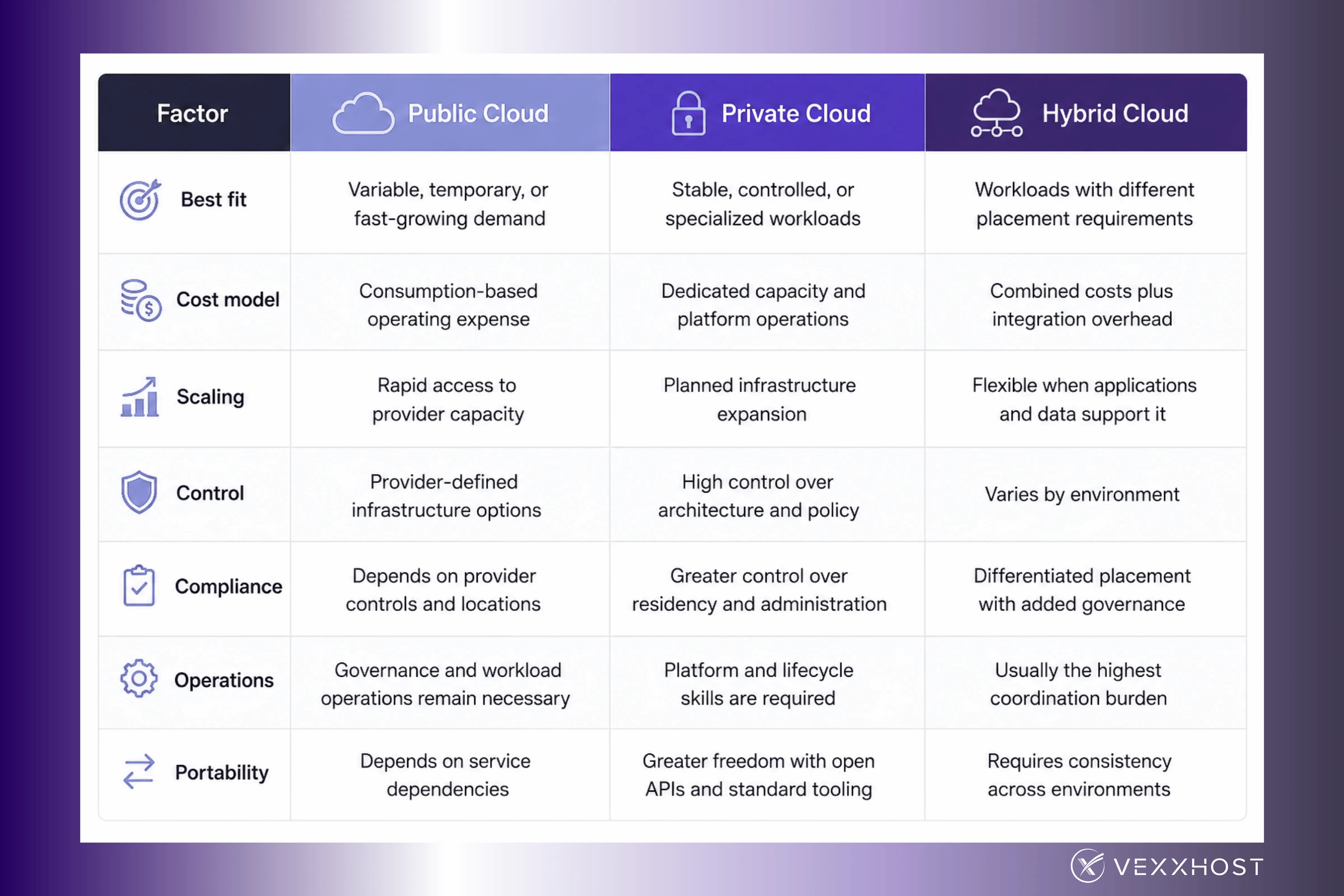
Public cloud reduces initial investment and can be economical for temporary or variable demand. It is not automatically the lowest-cost option: long-running instances, unused resources, premium services, storage growth, and outbound transfer can increase recurring spend.
Sustained utilization matters more than headline hourly pricing. An environment that appears inexpensive during a short pilot may produce very different economics when it operates continuously at scale.
Private cloud requires dedicated capacity, but its economics can become attractive for stable, highly utilized workloads or specialized hardware.
Hybrid cloud may improve placement economics by allowing organizations to select the most suitable environment for each workload. However, duplicated tooling, cross-cloud data movement, fragmented teams, and inconsistent governance can offset infrastructure savings.
Security is determined by architecture and operations, not only by tenancy.
In public cloud, the provider secures the underlying service while the customer remains responsible for workload configuration, identity, access, data protection, and application security.
Private cloud offers more direct control over segmentation, administration, hardware, encryption, and logging. That control can support demanding requirements, but it also creates responsibility. Dedicated infrastructure is not automatically secure.
Compliance requirements should become specific technical and operational controls. These may cover:
Hybrid cloud enables selective placement; for example, keeping regulated data in private infrastructure while using public cloud capacity for less sensitive services. The trade-off is more complex policy enforcement across environments.
Public cloud offers many instance, storage, and accelerator options, but performance depends on service tier, region, network path, tenancy, and provider architecture.
Private cloud can be designed around known requirements, including processor types, GPUs, storage systems, network interfaces, oversubscription policies, and availability architecture. This can benefit latency-sensitive applications, data-intensive platforms, AI infrastructure, and high-performance computing.
Hybrid architectures can place processing near users, datasets, or specialized systems. They can also create bottlenecks when tightly coupled components are separated.
Data gravity is especially important. Compute capacity may be relatively easy to move but transferring large datasets or continuously synchronizing them across environments can affect cost, latency, and application design.
Public cloud removes most hardware operations, but teams still need infrastructure as code, monitoring, security controls, cost governance, incident response, backups, and architecture standards.
Private cloud adds lifecycle responsibilities across compute, storage, networking, identity, and automation. A hosted or managed private cloud can transfer much of that work to a specialist while preserving dedicated infrastructure and greater architectural control.
Hybrid cloud is usually the most operationally demanding model. Networking, identity, observability, policy, support boundaries, and ownership often create more difficulty than basic workload portability.
Disaster recovery can use any deployment model, but backup, replication, high availability, and disaster recovery are different capabilities:
Whichever model is selected, failover and restoration must be tested.
Long-term flexibility also depends on architecture. Open APIs, portable images, Kubernetes, infrastructure as code, and documented dependencies can ease future migration. Proprietary services may provide real value, but their replacement and data-extraction costs should be understood before adoption.
Development, testing, proofs of concept, and web applications with unpredictable demand often fit public cloud. Teams can provision resources quickly without holding permanent capacity for short-lived requirements.
Stable applications may fit private cloud when they run continuously, depend on large datasets, or need consistent infrastructure performance.
A hybrid design may keep public-facing services in public cloud while private systems hold sensitive data or connect to established enterprise applications.
Databases, AI/ML platforms, and HPC workloads should be placed according to:
Public cloud can provide rapid access to GPUs or large compute pools for experimentation and temporary projects. Private infrastructure may better fit sustained accelerator utilization, sensitive datasets, specialized networks, or predictable performance.
Avoid separating tightly coupled applications and databases unless network behavior, failure modes, and transfer costs have been tested under realistic conditions.
Private cloud often fits requirements for dedicated infrastructure, precise data residency, customized audit processes, or direct administrative control.
Public cloud may also support regulated workloads when its locations, controls, contracts, and operating model align with the organization’s obligations.
Compliance should be based on evidence, not labels. Teams should evaluate the complete architecture and operating model rather than assuming that one deployment type is inherently compliant.
Kubernetes can run across all three models. The more important questions include:
VEXXHOST Managed Kubernetes supports deployments across OpenStack, public clouds, VMware, bare metal, and hosted infrastructure.
Legacy enterprise applications often fit private cloud during modernization because they depend on established virtual machine, network, storage, or operating system patterns.
A VMware-to-OpenStack migration should be grouped by application dependency, risk, and validation requirements, not treated as a simple bulk transfer. Discovery, dependency mapping, pilot migrations, rollback planning, and phased workload waves help reduce migration risk.
Recovery environments may use on-demand public capacity, a second private cloud, or a hybrid design. The right approach depends on recovery time, recovery point, performance, replication, and testing requirements.
One common mistake is comparing only infrastructure prices. A realistic evaluation should also include:
Organizations also underestimate operations. A service may be easy to provision while still requiring substantial governance, monitoring, security, backup, and cost control.
Another mistake is assuming that public cloud is always cheaper or private cloud is always safer. Both conclusions require workload-specific evidence.
Teams may also select a platform before defining compliance requirements or mapping application dependencies. This can force expensive redesigns later.
Finally, optimizing only for initial deployment may create portability problems. The more tightly an application depends on one proprietary service or operating model, the harder future change may become.
Before selecting a deployment model, ask:
Public cloud suits rapid deployment, variable demand, and temporary capacity. Private cloud offers greater control, customization, sovereignty, and predictable infrastructure for sustained workloads. Hybrid cloud combines environments when distinct requirements justify the additional integration.
Every workload placement decision should connect to a clear requirement involving performance, security, compliance, economics, resilience, or operational goals.
VEXXHOST supports organizations with OpenStack Public Cloud, hosted and on-premises Private Cloud, hybrid OpenStack deployments, Managed Kubernetes, VMware-to-OpenStack Migration, and OpenStack Professional Services.
The objective is not to force every workload into one environment. It is to design an infrastructure model that fits current requirements and can evolve with them.
Not sure which cloud model fits your workloads?
VEXXHOST can help you evaluate performance, compliance, scalability, operational requirements, and long-term cost to determine whether public, private, or hybrid cloud is the right fit. Talk to us!
Choose from Atmosphere Cloud, Hosted, or On-Premise.
Simplify your cloud operations with our intuitive dashboard.
Run it yourself, tap our expert support, or opt for full remote operations.
Leverage Terraform, Ansible or APIs directly powered by OpenStack & Kubernetes