

Kubernetes
SaaS Infrastructure: Shared Kubernetes, Clusters or VMs?
Compare shared Kubernetes, tenant namespaces, dedicated clusters, and VMs for SaaS infrastructure. Learn how isolation, costs, and operations shape your choice.
Read field noteField notes / Latest
Engineering notes from operating open infrastructure: the failures, design decisions, and upstream work that make open infrastructure better.
Browse all field notesCompare shared Kubernetes, tenant namespaces, dedicated clusters, and VMs for SaaS infrastructure. Learn how isolation, costs, and operations shape your choice.
Read field note
Learn why backups alone don't guarantee recovery and how RTO, RPO, infrastructure dependencies, and recovery testing improve disaster readiness.
Read field note
Compare private AI inference, managed endpoints, and public AI APIs. Learn when data control, latency, model flexibility, and cost justify a change.
Read field note
Learn how OpenStack private cloud works, what drives its cost, how it compares with public cloud and virtualization, and when it makes sense for your infrastructure.
As infrastructure grows, organizations often reach a point where the question is no longer simply where to run virtual machines.
The bigger decision is how the underlying infrastructure should be operated.
Should workloads remain in public cloud? Should the organization continue running an existing virtualization platform? Or does it make sense to operate dedicated private cloud infrastructure with its own compute, networking, storage, identity, and automation layers?
For organizations evaluating that third option, OpenStack is one of the major open-source platforms available for building private cloud infrastructure.
An OpenStack private cloud provides cloud infrastructure dedicated to a single organization using open-source compute, networking, storage, identity, and automation services. It can make sense for organizations with sustained infrastructure demand, specialized workloads, data-control requirements, or a need for greater control over infrastructure architecture and lifecycle.
But OpenStack should not be evaluated simply as a cheaper alternative to public cloud or proprietary virtualization.
Its value depends on whether the architecture, operating model, workload profile, utilization, and operational requirements fit the organization.
An OpenStack private cloud uses OpenStack to provide cloud infrastructure for the exclusive use of one organization.
That infrastructure can run in an organization's own data center or be hosted by a provider. What makes it private is not necessarily its physical location, but that the cloud environment and its resources are dedicated to one organization.
Instead of administrators manually configuring individual servers, networks, and storage resources for each workload, OpenStack exposes infrastructure through APIs, services, and automation.
Core OpenStack services commonly include:
Additional services can provide capabilities such as load balancing, orchestration, bare-metal provisioning, DNS, secrets management, and Kubernetes integration.
The result is not simply another virtualization layer. OpenStack provides a broader cloud operating model in which infrastructure can be provisioned and managed programmatically.
There is no single OpenStack architecture that fits every organization.
The design depends on workload scale, availability requirements, networking, storage, hardware, failure domains, and how much infrastructure the organization expects to operate.
A typical production environment includes several core layers.
The control plane runs APIs, identity, scheduling, databases, messaging, and other coordination services.
Production environments typically design these services for high availability, so the failure of a single control-plane node does not make the cloud unavailable.
Compute nodes provide the CPU, memory, GPUs, and other resources used by workloads.
Capacity planning matters because private cloud capacity is finite. The architecture needs to account for workload growth, maintenance, hardware failures, and spare capacity rather than sizing only for today's normal demand.
OpenStack networking separates the logical networks consumed by workloads from the underlying physical network.
Technologies such as Open Virtual Network (OVN) can provide virtual networks, routers, and security controls, while the physical network carries traffic between compute, storage, control-plane, and external systems.
The underlying network still matters. Oversubscription, east-west traffic, storage traffic, and external connectivity can all affect application performance.
Storage design depends heavily on the workloads being supported.
Distributed platforms such as Ceph are commonly used to provide resilient storage, while some workloads may use local disks or specialized external storage systems.
Capacity is only one consideration. Latency, throughput, durability, recovery behavior, and failure tolerance are equally important.
A production private cloud also needs monitoring, logging, backup, alerting, security processes, configuration management, upgrade procedures, and capacity management.
These operational layers often determine whether the cloud remains reliable long after deployment.
There is no universal cost per VM for an OpenStack private cloud.
The economics depend on architecture, workload characteristics, operational responsibility, and how efficiently the organization uses its available capacity.
A useful cost model should include several categories.
For an on-premises deployment, costs may include:
Requirements can vary significantly depending on whether the environment supports general-purpose VMs, databases, storage-heavy applications, GPU workloads, or specialized systems.
Infrastructure also requires power, cooling, physical security, connectivity, and space.
Organizations deploying internally need to account for those costs. A hosted OpenStack private cloud can instead incorporate much of the physical infrastructure into the service model.
OpenStack is open source, but operating infrastructure still requires expertise.
Teams need to handle monitoring, upgrades, security updates, incident response, capacity management, networking, storage, and the OpenStack control plane.
Those responsibilities may remain with an internal team or be handled through a managed private cloud model.
Private cloud economics should be modeled over several years rather than only at deployment.
Hardware needs replacement. OpenStack needs upgrades. Operating systems, storage platforms, firmware, and networking components all have their own lifecycles.
Ignoring those costs can make an infrastructure comparison misleading.
One of the biggest variables in private cloud economics is utilization.
Public cloud lets organizations consume infrastructure when needed and release it afterward. Private cloud generally involves dedicated capacity that exists whether it is fully used or not.
That means stable demand can make private cloud economics more attractive.
An organization consistently running hundreds of virtual machines and substantial storage can spread infrastructure costs across continuously used resources.
Another organization might need relatively little capacity most of the year but several times more during occasional peaks. Building enough private infrastructure for that peak could leave expensive capacity idle.
The useful comparison is therefore not simply:
Private cloud hardware cost vs. public cloud VM price.
It is:
Total cost of operating the required capacity over time vs. the cost and operational characteristics of the realistic alternative.
Public and private cloud solve different infrastructure problems, and many organizations use both.
Public cloud is useful when rapid provisioning, broad geographic reach, variable demand, or access to managed services matters.
OpenStack private cloud becomes more relevant when organizations need greater control over:
The tradeoff is responsibility.
Dedicated infrastructure still needs to be designed, monitored, upgraded, secured, and maintained.
For some organizations, a hybrid approach provides the best fit: stable workloads remain on private infrastructure while bursty or service-dependent workloads run in public cloud.
Traditional virtualization and private cloud can both run virtual machines, but their operating models are different.
A virtualization platform primarily abstracts physical servers so multiple VMs can share the same hardware.
A private cloud adds a broader infrastructure layer that combines compute with networking, storage, identity, APIs, scheduling, quotas, and automation.
That distinction becomes more important as infrastructure grows.
If administrators still need to manually configure networks, storage, permissions, and workload placement for every request, the environment remains operationally dependent on the infrastructure team.
A cloud operating model allows more of those processes to become standardized and automated.
For organizations reconsidering a proprietary virtualization platform or planning a VMware migration, the question should therefore extend beyond where existing VMs will move.
It should also ask whether the next environment should reproduce the existing virtualization model or establish a more automated cloud operating model.
Organizations moving existing VMware workloads can also use tools such as MigrateKit to support phased VMware-to-OpenStack migrations by moving the bulk of VM data before the final cutover.
OpenStack becomes more relevant when several infrastructure requirements appear together.
Organizations with a substantial and predictable baseline of compute, storage, and networking can potentially use dedicated capacity efficiently.
Some organizations need control over hardware, network topology, storage architecture, lifecycle schedules, or where infrastructure is located.
Private cloud gives infrastructure teams more ability to design those layers around workload requirements.
Workloads may need to remain within a particular facility, country, or jurisdiction.
Private cloud allows infrastructure location and operating arrangements to be designed around those requirements rather than assuming that choosing a deployment model alone satisfies compliance obligations.
Some workloads require specific GPUs, networking, storage performance, hardware configurations, or other infrastructure characteristics that benefit from a purpose-built environment.
As workloads and teams increase, APIs, standardized provisioning, quotas, identity integration, and automation become increasingly valuable.
OpenStack uses an open-source development model and open APIs. Organizations can operate it internally, work with service providers, or deploy it across different infrastructure environments rather than tying their cloud operating model to one proprietary stack.
OpenStack should not be deployed simply because an organization wants to own infrastructure.
For small environments with a limited number of workloads, private cloud complexity may not be justified.
It may also be a poor fit when demand is highly unpredictable and maintaining enough capacity for occasional peaks would leave large amounts of hardware unused.
Operational capability matters as well.
Running OpenStack involves ongoing monitoring, upgrades, security maintenance, capacity planning, storage operations, networking, and incident response.
If an organization needs the infrastructure characteristics of private cloud but does not want to build those capabilities internally, a managed operating model can change the equation.
Choosing OpenStack does not necessarily mean building an internal OpenStack operations team.
An organization can:
VEXXHOST's Private Cloud services support OpenStack environments hosted in VEXXHOST infrastructure or deployed on-premises, with expert-supported and fully managed operating models.
The right model depends on which capabilities the organization actually wants to own.
Some teams want direct operational control. Others want control over infrastructure architecture, data location, and capacity without taking responsibility for day-to-day OpenStack lifecycle management.
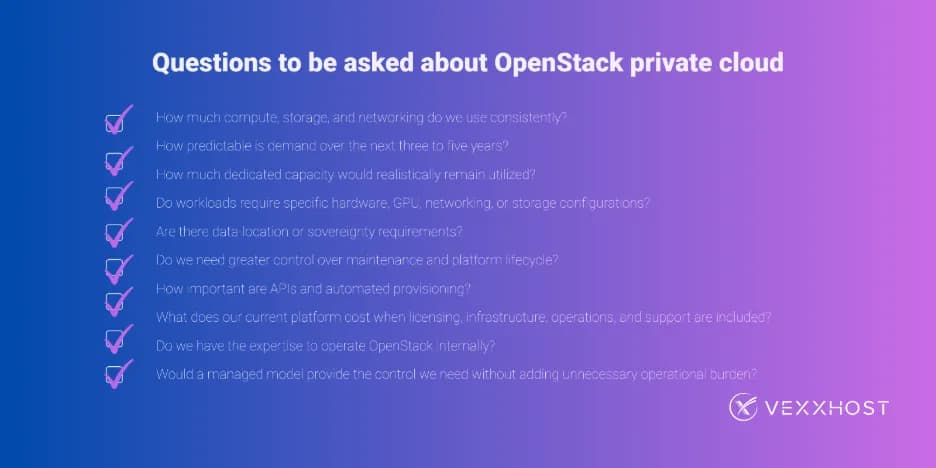 These questions provide a better basis for choosing an infrastructure model than comparing individual VM prices.
OpenStack private cloud is most useful when an organization has a clear reason to operate infrastructure differently.
That reason may be sustained demand, specialized hardware, data location, automation, infrastructure control, platform independence, or a combination of these factors.
Private cloud is not automatically cheaper than public cloud, and OpenStack is not automatically the right platform simply because it is open source.
The decision depends on architecture, utilization, lifecycle costs, operational responsibility, and what the organization expects from its infrastructure over the next several years.
When those requirements point toward dedicated infrastructure, OpenStack provides a way to build a cloud operating model around open APIs and infrastructure the organization can control.
And when managing that platform internally is not the goal, a managed OpenStack private cloud can separate control of the infrastructure from the day-to-day responsibility of operating it. Interested to discuss more? Talk to us now!
Choose from Atmosphere Cloud, Hosted, or On-Premise.
Simplify your cloud operations with our intuitive dashboard.
Run it yourself, tap our expert support, or opt for full remote operations.
Leverage Terraform, Ansible or APIs directly powered by OpenStack & Kubernetes