

Kubernetes
Private Cloud as a Service: PCaaS vs. Building Your Own
Learn when Private Cloud as a Service (PCaaS) makes sense. Compare managed private cloud, self-built infrastructure, costs, operations, and provider options.
Read field noteField notes / Latest
Engineering notes from operating open infrastructure: the failures, design decisions, and upstream work that make open infrastructure better.
Browse all field notesLearn when Private Cloud as a Service (PCaaS) makes sense. Compare managed private cloud, self-built infrastructure, costs, operations, and provider options.
Read field note
Learn the difference between Canadian sovereign cloud and data residency, including jurisdiction, infrastructure control, provider ownership, private cloud, and OpenStack.
Read field note
Evaluate OpenStack as a VMware alternative, including networking, storage, hardware reuse, migration methods, downtime, workload waves, and Day 2 operations.
Read field note
Learn when Private Cloud as a Service (PCaaS) makes sense. Compare managed private cloud, self-built infrastructure, costs, operations, and provider options.
Dedicated infrastructure does not have to mean building and operating an entire private cloud yourself.
For organizations running predictable production workloads, dedicated infrastructure can offer control over capacity, networking, storage, and workload placement. But building a private cloud also means taking responsibility for deployment, monitoring, upgrades, hardware maintenance, and incident response.
That creates an important decision for infrastructure leaders: Do we need to operate the cloud ourselves, or do we primarily need the control and capabilities it provides?
Private Cloud as a Service (PCaaS) addresses that distinction.
Rather than assembling and maintaining every infrastructure component internally, organizations can consume a dedicated cloud environment with defined operational services from a provider.
The right choice depends on workload demand, internal expertise, deployment requirements, and long-term costs.
Private Cloud as a Service (PCaaS) is a delivery model that combines private cloud infrastructure with provider-managed deployment, maintenance, support, and, where contracted, ongoing operations.
Unlike conventional multi-tenant public cloud infrastructure, a dedicated private cloud allocates physical compute resources to one organization. Unlike a self-operated private cloud, PCaaS transfers agreed infrastructure responsibilities to an external provider.
A typical offering combines:
However, PCaaS does not necessarily mean the provider owns the hardware or hosts the environment.
A private cloud can run in a customer's data center while an external provider remotely manages the platform.
The critical distinction is the division of operational responsibility.
Organizations generally have four infrastructure operating models to consider.
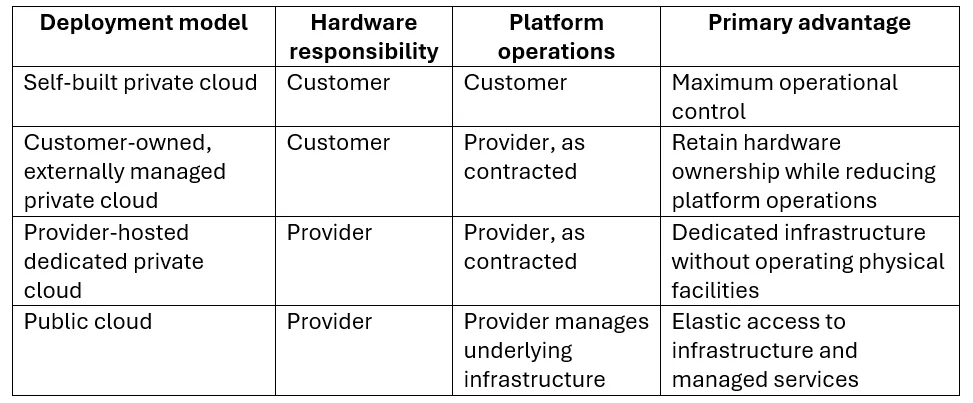
An organization acquires infrastructure, deploys its cloud platform, and operates the complete environment internally.
This provides control over hardware selection, architecture, security configurations, and platform maintenance.
However, it requires expertise across compute virtualization, distributed storage, networking, automation, monitoring, and recovery.
This model is appropriate when internal teams already possess those capabilities and direct operational ownership provides meaningful value.
The organization owns or controls the hardware, while a specialist provider deploys and operates defined cloud platform components.
This arrangement is useful when infrastructure must remain in an existing data center or when replacing hardware is unnecessary.
The customer typically retains facility and physical infrastructure responsibilities, while the provider handles the contracted software and operational layers.
A provider supplies dedicated infrastructure in its facilities and operates the cloud platform.
The customer accesses resources through cloud APIs, dashboards, and automation without managing physical servers or data center facilities.
This model suits organizations seeking dedicated capacity without making substantial investments in hardware procurement and infrastructure operations.
Public cloud remains attractive for variable workloads, rapid provisioning, temporary environments, and access to extensive managed-service ecosystems.
Its consumption-based model can be more economical when demand is uncertain or utilization is low.
Private and public cloud can also coexist, with workloads placed according to their requirements.
PCaaS is more than dedicated server hosting.
The service's value depends on how the infrastructure, cloud control plane, and operational responsibilities come together.
Dedicated infrastructure provides a defined resource pool, but usable capacity depends on redundancy and workload requirements.
For example, a cluster designed to survive a host failure must reserve sufficient resources to accommodate affected workloads.
Storage replication, maintenance capacity, network redundancy, and future expansion also influence the amount of usable infrastructure.
These considerations matter regardless of who operates the environment.
A cloud platform enables self-service provisioning, standardized APIs, identity management, network configuration, and resource administration.
OpenStack, for example, provides open-source services for managing infrastructure resources through a consistent cloud operating model.
This distinction separates private cloud from conventional dedicated hosting.
Dedicated servers provide physical resources. A cloud control plane provides the automation and management capabilities needed to consume those resources as a cloud.
Private cloud infrastructure must remain operational across software releases, hardware changes, and evolving workload requirements.
Ongoing activities include:
These responsibilities rarely disappear after deployment.
With managed private cloud services, an organization can transfer defined responsibilities to engineers specializing in the underlying infrastructure.
The customer remains responsible for anything outside the agreed service scope.
The strongest case for PCaaS emerges when an organization needs dedicated infrastructure but does not benefit from maintaining every layer of the platform itself.
Dedicated infrastructure can be attractive for workloads with steady CPU, memory, and storage requirements.
Consider a hypothetical software company running 100 production virtual machines, several databases, and internal application services.
Its infrastructure demand is relatively stable, but its engineering team focuses primarily on software development and application reliability.
Building a private cloud internally would require additional operational expertise across virtualization, storage, networking, and platform upgrades.
A provider-hosted managed private cloud could offer the same dedicated capacity with fewer infrastructure responsibilities for the internal team.
However, if the company already operates a mature private cloud platform with experienced engineers, continuing to manage it internally may be more economical.
The determining factors are actual utilization, operating capabilities, and the cost of each delivery model—not simply the number of virtual machines.
Operating a private cloud requires specialized knowledge that may not align with an organization's core engineering priorities.
A team experienced in Kubernetes and application delivery may not also have the capacity to maintain OpenStack control-plane services, distributed storage, and physical infrastructure.
PCaaS establishes an operational boundary.
The provider manages the contracted infrastructure layers while internal teams focus on applications, deployment pipelines, and workload performance.
Organizations can also combine dedicated infrastructure with Managed Kubernetes when they want to reduce the operational burden at the container orchestration layer.
Some organizations need dedicated infrastructure in a specific country, data center, or controlled physical environment.
An externally managed on-premises cloud can preserve hardware ownership and location control while reducing platform maintenance responsibilities.
However, physical location alone does not guarantee data sovereignty or regulatory compliance.
Organizations must evaluate administrative access, support arrangements, applicable jurisdictions, encryption key management, and contractual controls.
AI workloads, high-performance databases, and latency-sensitive applications may require specialized networking, storage configurations, or hardware acceleration.
For example, a private GPU cloud needs more than access to dedicated accelerators. It requires coordinated provisioning, workload isolation, storage throughput, network capacity, and lifecycle management.
Organizations evaluating these environments can also consider GPU infrastructure designed for production workloads.
A provider experienced with these infrastructure components may reduce integration and maintenance complexity.
The financial comparison should extend beyond hardware costs and monthly service fees.
A self-managed private cloud includes:
A PCaaS contract may consolidate some of these expenses into recurring infrastructure and management charges.
However, managed service fees, minimum commitments, expansion costs, migration expenses, and customer-retained responsibilities must still be considered.
Compare both models over the same period using:
Five-year TCO = Infrastructure + Facilities + Platform + Operations + Support + Lifecycle Costs
For an accurate comparison, organizations should answer four questions:
PCaaS may offer more predictable operational costs, but it is not automatically cheaper than public cloud or an established self-managed environment.
The economic advantage depends on utilization, staffing, service scope, and the cost of maintaining equivalent reliability.
One of the most important procurement steps is documenting the shared-responsibility model.
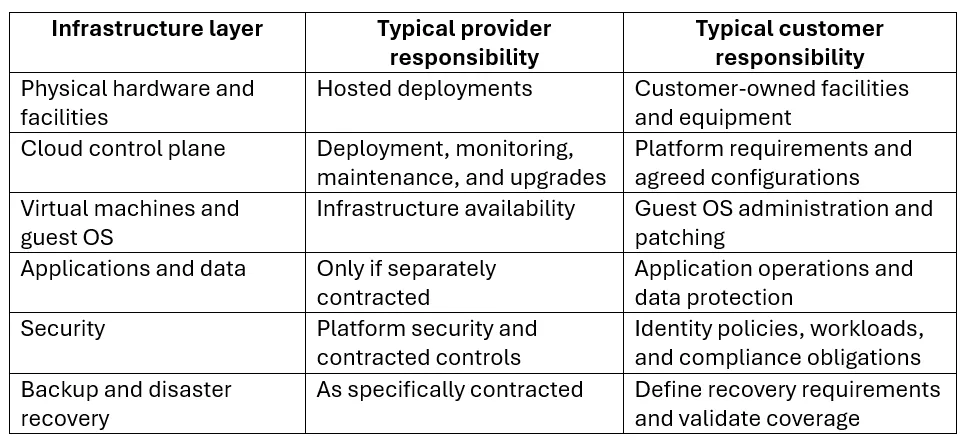
These are illustrative boundaries, not universal rules.
For example, infrastructure snapshots do not necessarily constitute a complete application backup strategy. Likewise, an availability SLA does not automatically establish disaster recovery capabilities.
Buyers should request a written responsibility matrix before signing an agreement.
A provider evaluation should clarify both technical capabilities and operational commitments.
1. What infrastructure is dedicated?
Confirm whether compute, storage, and networking components are single-tenant or shared, and how isolation works.
2. Where is the infrastructure located?
Identify physical deployment locations, ownership, administrative access, and relevant jurisdictional requirements.
3. What does the service include?
Establish responsibility for monitoring, patching, incident response, upgrades, backups, and hardware failures.
4. How is availability designed?
Review failure domains, redundancy, maintenance processes, recovery objectives, and SLA exclusions.
5. Can teams use standard automation tools?
Evaluate APIs, infrastructure-as-code integration, identity federation, monitoring access, and self-service capabilities.
6. How does capacity expansion work?
Ask about hardware lead times, capacity reservations, minimum commitments, and changes to compute, storage, or networking independently.
7. What happens if the organization changes providers?
Understand workload export, data retrieval, networking dependencies, configuration portability, and termination procedures.
The answers help determine whether a private cloud service can support the organization throughout its infrastructure lifecycle.
OpenStack provides an open-source foundation for private cloud infrastructure, including compute, networking, identity, and storage integration.
However, OpenStack alone is not a managed service.
Production environments still require architecture design, deployment automation, monitoring, upgrades, and operational expertise.
VEXXHOST provides private cloud solutions for hosted and on-premises environments, with expert support or managed operations depending on the chosen engagement model.
Its OpenStack infrastructure is supported by Atmosphere, the deployment and operations platform used to manage cloud environments.
Organizations can combine this foundation with Kubernetes, Ceph storage, and specialized infrastructure when workload requirements extend beyond conventional virtual machines.
The important consideration is not simply which cloud software is installed, but who maintains the platform and how reliably its services can be delivered.
It can be for sustained, predictable workloads with sufficiently high utilization. Public cloud may be more economical for variable or temporary workloads. A meaningful comparison must include operations, redundancy, capacity commitments, and lifecycle costs.
The terms frequently overlap. PCaaS generally describes consuming private cloud capabilities through a service arrangement, while managed private cloud emphasizes the provider's operational responsibilities. Specific definitions and included services vary between providers.
Dedicated hosting primarily supplies dedicated physical infrastructure. PCaaS typically adds cloud management capabilities, automation, provisioning interfaces, and defined infrastructure operations. The exact service boundary should be verified.
Building and operating private cloud internally makes sense when an organization has the expertise, scale, and strategic reasons to maintain complete infrastructure ownership.
For others, the requirement is different.
They need dedicated resources, infrastructure control, reliable operations, and predictable capacity, but not necessarily an internal team responsible for every platform component.
Private Cloud as a Service separates infrastructure control from the responsibility of operating the entire cloud environment.
The best approach depends on workload characteristics, internal capabilities, location requirements, and long-term costs.
Organizations evaluating dedicated infrastructure can explore VEXXHOST Private Cloud to compare hosted and on-premises deployment models with expert support or managed operations.
Choose from Atmosphere Cloud, Hosted, or On-Premise.
Simplify your cloud operations with our intuitive dashboard.
Run it yourself, tap our expert support, or opt for full remote operations.
Leverage Terraform, Ansible or APIs directly powered by OpenStack & Kubernetes