

OpenStack
Ceph vs SAN: Enterprise Storage Modernization Guide
Ceph vs SAN: Compare performance, scalability, licensing, and operational costs to choose the right enterprise storage modernization strategy.
Read field noteField notes / Latest
Engineering notes from operating open infrastructure: the failures, design decisions, and upstream work that make open infrastructure better.
Browse all field notesCeph vs SAN: Compare performance, scalability, licensing, and operational costs to choose the right enterprise storage modernization strategy.
Read field note
Cloud exit strategy checklist: Review data ownership, exit costs, vendor lock-in, and migration support before signing a cloud contract.
Read field note
Compare in-house OpenStack operations, expert support, and managed services. Learn who should handle upgrades, incidents, and ongoing cloud operations.
Read field note
Ceph vs SAN: Compare performance, scalability, licensing, and operational costs to choose the right enterprise storage modernization strategy.
Enterprise storage modernization is not just about replacing aging hardware. It is about determining whether existing infrastructure can support future performance, capacity, and operational requirements without introducing unnecessary costs or complexity.
For organizations relying on traditional storage area networks (SANs), that decision increasingly involves evaluating distributed, software-defined storage platforms like Ceph.
But Ceph vs. SAN is not about which technology is universally better. The right choice depends on workloads, existing investments, operational expertise, and long-term infrastructure goals.
Here are the factors enterprise teams should evaluate before making a decision.
Traditional SAN environments typically provide centralized block storage through dedicated storage arrays and networks. They offer established management tools, vendor support, and predictable performance when appropriately sized for enterprise workloads.
Ceph takes a distributed approach.
Instead of relying on dedicated storage arrays, Ceph distributes data across multiple storage nodes. Its software-defined architecture allows organizations to expand capacity by adding hardware while supporting block, object, and file storage through a common platform.
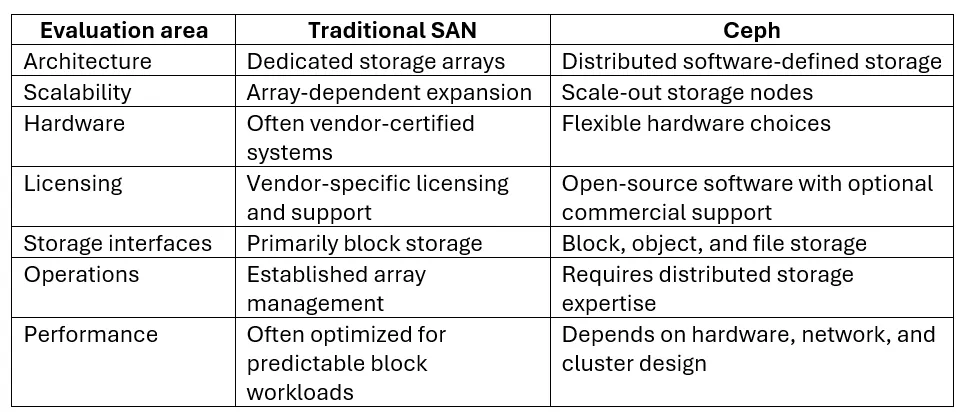
Ceph offers greater architectural flexibility, but it is not a direct replacement for every SAN feature or storage protocol. Application compatibility and operational requirements remain essential considerations.
For more on how Ceph's storage interfaces support private cloud environments, explore our guide to Ceph storage for private cloud.
Enterprise storage requirements rarely remain static. As data grows, infrastructure teams must determine whether existing storage systems can expand without major hardware investments.
Traditional SAN expansion depends on the platform and may involve additional shelves, controller upgrades, or new arrays.
Ceph offers a scale-out alternative, allowing organizations to add storage nodes and distribute data across the cluster.
However, expansion still requires careful planning around network capacity, failure domains, and data rebalancing.
What to evaluate: Can the current storage architecture scale economically over the next three to five years without requiring significant infrastructure replacement?
Performance should be evaluated against actual application requirements rather than theoretical benchmarks.
Traditional SAN platforms can be particularly effective for latency-sensitive applications that require consistent block storage performance.
Ceph can also support demanding production workloads, including virtual machines, databases, and Kubernetes applications. However, performance depends on hardware configuration, networking, replication policies, and workload distribution.
Infrastructure teams should assess:
A Ceph cluster optimized for high-capacity object storage will have different performance characteristics from one designed for latency-sensitive virtual machines.
What to evaluate: Can the proposed storage architecture meet application performance requirements during both normal operations and recovery scenarios?
One advantage of Ceph is its open-source licensing model.
Unlike some proprietary storage platforms, Ceph does not inherently require per-terabyte or per-protocol software licensing.
But lower licensing costs do not automatically translate into lower operational costs.
A realistic five-year total cost of ownership (TCO) comparison should account for hardware, networking, licensing, support, power consumption, administration, upgrades, and migration expenses.
Ceph may provide favorable economics for organizations with growing storage demands or those seeking greater hardware flexibility. However, an existing SAN with sufficient capacity and favorable support terms may remain the more cost-effective option.
What to evaluate: Which architecture offers better long-term economics after accounting for infrastructure, maintenance, and operational expertise?
Both traditional SAN systems and Ceph can provide enterprise-grade availability when properly designed.
Traditional arrays typically rely on redundant components and established data protection mechanisms.
Ceph distributes data across configurable failure domains using replication or erasure coding, depending on workload requirements.
These capabilities require appropriate capacity planning. Replication increases physical storage consumption, while recovery and rebalancing operations can affect performance.
Organizations should validate backup integration, disaster recovery procedures, and behavior during hardware or network failures.
What to evaluate: Can the storage platform meet availability and recovery objectives without compromising critical workloads?
Moving to Ceph changes how storage infrastructure is operated.
Organizations accustomed to traditional SAN management must account for distributed cluster monitoring, capacity balancing, failure recovery, and software upgrades.
For teams without specialized experience, these responsibilities can introduce additional complexity.
This is where supported or managed Ceph services can help organizations adopt distributed storage without building every operational capability internally.
What to evaluate: Does the organization have the expertise and resources to operate Ceph effectively, or would a managed approach be more appropriate?
Storage modernization is often part of a broader infrastructure strategy.
Ceph integrates with OpenStack to support persistent block storage and virtual machine workloads. It can also provide persistent volumes for Kubernetes applications through compatible storage drivers.
This makes Ceph particularly relevant for organizations building private cloud infrastructure or seeking greater flexibility across virtualized and containerized environments.
Traditional SAN platforms can also support modern infrastructure through appropriate integrations. The decision depends on automation, compatibility, portability, and operational requirements.
What to evaluate: Does the storage platform support the organization's long-term cloud architecture without introducing unnecessary dependencies?
Replacing an existing SAN is not always the right modernization strategy.
Retaining traditional storage may make more sense when:
Introducing Ceph solely because it is open source may create unnecessary complexity.
For some organizations, a phased or hybrid approach is more appropriate, retaining existing SAN infrastructure for selected workloads while introducing Ceph for new private cloud or scalable storage requirements.
When Ceph is a suitable alternative, modernization should begin with workload assessment rather than immediate infrastructure replacement.
Organizations should identify existing storage dependencies, establish performance baselines, validate application compatibility, and test recovery procedures before moving production workloads.
A pilot deployment can help evaluate operational requirements and establish confidence in the new architecture.
For organizations also transitioning from VMware to OpenStack, VEXXHOST MigrateKit can support virtual machine migration as part of a broader infrastructure modernization strategy. Storage design, data movement, and compatibility must still be assessed separately.
A phased approach helps reduce risk while allowing teams to validate performance and operational processes before expanding adoption.
Enterprise storage modernization should deliver measurable improvements in scalability, flexibility, and long-term cost, not simply replace one technology with another.
VEXXHOST provides Ceph storage solutions for organizations requiring scalable block, object, and file storage.
With hosted and on-premises deployment options, expert support, fully managed operations, and integration with OpenStack and Kubernetes, VEXXHOST helps organizations design and operate storage infrastructure around their specific workload requirements.
Whether you are evaluating a SAN alternative, expanding private cloud infrastructure, or planning a storage migration, the first step is understanding which architecture best supports your needs.
Talk to VEXXHOST's Ceph specialists to evaluate your enterprise storage modernization options.
Choose from Atmosphere Cloud, Hosted, or On-Premise.
Simplify your cloud operations with our intuitive dashboard.
Run it yourself, tap our expert support, or opt for full remote operations.
Leverage Terraform, Ansible or APIs directly powered by OpenStack & Kubernetes