
OpenStack
Ceph Storage for Private Cloud: Unified Storage Decisions
Evaluate when Ceph RBD, RGW, and CephFS should share a private cloud cluster, including performance isolation, failure domains, and SAN trade-offs.
Read field noteField notes / Latest
Engineering notes from operating open infrastructure: the failures, design decisions, and upstream work that make open infrastructure better.
Browse all field notesEvaluate when Ceph RBD, RGW, and CephFS should share a private cloud cluster, including performance isolation, failure domains, and SAN trade-offs.
Read field note
Learn why infrastructure documentation becomes outdated, the operational risks it creates, and how automation helps keep it accurate.
Read field note
Learn when Private Cloud as a Service (PCaaS) makes sense. Compare managed private cloud, self-built infrastructure, costs, operations, and provider options.
Read field note
Evaluate when Ceph RBD, RGW, and CephFS should share a private cloud cluster, including performance isolation, failure domains, and SAN trade-offs.
Private cloud storage decisions are rarely just about capacity. Organizations also need to determine how storage will support virtual machines, containers, databases, backups, and applications with different performance and availability requirements.
Traditionally, those requirements might be addressed through separate platforms: a storage area network (SAN) for block storage, an object storage system for unstructured data, and a network-attached storage (NAS) platform for shared files.
That approach can work, but maintaining multiple storage systems introduces separate management tools, scaling decisions, hardware lifecycles, and operational dependencies.
Ceph storage offers an alternative: a distributed storage platform that delivers block, object, and file interfaces from a common storage cluster.
For organizations building an OpenStack private cloud or running Kubernetes alongside virtualized workloads, this can simplify infrastructure architecture and provide greater flexibility as storage demands grow.
However, placing every workload on one cluster is not automatically the right decision. Performance isolation, failure domains, recovery behavior, and capacity planning still determine whether consolidation makes operational and financial sense.
The question is not whether Ceph can support all three storage types. It is whether those workloads should share the same infrastructure.
Ceph is a software-defined storage platform built around RADOS, a distributed object storage layer responsible for storing data across a cluster of storage devices.
Instead of relying on a single storage controller, Ceph distributes data across Object Storage Daemons (OSDs). Its CRUSH placement algorithm determines where data should be stored according to defined placement rules and physical failure domains.
On top of that foundation, Ceph exposes three primary storage interfaces:
These interfaces can use the same underlying cluster while maintaining separate storage pools, access controls, and data-placement policies.
Unified storage does not mean every workload has identical performance requirements or uses the same physical disks.
A well-designed Ceph architecture can place latency-sensitive block volumes on NVMe or SSD devices while using higher-capacity media for object storage.
The benefit is a common storage foundation without requiring every workload to follow the same storage policy.
Block storage is often the foundation of a private cloud.
Virtual machines need persistent disks, databases require predictable I/O performance, and containerized applications may need volumes that remain available when workloads are rescheduled.
Ceph RBD provides distributed block devices that integrate with OpenStack services, including:
For Kubernetes environments, Ceph-CSI enables dynamic provisioning of RBD-backed persistent volumes through Kubernetes StorageClasses.
This gives platform teams a consistent storage backend across virtual machines and containers.
However, RBD performance depends on the entire storage path: application I/O patterns, network latency, OSD performance, replication policies, and the available recovery capacity.
Simply deploying Ceph does not guarantee low-latency storage.
Object storage addresses a different requirement.
Instead of exposing a block device, Ceph RGW provides an HTTP-based interface compatible with a substantial subset of the Amazon S3 API, as well as Swift-compatible access.
Common private cloud use cases include application-generated objects, backup repositories, artifacts, media files, and large datasets.
RGW can allow organizations to operate object storage within their own infrastructure rather than depending entirely on an external service.
It is particularly useful when applications already support S3-compatible endpoints.
Compatibility should still be validated against the specific S3 features an application requires.
Some workloads need multiple systems to access a shared file system.
CephFS provides this capability through a distributed file system with dedicated Metadata Servers (MDS) that manage namespace and file metadata operations.
Examples include shared application directories, development environments, data-processing pipelines, and workloads requiring shared Kubernetes volumes.
CephFS can also integrate with OpenStack Manila for managed file shares, including deployments that expose NFS through an additional gateway layer.
File storage requires its own architectural considerations. Metadata performance, directory structures, small-file activity, and client concurrency can affect results even when the underlying cluster has sufficient raw capacity.
Consolidation becomes attractive when an organization has several storage requirements but wants to reduce the number of independent platforms it operates.
Consider a private cloud running OpenStack virtual machines, Kubernetes applications, and an internal S3-compatible object storage service.
Separate systems could require different capacity expansions, monitoring workflows, procurement cycles, and operational expertise.
A shared Ceph foundation can provide three advantages.
Distributed storage allows capacity to expand by adding appropriately sized storage devices and nodes.
This is useful for environments where capacity requirements grow over time rather than in predictable, fixed increments.
The expansion process still needs adequate network bandwidth, failure-domain distribution, and room for data rebalancing.
Ceph provides common tools for monitoring cluster health, managing storage pools, controlling data placement, and performing maintenance.
For teams operating OpenStack private cloud infrastructure, integration with Cinder, Glance, Nova, and Kubernetes storage provisioning can reduce the need for application-specific storage infrastructure.
Sharing a storage platform can reduce duplicated management infrastructure and allow teams to plan hardware investment across several workloads.
However, capacity is not always interchangeable.
An underutilized HDD-backed object storage pool cannot necessarily absorb the requirements of a saturated NVMe-backed database pool.
The financial benefit depends on workload distribution and how effectively the cluster's hardware can be used.
The most important design decision is not the number of storage interfaces. It is how their underlying resources are allocated.
Ceph pools allow administrators to define storage policies for different workloads.
CRUSH rules can direct data toward specific device classes, such as HDD, SSD, or NVMe, and distribute copies across hosts or racks.
For example, a private cloud might use one replicated NVMe pool for latency-sensitive RBD volumes and separate capacity-oriented pools for object data.
CephFS metadata should also receive appropriate low-latency storage resources.
These decisions prevent all workloads from being treated as though their requirements were identical.
Importantly, separate pools do not necessarily provide complete performance isolation if they still compete for the same OSDs, network links, or cluster resources.
Ceph distributes data according to a configured failure-domain hierarchy.
A cluster can place replicas across separate hosts or racks, depending on its architecture.
This matters because three copies of data provide limited protection against a rack-level failure if all three are placed within that rack.
Storage design should account for the failures the organization expects to tolerate, rather than relying only on replica counts.
Normal performance benchmarks are only part of the picture.
When a storage device or node fails, Ceph may need to recover or redistribute data. Those operations consume disk throughput, CPU, and network bandwidth.
A cluster that performs adequately during normal operation may experience substantial latency increases while recovering.
Production sizing should therefore test workload performance under degraded conditions, not just on a healthy cluster.
Mixed workloads require clear ownership of capacity, quotas, access permissions, alerting, upgrades, and maintenance.
Teams should also monitor pool utilization, latency, recovery rates, gateway performance, and CephFS metadata behavior.
For environments without dedicated storage engineering resources, managed Ceph storage can provide a way to operate the platform without building every operational capability internally.
Ceph storage economics depend heavily on the selected data-protection strategy.
With three-way replication, each stored object has three copies. As a simplified example, 100 TB of logical data requires approximately 300 TB of raw storage before accounting for additional overhead and operating headroom.
Erasure coding can reduce capacity overhead.
A 4+2 erasure-coded configuration, for example, uses six fragments for every four data fragments, producing a theoretical 1.5× storage overhead.
That same 100 TB of logical data would require approximately 150 TB before additional overhead and free-space reserves.
But erasure coding is not automatically preferable.
It introduces computational and I/O trade-offs, particularly for small writes, random I/O, and recovery operations.
Additionally, RBD and CephFS require replicated metadata pools when using erasure-coded data pools.
For private clouds, the practical approach is to evaluate data-protection policies by workload rather than applying one policy to everything.
Capacity calculations must also reserve sufficient free space for failures, recovery, rebalancing, and future growth.
There are situations where separate Ceph clusters, or entirely different storage technologies, are more appropriate.
Strict performance requirements: High-intensity database workloads may require predictable tail latency that is difficult to maintain alongside heavy object ingestion or large recovery operations.
Different availability requirements: An application requiring an independent maintenance schedule or recovery boundary may not belong in the same cluster as less critical workloads.
Large differences in growth: If object storage is growing rapidly while block capacity remains stable, sharing the same infrastructure may complicate expansion and resource allocation.
Security and operational isolation: Separate pools and credentials provide logical separation, but they do not eliminate shared control-plane dependencies. Some environments require stronger infrastructure isolation.
Specialized workloads: Extremely latency-sensitive applications, legacy storage protocols, or specific hardware integration requirements may be better served by dedicated systems.
The distinction is important: Ceph supports multiple storage interfaces, but a single cluster still has shared operational dependencies.
Separate clusters can provide stronger isolation, although they also introduce additional hardware, management, and capacity overhead.
Organizations evaluating Ceph for private cloud frequently compare it with existing SAN infrastructure.
Neither approach is universally superior.
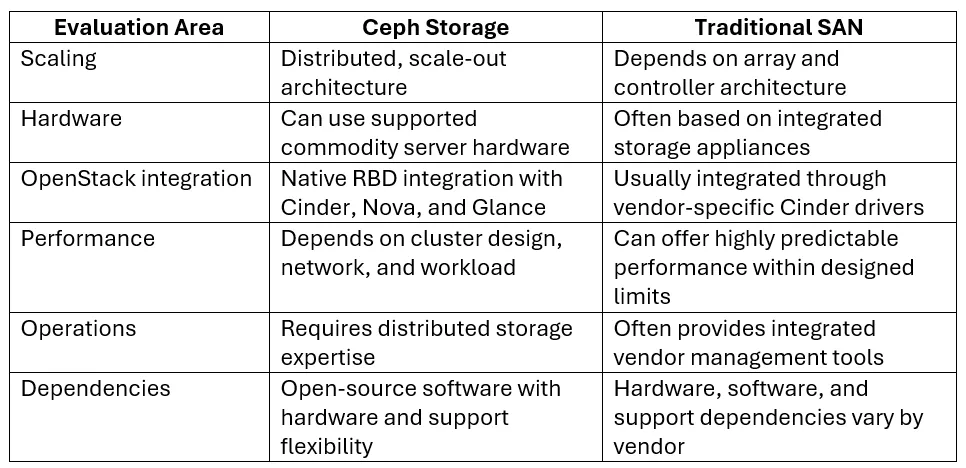
Traditional SAN platforms can remain a strong fit for organizations with stable workloads, existing storage investments, and well-established operational processes.
Ceph becomes particularly compelling when private cloud infrastructure needs horizontal growth, infrastructure automation, and closer integration with OpenStack and Kubernetes.
The comparison should also include total cost of ownership: hardware, networking, software support, power, rack space, staff time, upgrades, and capacity expansion.
Lower licensing costs do not automatically mean lower operational costs.
Before consolidating storage, infrastructure teams should answer several questions:
The answers should guide the storage architecture before hardware is purchased.
An organization primarily operating virtual machines may initially need only RBD. RGW or CephFS can be introduced when actual workload requirements justify them.
There is no requirement to deploy all three interfaces simply because Ceph supports them.
Ceph is particularly relevant to private cloud environments that need flexibility across OpenStack, Kubernetes, and application storage.
Its value comes from combining distributed storage capabilities with the ability to define different storage policies within a common platform.
But successful consolidation depends on more than selecting Ceph.
It requires realistic performance benchmarks, correctly configured failure domains, capacity headroom, and an operating model capable of managing failures and upgrades.
For organizations evaluating a new private cloud or replacing proprietary storage, the better question is not how many storage systems Ceph can replace.
It is which workloads benefit from sharing infrastructure, and which need stronger isolation.
VEXXHOST provides Ceph storage services for hosted and on-premises environments, including architecture design, deployment, ongoing operations, and integration with Managed Kubernetes and OpenStack.
The goal is to build a storage architecture around the workloads it needs to support, rather than forcing every workload onto the same platform.
Choose from Atmosphere Cloud, Hosted, or On-Premise.
Simplify your cloud operations with our intuitive dashboard.
Run it yourself, tap our expert support, or opt for full remote operations.
Leverage Terraform, Ansible or APIs directly powered by OpenStack & Kubernetes