Booting a GPU server isn't the same as making it production-ready. How Atmosphere unifies OpenStack, Ironic, and Kubernetes to turn H200 hardware into recoverable, reusable AI infrastructure.
What Matters
An AI cloud is ready only when its control plane can turn a request into usable, recoverable and reusable accelerator capacity. This article connects all of those responsibilities so the result cannot be mistaken for a one-off server boot. It establishes the top-level evidence that Atmosphere is ready to operate the validated H200 AI-infrastructure path, while identifying the parts that remain separate or still need acceptance.
This effort was not a test of one OpenStack service or one server boot method. We set out to validate Atmosphere as the complete operating platform for physical GPU infrastructure: prepare the cloud control plane on Kubernetes, enroll real accelerator hardware, deploy its operating system, attach its networks, expose a usable remote console, recover it from firmware failures, return it to the resource pool, and finally consume the same hardware through a declarative Kubernetes workflow. The infrastructure exists to serve people doing real AI work: interactive development, model training and fine-tuning, batch processing, and online or offline inference.
💡 Major Takeaway: Unified GPU Infrastructure with Atmosphere
Building a production GPU cloud is not about booting individual servers. It requires an integrated platform (Atmosphere) that connects OpenStack, Ironic and Kubernetes to one physical hardware pool. The direct, unvirtualized eight-H200 path passed an AI workload; the declarative mCAPI path passed its physical control-plane slice and still requires full one-control-plane plus two-worker acceptance.
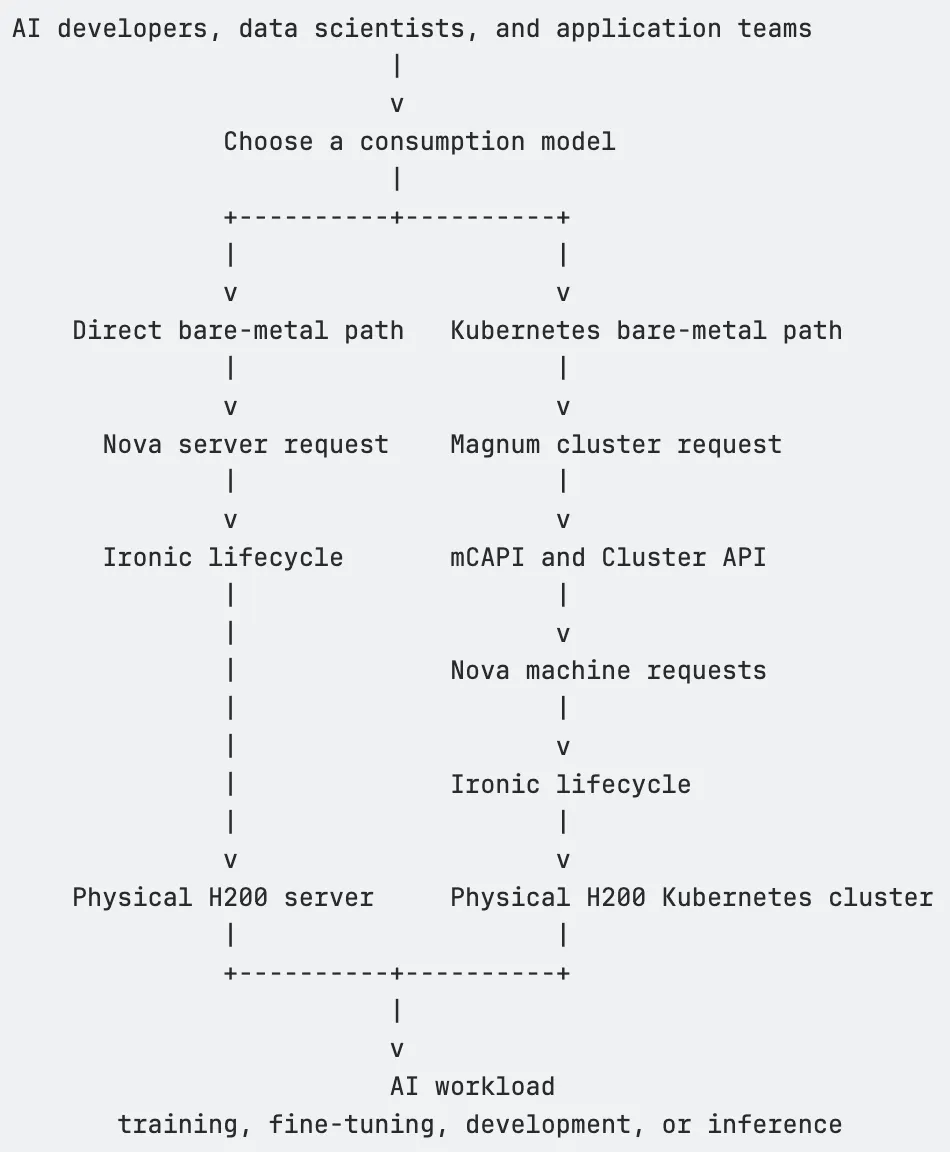
Both paths share the same cloud and hardware foundations. Atmosphere operates the cloud services on top of Kubernetes; OpenStack represents capacity and the user-facing lifecycle; Ironic translates requests into physical provisioning; and Redfish controls the out-of-band hardware path. The guest image and first-boot system complete configuration inside the installed server. The difference is the consumer contract: Nova gives a user a whole H200 server, while Magnum, mCAPI, and Cluster API reconcile a Kubernetes cluster request into the Nova and Ironic machines that become its control-plane and worker nodes. Both paths return usable physical GPU capacity to the same AI workloads.
Why Atmosphere And Ironic Work Well for an AI workflow
Atmosphere provides an opinionated platform to deploy, operate, and reconcile OpenStack services containerized on Kubernetes. Ironic adds physical-node provisioning to that cloud. The combination is particularly powerful for AI workflows because the same Atmosphere-managed control plane can serve both direct bare-metal compute and containerized Kubernetes worker nodes while physical mechanics remain reliably delegated to Ironic.
Atmosphere ensures the control plane's cross-service contracts remain aligned:
- Service contract: API endpoints, credentials, policy, message queues, databases, and network access are continuously reconciled by Atmosphere before Ironic reconciliation.
- Image contract: the conductor, deploy agent, boot artifacts, and guest image are version-managed and kept mutually compatible.
- Scheduling contract: the Ironic node resource class matches the custom resource requested by the Nova flavor.
- Network contract: the Ironic physical ports, Neutron ports, provider networks, and switch configuration describe the same physical path.
- BMC contract: Redfish capabilities, certificate policy, virtual-media behavior, and firmware boot semantics are validated per hardware model.
Breaking any one of these contracts can leave the cloud healthy while physical deployment fails. Atmosphere's declarative deployment model keeps these contracts predictable across updates and operational lifecycles.
The Users And Workloads At The Top
The cloud and hardware layers don't deliver the final product. Different users consume the same physical capacity in different ways:
- AI researchers and data scientists need interactive access, repeatable environments, model and dataset access, and long-running training or fine-tuning jobs.
- Inference engineers need stable accelerator capacity for model servers, predictable networking, controlled rollout, monitoring, and recovery.
- Application teams need an API endpoint or Kubernetes service rather than direct knowledge of BMCs, firmware, or physical switch ports.
- Platform engineers need schedulable GPU resources, Kubernetes lifecycle, image management, tenant boundaries, and a reliable handoff to workload tooling.
- Infrastructure operators need inventory, provisioning, console access, firmware recovery, evidence collection, deletion, and reuse.
These needs explain why a successful server boot is not enough. A useful handoff must provide a stable operating system, accelerator visibility, access to the required model and data paths, working network connectivity, and an operational recovery path. From there, workload acceptance can run an actual training, fine-tuning, or inference scenario and measure whether the environment meets that workload's functional and performance objectives.
Building Production-Oriented GPU Infrastructure with Atmosphere
Installing accelerators is only the first step in building a GPU cloud. The harder problem is turning each physical server into capacity that can be requested through an API, deployed repeatedly, observed during failure, and returned safely to the resource pool.
Atmosphere provides the overarching architecture and operational engine to unify these systems into a cohesive production platform:
- Glance owns the deployable operating-system image.
- Neutron owns the network resources presented to the server.
- Nova owns the user-facing server lifecycle and scheduling request.
- Ironic owns the physical-node lifecycle.
- Redfish provides out-of-band power, boot, media, and hardware-management operations.
- Atmosphere orchestrates and reconciles all of these control-plane services as Kubernetes workloads.
We assembled this path and validated its physical lifecycle on NVIDIA H200 hardware powered by Atmosphere. The useful result was not simply that the server booted. The result was a repeatable chain from cloud API request to local-disk deployment, networked guest, remote graphical console, cleanup, and resource reuse.
Start With The Operating Model
A physical server differs from a virtual machine in one important way: many failures happen outside the hypervisor boundary. Firmware can retain stale boot state. A BMC can accept a request but not apply it. A network interface may appear in a different mode after a firmware reset. An operating-system image can boot successfully yet fail first-boot networking.
The architecture therefore needs explicit fault domains:
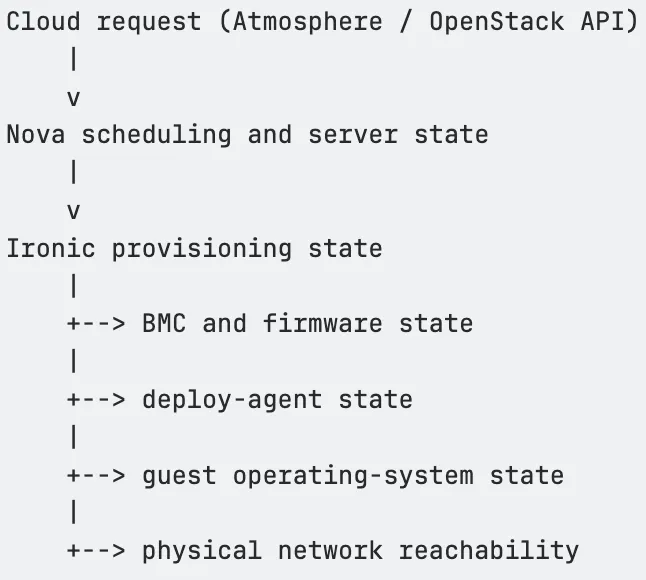
Operators should be able to inspect every boundary independently. A Nova server in ACTIVE state is useful evidence, but it does not prove that the guest has configured its network. An Ironic node in active state proves that deployment completed from Ironic's perspective, but it does not prove application readiness.
Deploy In Dependency Order
With Atmosphere, the base cloud is deployed and validated in a strict dependency order on Kubernetes before adding Ironic:
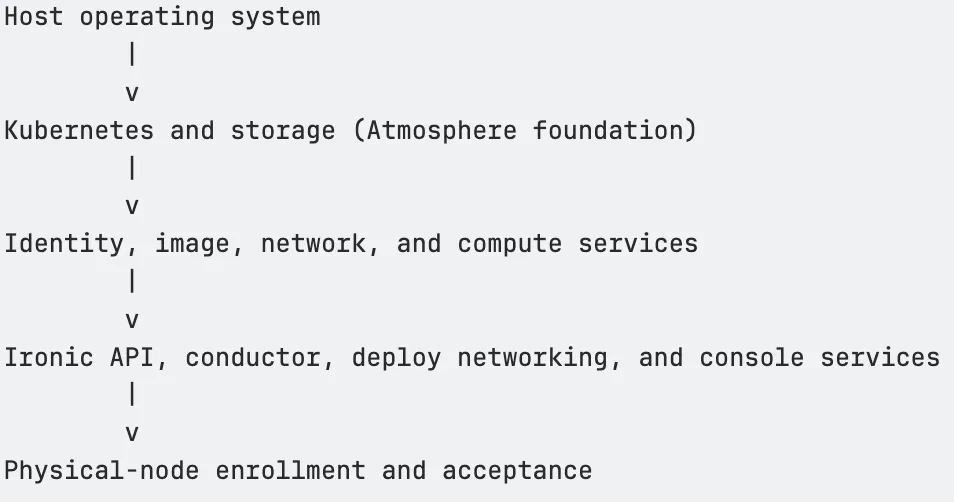
This order keeps failures attributable. If Kubernetes storage is unhealthy, debugging a conductor rollout adds noise. If Glance cannot serve an image, testing Redfish media insertion is premature.
It also supports smaller reconciliations. Atmosphere allows changes to a console image or service configuration without requiring a full cloud rebuild. A new guest image can be promoted through Glance without disrupting the control plane. Every deployable artifact uses an immutable version or digest so rollback identifies an exact prior state.
This is why a GPU cloud built with Atmosphere is an operational system rather than a static hardware inventory. Atmosphere makes the underlying physical lifecycle observable, automated, and repeatable.
Hosted And Customer-Owned Infrastructure
The same Atmosphere architecture applies to hosted and on-premises deployments, but the integration details remain local:
- who owns the BMC network;
- where images are published for BMC retrieval;
- how provider networks reach physical switch ports;
- which certificate authority signs BMC certificates;
- how firmware baselines are managed; and
- which team owns destructive recovery operations.
Those decisions should be explicit before enrollment. Atmosphere provides the cloud platform and resource model, but it cannot remove the need for accurate physical inventory and operating procedures.
Some Best Practices
Three practices mattered most:
- Treat every cross-service interface as a versioned contract.
- Separate control-plane completion from guest and physical reachability.
- Preserve enough evidence to reproduce a failure without exposing credentials or short-lived access tokens.
With those practices, Atmosphere provides a strong foundation for operable GPU infrastructure.
If you're interested in learning more, reach out to us for a conversation.