This post takes a closer look at the real-world failure points in OpenStack, how to design around them using practical strategies, and how Atmosphere simplifies some of this work.
Failure in production-grade cloud environments is inevitable. OpenStack, while robust, is a distributed system composed of many moving parts. Every piece, from compute nodes to control plane services, carries the potential to fail.
This post takes a closer look at the real-world failure points in OpenStack and how to design around them using practical strategies. It also looks at how Atmosphere simplifies some of this work.
Understanding Where OpenStack Fails
Failures in OpenStack usually follow familiar patterns:
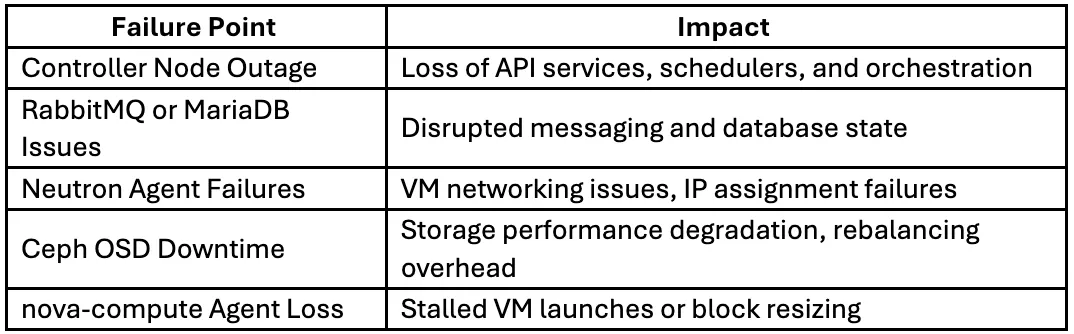
While each failure scenario affects availability and user experience differently, these are the kind of things that show up in day-to-day operations if the architecture isn’t built to absorb them.
Building for Resilience
A resilient OpenStack deployment prioritizes redundancy, isolation, and recoverability over theoretical perfection.
Redundancy
- Deploy multiple instances of API services to eliminate single points of failure.
- Implement highly available database and messaging layers.
- Distribute Ceph OSDs intelligently across racks and zones.
- Utilize Neutron High Availability (HA) or Distributed Virtual Routing (DVR) to maintain networking continuity.
Failure Domain Isolation
- Separate control and data plane networks to limit blast radius.
- Design availability zones carefully to distribute tenant workloads.
- Ensure that losing one zone or rack does not compromise the entire cloud.
Catching Issues Before They Escalate
Monitoring isn’t only about uptime, it’s about behavior. Spotting patterns like high API latency, flapping Neutron agents, or unexpected spikes in RabbitMQ queues can reveal deeper problems. That’s where metrics, logs, and synthetic checks (like scheduled VM boot tests) become essential.
The best alerting setups don’t just shout when something breaks. They help explain why. For example: if VM launches fail, it shouldn’t stop at “boot error.” It should also point to recent Glance slowdowns, Nova scheduler lag, or RabbitMQ restarts.
Recovery Over Perfection
Efforts to prevent every failure are impractical; instead, focus on enabling rapid, reliable recovery.
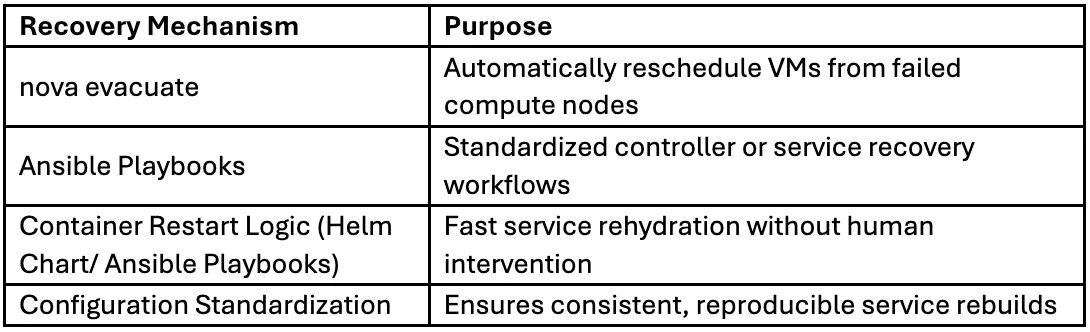
Fast recovery minimizes downtime and operational panic.
How Atmosphere Embeds These Principles
Atmosphere, the OpenStack-based platform developed by VEXXHOST, incorporates resilience at every layer:
- A pre-integrated monitoring and alerting stack that covers over 300 metrics and key service checks.
- Prebuilt Ansible playbooks for automated failover, restoration, and scaling operations.
- A scheduled backup for instances (in case and instance crashes or gets corrupted) to allow for easy restoration of data.
- Kubernetes orchestration manages containerized services with native retry and scaling policies.
- Highly available for core services are standard. No extra fiddling needed. This ensures critical components restart and recover predictably.
The focus is on giving operators what they need to respond fast when something goes wrong and lowering the chances of it happening in the first place. This level of automation also reduces the operational overhead required to run things smoothly.
Designing for failure is essential for building robust systems - systems that can take the hit and bounce back fast. The key elements of a resilient cloud architecture have built-in redundancy, isolated failure domains, systems for monitoring and fallback.
Atmosphere brings all of that into one package. This way businesses can deploy OpenStack environments that withstand failure with minimal disruption, while enjoying the flexibility and openness that the platform offers.
If you’re curious about how Atmosphere can help your business scale, reach out for a free consultation.