

OpenStack
Why Cloud Infrastructure Gets More Expensive as It Matures
Discover why cloud infrastructure costs rise over time and how effective resource management and cost visibility can help control spending.
Read field noteField notes / Latest
Engineering notes from operating open infrastructure: the failures, design decisions, and upstream work that make open infrastructure better.
Browse all field notesDiscover why cloud infrastructure costs rise over time and how effective resource management and cost visibility can help control spending.
Read field note
VEXXHOST recaps OpenInfra Day North America 2026 in Chicago, highlighting its headline sponsorship, Mohammed Naser's talks, and the future of OpenStack operations.
Read field note
Ceph vs SAN: Compare performance, scalability, licensing, and operational costs to choose the right enterprise storage modernization strategy.
Read field note
A one-week test plan for any provider's free cloud server trial: repeatable fio and iperf3 runs, Terraform and API checks, a real restore, a bill reconciliation and one timed support ticket, with the results that should end an evaluation early.
A small team picks where production runs once, then lives with that choice through every incident, invoice and hiring decision that follows. A free cloud server trial, the short window in which a provider lets you run servers before you pay, is the cheapest point at which to test the choice. A trial spent launching one server and clicking through the dashboard ends in a decision made on feel.
The bill is one place a poor choice shows. In Flexera's 2026 State of the Cloud report, 85% of respondents named managing cloud spend a top challenge, and wasted spend rose to 29%, its first increase in five years.
A one-week plan turns the trial into evidence. It rests on these checks:
The week ends in one of three calls: move production, extend the test or walk away. A wrong pick can mean a second migration later.
Write the pass marks before you sign up, while nobody has a favourite yet.
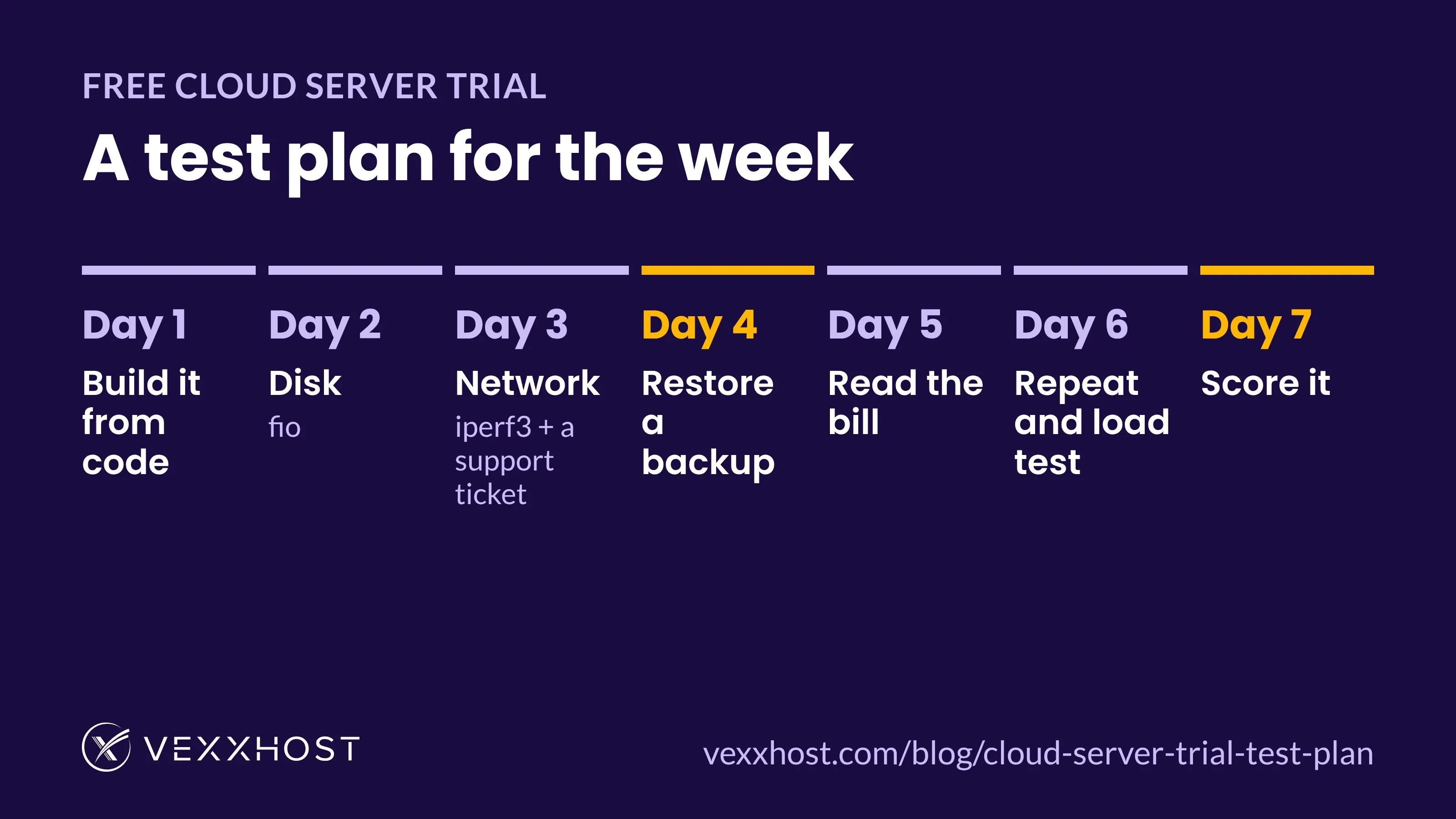
Each day ends with a written result: a number, a pass or fail against the pass marks, and the raw output saved where both readers can find it.
If production cannot be rebuilt from code on a provider, every later change and the eventual exit involve more manual work.
Our public cloud runs OpenStack, and the OpenStack provider for Terraform automates OpenStack clouds generally. Its maintainers test against upstream OpenStack, and some features need a minimum API version, so check each cloud's configuration and the resources it offers before reusing code.
Storage latency affects how large a database server you pay for and how it behaves under load. Run fio on the storage type production would use, network block volume or local disk, at the volume size you would buy, with the run settings your engineer uses for production capacity tests.
Throughput between your own servers affects how many hosts a service needs. The path to users sets what they experience.
Test from the region nearest your users. Our public cloud has regions in Montreal, Santa Clara and Amsterdam, so a team with European customers can measure the Amsterdam path directly.
Open the support ticket today. Use a real question raised in days one to three: a quota increase, a throughput result below what you expected, or how backups are billed. Record when you opened it, when a person first replied, and whether the reply answered the question asked. Opening it on day three leaves four days for the answer to arrive inside the trial.
An untested restore turns the recovery point and recovery time in your customer contracts into guesses.
Test the copy you would rely on after losing the original: a volume backup. In OpenStack's block storage service, backups go to a separate backup repository, object storage by default. A volume snapshot stays tied to its volume. The block storage service deletes a volume that has snapshots only when the snapshots are deleted with it, so a snapshot cannot be the copy that survives this test.
The invoice is the number the bill signer will see every month for years, so read it while the resources are still small enough to count by hand.
Billing granularity changes this arithmetic. Our public cloud has billed per minute since May 2019: a resource that runs for 20 minutes is charged for 20 minutes.
A single benchmark run is an anecdote. Repeat the day two and day three jobs with identical settings at a different time of day, ideally during your users' peak hours.
Put each result next to the number written before day one, and add the support ticket's timings and the bill reconciliation. Before deciding, confirm the business terms the tests cannot show:
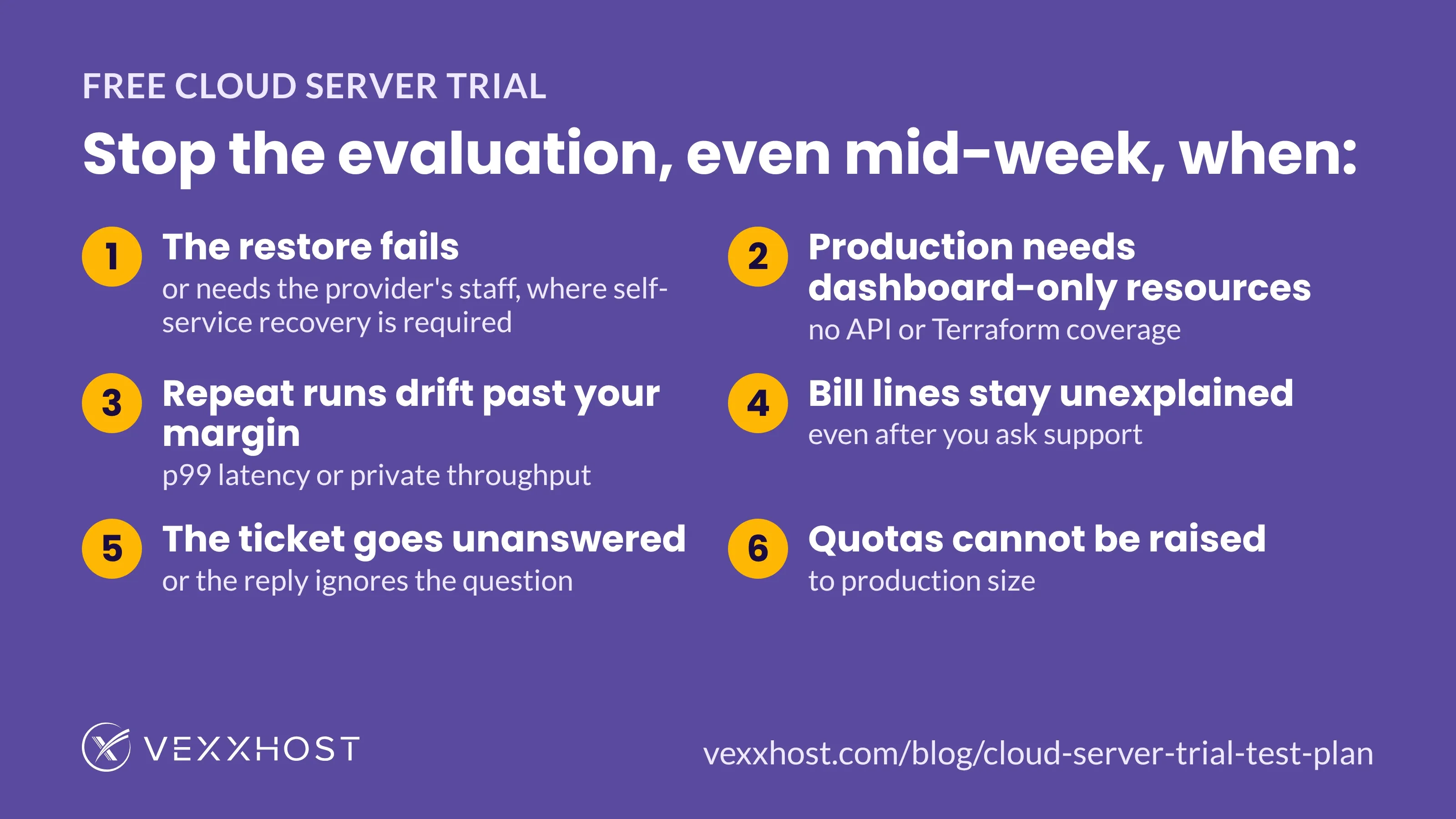
Some results outweigh any price difference. Stop the evaluation, even mid-week, when:
A week leaves gaps:
Skipping the plan and defaulting to a hyperscaler is a reasonable choice when production depends on a managed service only a hyperscaler offers. The test then belongs on that managed service, and server benchmarks matter less. The plan also shrinks for a stateless service already fully defined in Terraform, where moving later is cheap and days one, five and six carry most of the weight. A team choosing a dedicated private cloud needs a longer production proof of concept with an upgrade inside it, which a week on shared servers cannot replace.
Apply the week's results in this order:
Our public cloud runs OpenStack, works with the OpenStack provider for Terraform and bills per minute, so this plan's Terraform runs, regional tests and bill reading apply to it directly. We were one of the 10 founding providers of the OpenStack Public Cloud Passport in 2017, a program set up so teams could trial OpenStack public clouds. We also moved our public and private clouds to OpenStack Stein on its release day in 2019.
If the week's results fit none of these rules, they are worth discussing with our team, together with the workload, region, capacity and recovery needs behind them.
Choose from Atmosphere Cloud, Hosted, or On-Premise.
Simplify your cloud operations with our intuitive dashboard.
Run it yourself, tap our expert support, or opt for full remote operations.
Leverage Terraform, Ansible or APIs directly powered by OpenStack & Kubernetes