
Sovereign by Architecture: Building AI Infrastructure for the EU AI Act
The EU AI Act takes effect August 2026. Compliance starts at the infrastructure layer. Learn why sovereign AI needs OpenStack, Kubernetes, and Atmosphere.

Insights, updates, and stories from our team
The EU AI Act takes effect August 2026. Compliance starts at the infrastructure layer. Learn why sovereign AI needs OpenStack, Kubernetes, and Atmosphere.
Learn how a lightweight keystoneauth1 plugin brings your existing browser-based MFA and SSO to the OpenStack CLI, with no changes to any client tools.
Hyperscaler AI looks fast but hides long-term lock-in and rising costs. See how OpenStack and Kubernetes deliver GPU infrastructure you actually control.

Check how to build a smarter, faster, and more resilient infrastructure with Atmosphere OpenStack for SaaS.
As organizations increasingly embrace digital transformation, SaaS platforms remain at the forefront of the change. In fact, over 95% of organizations have adopted SaaS solutions, reflecting a significant shift towards cloud-based applications. From startups to enterprise-scale platforms, SaaS companies need a cloud infrastructure that is reliable, scalable, secure, automated, and efficient.
However, scaling SaaS applications presents unique challenges: isolating tenants, managing network boundaries, orchestrating Kubernetes, automating pipelines, and monitoring performance — all while maintaining cost-efficiency and uptime.
Atmosphere OpenStack is here for the help. A production-ready OpenStack-based IaaS platform, Atmosphere helps SaaS companies build resilient cloud environments that scale effortlessly, using open-source technologies and best practices — with expert support every step of the way.
In this post, we’ll explore the core architectural principles for scaling SaaS platforms, and how Atmosphere supports each one — from tenant isolation to Kubernetes auto-scaling.
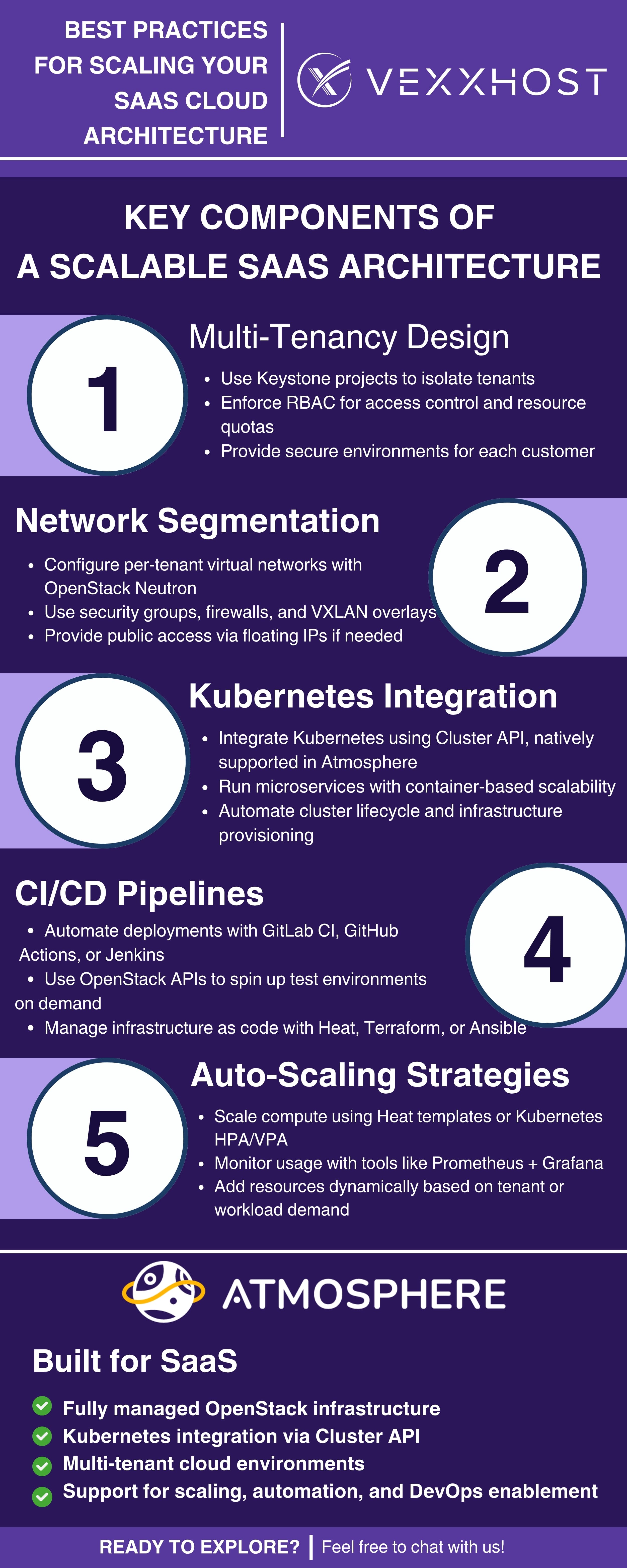
SaaS applications are inherently multi-tenant, but how you design your tenant architecture impacts your scalability. A solid multi-tenant structure is key to managing complexity as you grow.
How Atmosphere Helps:
This separation ensures that customers’ environments don’t interfere with each other. Whether you’re managing 10 clients or 10,000, Atmosphere supports seamless resource allocation and security — crucial for compliance and billing.
Pro tip: Automate tenant provisioning with tools like Terraform or Ansible within Atmosphere.
For multi-tenancy to work, network isolation and security are critical. Atmosphere leverages OpenStack Neutron to manage network segmentation effectively.
Key Features:
With these capabilities, SaaS companies can implement a zero-trust architecture, limit attack surfaces, and offer secure, virtual private environments for customers — without requiring a tangle of third-party networking plugins.
Need even tighter control? Neutron allows you to plug in SDN solutions or route traffic through custom gateways.
Modern SaaS platforms rely heavily on containers — whether it’s microservices, APIs, event-driven apps, or other distributed systems. Kubernetes has become essential for orchestrating these containers at scale, managing workloads across clusters, and ensuring high availability.
As discussed in our Inside Kubernetes Sandwich blog post, Kubernetes enables SaaS teams to efficiently manage large-scale environments, ensuring that applications can scale rapidly without compromising on performance.
How Atmosphere Helps:
Atmosphere supports Kubernetes through Cluster API, an open-source Kubernetes subproject that automates cluster provisioning and lifecycle management. This integration brings several key benefits:
This integration allows your SaaS teams to deploy and manage Kubernetes clusters seamlessly on OpenStack, combining the flexibility of Kubernetes with the control of OpenStack-based infrastructure.
Need GPU support for AI/ML workloads? Atmosphere can integrate GPU-backed flavors into Kubernetes for data-intensive applications, allowing for high-performance computing where it's most needed.
In the fast-paced world of SaaS, speed is critical. Continuous Integration and Continuous Deployment (CI/CD) pipelines are the cornerstone of rapid, efficient, and reliable software delivery. They enable SaaS teams to deploy new features and updates at lightning speed, without compromising on quality or performance.
Atmosphere makes it easy to integrate OpenStack with popular CI/CD tools, allowing SaaS teams to automate and streamline their workflows. By connecting with tools such as:
SaaS teams can benefit from full automation at every stage of their deployment pipeline, ensuring faster time-to-market and minimal manual intervention.
With these integrations, you can:
CI/CD pipelines not only reduce human error but also accelerate deployment velocity, giving SaaS teams the flexibility to release new features and fixes quickly. Additionally, they improve customer satisfaction by enabling tenant-specific releases and ensuring that updates don’t disrupt ongoing operations.
By embedding automation and streamlining the development-to-production process, Atmosphere enables SaaS companies to scale faster, innovate continuously, and deliver exceptional user experiences.
Manually scaling infrastructure can lead to inefficiencies, downtime, or resource wastage. Atmosphere enables the creation of intelligent, self-healing, and demand-driven environments that dynamically adapt to real-time workloads. By leveraging advanced metrics and automation, scaling becomes seamless, efficient, and aligned with business needs.
Dynamic Scaling with Atmosphere
Compute Auto-Scaling: Dynamically adjust virtual machine or bare metal instance counts based on customizable performance thresholds, such as CPU utilization, memory consumption, or network traffic. This ensures optimal performance during peak loads and cost savings during downtime.
Comprehensive Kubernetes Auto-Scaling:
Integrated Monitoring & Automated Triggers:
With native integration of Prometheus and Grafana, gain real-time visibility into performance metrics and set intelligent scaling triggers. These tools provide actionable insights, ensuring scaling decisions are data-driven and efficient.
Benefits of Automated Scaling:
Scaling infrastructure on demand eliminates overprovisioning and ensures resources are used efficiently. By aligning infrastructure usage with actual demand, costs are optimized, and performance is consistently reliable—even during unpredictable workload spikes.
Here’s why Atmosphere is the perfect fit for fast-growing SaaS companies:
Fully managed OpenStack infrastructure — no need for in-house OpenStack expertise.
Native Kubernetes support via Cluster API.
True multi-tenancy and network isolation.
Seamless CI/CD integration with infrastructure-as-code support.
Scalable by design — from compute and storage to containers.
Backed by VEXXHOST’s expert team and upstream OpenStack involvement.
Whether migrating from another cloud or starting fresh, Atmosphere provides a stable, flexible, and open foundation for your SaaS without vendor lock-in.
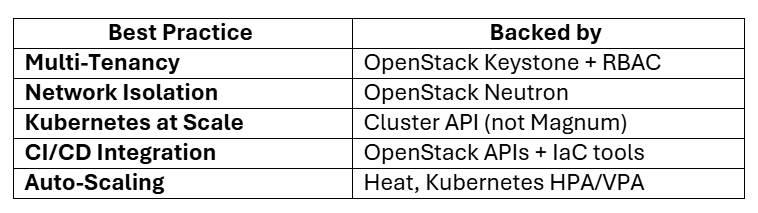
Building a cloud-native SaaS platform requires more than just VMs and storage — it demands a scalable, flexible architecture that grows with your customers and your code.
With Atmosphere, you’re not just deploying infrastructure; you’re deploying with confidence. Powered by OpenStack, backed by Ceph, and supported by cloud-native tooling, Atmosphere enables you to build smarter, scale faster, and operate without compromise.
Ready to scale your SaaS platform with confidence?
Check Atmosphere for a resilient, scalable, and fully managed infrastructure solution. Get in touch with our experts today to learn how we can help you build smarter and scale faster, without the complexity. Contact us now to get started!
Choose from Atmosphere Cloud, Hosted, or On-Premise.
Simplify your cloud operations with our intuitive dashboard.
Run it yourself, tap our expert support, or opt for full remote operations.
Leverage Terraform, Ansible or APIs directly powered by OpenStack & Kubernetes
