

GPUs
Private AI Inference vs. Public AI APIs
Compare private AI inference, managed endpoints, and public AI APIs. Learn when data control, latency, model flexibility, and cost justify a change.
Read field noteField notes / Latest
Engineering notes from operating open infrastructure: the failures, design decisions, and upstream work that make open infrastructure better.
Browse all field notesCompare private AI inference, managed endpoints, and public AI APIs. Learn when data control, latency, model flexibility, and cost justify a change.
Read field note
Evaluate when Ceph RBD, RGW, and CephFS should share a private cloud cluster, including performance isolation, failure domains, and SAN trade-offs.
Read field note
Learn why infrastructure documentation becomes outdated, the operational risks it creates, and how automation helps keep it accurate.
Read field note
Compare private AI inference, managed endpoints, and public AI APIs. Learn when data control, latency, model flexibility, and cost justify a change.
Public AI APIs are often the fastest way to add a language model to an application. Teams can test models, integrate an endpoint, and start building without provisioning GPUs or maintaining a serving stack.
Production changes the decision. Applications may process confidential documents, need predictable response times during traffic spikes, or require particular model versions and processing locations.
Private AI inference is worth evaluating when an existing public API cannot meet a workload's requirements for data handling, deployment control, model choice, performance, or operations. A managed endpoint can address some of those needs without requiring the organization to operate its own model-serving infrastructure. But private deployment is not automatically more secure, faster, or cheaper; the details of the service matter.
AI inference is the process of running a trained model on new inputs to generate an output. For a large language model (LLM), that output could be an answer, summary, classification, or structured response.
Private AI inference generally describes model serving within a defined environment where an organization can specify processing location, access boundaries, and data-handling requirements. It might be hosted by a provider, deployed on dedicated infrastructure, or operated in the customer's data center.
Two terms are especially important to separate:
A managed endpoint is not necessarily private by default, and dedicated GPUs do not automatically make a system compliant. Those characteristics must be confirmed in the architecture and service agreement.
All three options can expose an API to applications. They differ in who operates the serving layer and how much control the customer can exercise.
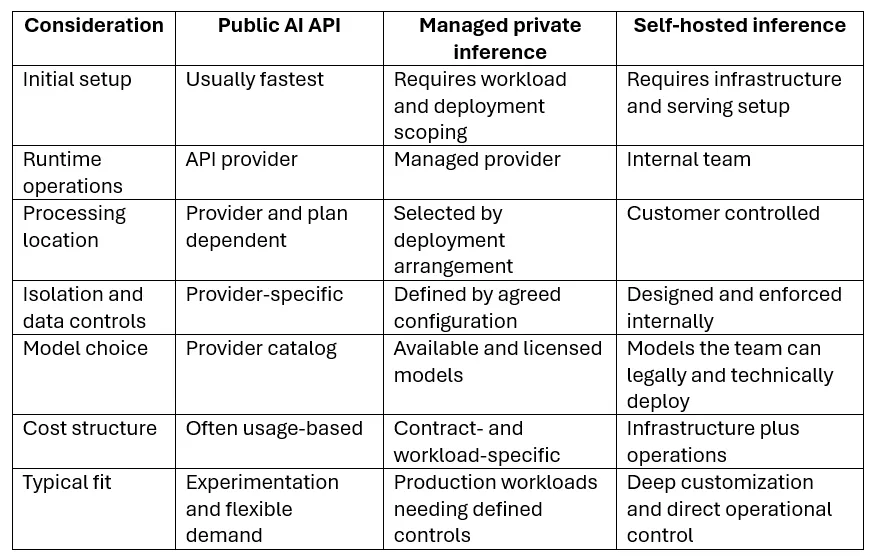
These are common patterns, not guarantees. Some enterprise public APIs offer regional processing, retention controls, and private connectivity. Equally, some managed services use shared infrastructure unless dedicated capacity is part of the agreed deployment.
The model endpoint is only one part of the application's data path. Consider an internal assistant using retrieval-augmented generation (RAG):
The retrieved context could contain sensitive customer details even if the user's question does not. Moving the model to a private environment will not protect that data if logs, retrieval services, or connected tools send it elsewhere.
Before choosing an AI inference service, ask:
These questions apply to public and private deployments alike. Data residency also differs from sovereignty or compliance: locating inference in a country does not resolve every legal, contractual, or operational-access requirement.
Not necessarily. Security depends on controls such as authentication, encryption, network restrictions, tenant isolation, retention policies, and auditing—not on whether an endpoint is called private. A private deployment may provide greater control over those measures, but the organization still needs to address application vulnerabilities, overly broad access, and prompt-injection risks.
Running a model in production involves more than loading weights onto a GPU. The serving stack must manage memory, batching, concurrency, request queues, availability, observability, model updates, and failures. Long input contexts and simultaneous users can change latency and capacity requirements significantly.
A self-hosted setup can be appropriate when a team needs extensive runtime customization and has the skills to operate it. But an organization may need control over deployment and data handling without wanting to maintain that stack internally.
That is where managed inference fits. With VEXXHOST AI Inference, teams can evaluate open, commercial, or custom model options behind an operated endpoint. Deployment can be VEXXHOST-hosted or on-premises, with data-residency and retention choices scoped to the workload. Zero Data Retention is available for eligible deployment configurations, rather than being a universal feature.
For customer-premises inference, VEXXHOST requires its GPU Infrastructure product. This separates the managed model-serving service from the accelerated compute layer beneath it.
The best model is the one that meets the application's quality and operational requirements, not necessarily the newest or largest.
Commercial models may offer strong capabilities and convenient integrations, but access and deployment rights depend on the vendor. A commercial model available through an API is not automatically licensed for customer-hosted deployment.
Open-weight models can offer greater freedom over placement, versions, and serving configurations. Teams still need to review licenses, hardware demand, accuracy, and security. “Open weight” does not always mean unrestricted use.
Custom or fine-tuned models can suit domain-specific terminology, outputs, or processes. They also require repeatable evaluation and version management as data and requirements evolve.
Private or controlled inference deserves consideration when one or more production requirements cannot be adequately met through the current API arrangement.
Sensitive information and governance. Requests include customer records, proprietary documents, or regulated data, and the organization needs specific processing, access, or retention guarantees. Confirm the entire application data path, not just the model endpoint.
Deployment or residency constraints. Inference must run in an approved region or customer-controlled environment. Verify operational access, backup locations, and any applicable contractual or jurisdictional requirements.
Predictable, sustained usage. Stable request volumes may justify evaluating reserved capacity or a tailored managed service. The economics depend on achieved utilization, concurrency, latency targets, and operations—not volume alone.
Performance requirements. User-facing applications may need consistent time to first token (TTFT), p95 response latency, throughput, and error rates. A controlled deployment can help teams tune placement and serving behavior, but only workload testing establishes whether it performs better.
Model customization and lifecycle control. Teams may require a specific model version, fine-tuning, or a defined upgrade process. A managed endpoint can support an agreed model strategy while reducing the burden of operating its serving environment.
Provider dependence. Organizations may want the option to change models or deployment locations over time. An API abstraction can help, but portability still requires testing because tokenization, tool use, context windows, and output behavior vary between models.
A public API often remains the practical choice for prototypes, low or irregular traffic, rapidly changing model experiments, and applications whose security and residency needs already fit the provider's enterprise terms. There is no benefit in introducing infrastructure complexity merely to make an application “private.”
A hybrid approach may be sensible too: route sensitive or predictable workloads to a controlled endpoint while retaining public APIs for other applications. That requires explicit routing rules so protected data cannot accidentally reach the wrong service.
Public APIs commonly charge by input and output tokens. That limits upfront capacity commitments but can become expensive as usage grows.
Dedicated infrastructure has different economics: reserved GPU capacity, supporting systems, operational effort, and headroom for peaks must be paid for even when utilization is low. Managed inference is not necessarily sold as a fixed GPU reservation. For example, VEXXHOST quotes token-based pricing according to model choice, expected volume, and deployment location.
Compare total cost per successful application outcome, along with latency and service requirements. For a deeper calculation, see Reducing Your LLM Inference Costs.
The output should be a documented decision: which model, where it runs, what controls apply, who operates it, and how success will be measured.
Public AI APIs are valuable because they let teams move quickly. Private inference becomes relevant when production applications need specific controls over data, deployment, models, or the serving environment. Self-hosting remains a valid choice for teams prepared to own those operations; managed inference offers a middle ground.
VEXXHOST can help scope that decision through AI Inference, with hosted or on-premises managed endpoints and deployment-specific data-handling options. If the workload requires dedicated accelerated capacity, GPU Infrastructure addresses the compute layer. If the use case or model approach is still unclear, AI Advisory helps define the path to production.
The goal is not to make every AI application private. It is to choose an inference operating model that meets the workload's real requirements without taking on unnecessary complexity.
Choose from Atmosphere Cloud, Hosted, or On-Premise.
Simplify your cloud operations with our intuitive dashboard.
Run it yourself, tap our expert support, or opt for full remote operations.
Leverage Terraform, Ansible or APIs directly powered by OpenStack & Kubernetes