

GPUs
Bare Metal Kubernetes vs. VMs for AI and GPU Workloads
Compare bare-metal Kubernetes and GPU VMs for AI workloads. Learn how hardware access, isolation, provisioning, and operations shape the right architecture.
Read field noteField notes / Latest
Engineering notes from operating open infrastructure: the failures, design decisions, and upstream work that make open infrastructure better.
Browse all field notesCompare bare-metal Kubernetes and GPU VMs for AI workloads. Learn how hardware access, isolation, provisioning, and operations shape the right architecture.
Read field note
Discover why cloud infrastructure costs rise over time and how effective resource management and cost visibility can help control spending.
Read field note
VEXXHOST recaps OpenInfra Day North America 2026 in Chicago, highlighting its headline sponsorship, Mohammed Naser's talks, and the future of OpenStack operations.
Read field note
Compare bare-metal Kubernetes and GPU VMs for AI workloads. Learn how hardware access, isolation, provisioning, and operations shape the right architecture.
AI infrastructure teams must decide whether Kubernetes workers should run in GPU VMs or directly on physical servers. The choice affects hardware access, isolation, capacity allocation, and GPU operations.
Bare metal is not automatically faster or better. Removing virtualization matters only when it is a bottleneck or a workload needs direct hardware access. A VM may provide GPU passthrough or supported vGPU, while a physical node can still be constrained by drivers, networking, storage, or application code.
The question is whether a VM remains the most useful unit of infrastructure. Many platforms will use both: GPU VMs for variable work and bare-metal Kubernetes pools for sustained workloads that benefit from dedicated servers.
Bare-metal Kubernetes is most useful when a workload needs a dedicated server or direct host-level configuration, and its utilization justifies that capacity. GPU VMs are usually the better fit for variable demand, VM-level tenancy, and workloads that have already been validated on passthrough or vGPU.
Kubernetes schedules pods onto worker nodes whether they are virtual machines or physical servers. What changes is the infrastructure beneath the operating system.
In a VM-based design, each worker is a guest operating system on a hypervisor. The platform allocates CPU, memory, storage, networking, and possibly GPU devices to that guest through passthrough or supported vGPU.
In a bare-metal design, the host operating system runs directly on a physical server. Kubernetes still needs drivers and a device plugin or vendor operator to discover and advertise GPU resources.
Bare-metal Kubernetes does not mean “no abstraction.” Kubernetes still abstracts applications from individual servers.
AI workloads can place sustained demand on GPUs, memory, storage, and high-speed networking. Distributed training depends on communication between accelerators; inference may need consistent latency as requests change. GPU assignment, topology, and data movement all affect utilization.
These demands can make teams examine every layer between a workload and its hardware. But the hypervisor alone does not prove a bottleneck. GPU passthrough can give a VM access to a physical GPU, and supported vGPU models can expose a virtualized share. NVIDIA lists bare metal, passthrough VMs, and supported vGPU platforms among its GPU Operator deployment options.
The useful question is: Does this workload perform better, operate more predictably, or become simpler to manage when the VM boundary is removed? Test the intended GPU, server, driver, Kubernetes distribution, network, storage, and application stack.
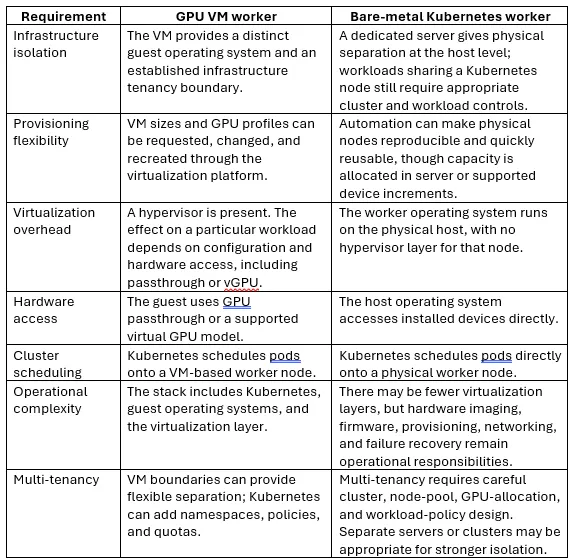
Neither option guarantees a particular level of performance, isolation, or operational simplicity. Results depend on hardware, platform, policy, and workload design.
VMs remain strong when flexibility and the VM boundary matter more than direct access to an entire server.
Demand is variable. Experiments, development, and occasional inference may not keep a GPU server busy. VM workers can be easier to create or remove, combine with CPU-only nodes, and integrate with cloud quotas and automation.
Teams need separate guest environments. A VM gives a tenant its own operating system and configurable instance boundary. Kubernetes adds application controls on top, fitting organizations that already allocate capacity through VM projects or quotas.
The workload is validated on virtualized GPUs. Passthrough or vGPU may meet performance and functionality requirements. Validate the GPU, hypervisor, firmware, driver, Kubernetes version, and vendor support before standardizing.
The hypervisor is not the bottleneck. If profiling points to storage, preprocessing, CPU, network collectives, or application code, bare metal may add operational work without fixing the constraint.
Bare metal makes sense when a physical server is the practical unit of GPU capacity and its lifecycle can be operated reliably.
The workload uses GPU servers for long, sustained jobs. Dedicated training or inference pools may be easier to plan when capacity is reserved at the server level. High utilization can make predictable access and topology-aware placement more valuable than subdividing the host into VM shapes.
The workload needs direct hardware or host-level configuration. Accelerator, NUMA, firmware, networking, or storage requirements may be easier to validate on a direct host. Benchmark to confirm they affect the application.
Virtualization adds real friction. If GPU assignment, hypervisor maintenance, guest configuration, or cross-layer troubleshooting repeatedly slows delivery, bare metal may simplify the worker path. Teams still maintain host images, drivers, firmware, Kubernetes, and recovery procedures.
The organization wants dedicated physical pools. Bare-metal pools can assign servers to teams or workload classes. Kubernetes labels, taints, quotas, admission rules, and policy should match the required isolation level.
Bare metal can support multi-tenant AI platforms, but dedicated servers alone do not define isolation. Tenants sharing a cluster or node may share the host kernel and device software stack. Namespaces help organize and control workloads, but do not replace every infrastructure boundary.
Define what must be isolated: API access, secrets, data, network traffic, GPU memory, host OS, server, or cluster. Then choose an appropriate boundary: strict namespace policies, dedicated GPU pools, separate clusters, or single-tenant servers. Use GPU partitioning or sharing only where hardware and software meet the required isolation and resource guarantees.
Set quotas for GPUs and other scarce resources, prevent unauthorized workloads from selecting protected nodes, monitor contention, and define how data, disks, credentials, and node state are cleared before reassignment. Test failed jobs and node replacement as part of the tenant lifecycle.
Bare-metal Kubernetes depends on repeatable lifecycle operations: validate a server, install a known OS image, configure its network and storage, apply the approved GPU stack, add it to a node pool, and verify readiness.
When a server fails or is reclaimed, drain workloads where possible, remove it from scheduling, repair or replace hardware, reinstall a trusted image, clear tenant state, and return it to service. A baseboard management controller supports recovery when the host OS or network is unavailable.
OpenStack Ironic provisions physical machines within the cloud’s compute and networking workflow. Cluster lifecycle tools work at another layer: Magnum exposes Kubernetes clusters as OpenStack resources; Cluster API provides declarative APIs for creating and managing clusters. These tools have different responsibilities. Automate the transition from server provisioning to a ready Kubernetes node.
VEXXHOST has described an Atmosphere architecture connecting OpenStack, Ironic, Redfish, and Kubernetes for GPU server provisioning, recovery, and declarative consumption. Read its production-oriented GPU infrastructure write-up for the operating model behind a bare-metal AI platform.
Direct hardware access does not guarantee that GPUs stay busy. Training and inference can be limited by dataset reads, checkpoint writes, network collectives, bandwidth, or traffic between the cluster and users. Benchmark the path from data source to accelerator, including topology, congestion, failure behavior, and data staging.
GPU clusters need controlled updates for drivers, firmware, host OS, Kubernetes, device plugins, and images. Test upgrades with representative workloads, roll them out by pool, and keep a rollback plan. Monitor GPU and node health, job outcomes, storage, and networking.
These requirements apply to virtualized GPU clusters too. Bare metal changes the underlying host model; it does not eliminate the need to manage the accelerator stack as a system.
Teams do not need one node type for every workload. VM clusters can serve flexible development, low-utilization jobs, or tenants that need VM boundaries; bare-metal clusters can serve sustained training and inference that benefits from dedicated GPU servers.
Keep container images, deployment pipelines, identity controls, observability, and workload definitions consistent where possible. Use separate clusters when security or lifecycle differences require them. Set placement rules so teams know why a job belongs on a pool and how much capacity it uses.
This offers an evidence-based path to bare metal: move only the workloads that benefit and keep VMs where their flexibility remains valuable.
GPU VMs fit when flexible provisioning, VM-level tenancy, or variable demand matters more than direct host access. Bare-metal Kubernetes fits when sustained workloads benefit from dedicated servers or direct hardware configuration, or benchmarks show a constraint in the virtualized path.
Use benchmarks, isolation requirements, utilization, and lifecycle costs to make the choice. Many organizations will combine VM and bare-metal clusters under one Kubernetes operating model.
VEXXHOST offers Managed Kubernetes for hosted and on-premises deployments, alongside OpenStack and GPU Infrastructure. Teams can match Kubernetes and GPU placement to workload and operating requirements.
Choose from Atmosphere Cloud, Hosted, or On-Premise.
Simplify your cloud operations with our intuitive dashboard.
Run it yourself, tap our expert support, or opt for full remote operations.
Leverage Terraform, Ansible or APIs directly powered by OpenStack & Kubernetes