Learn what data sovereignty means, how it differs from data residency, and the infrastructure decisions that support secure private clouds.
TL;DR: Data sovereignty goes beyond where data is stored. It requires careful decisions about deployment, storage, access, and operations to ensure data remains under the appropriate legal jurisdiction. This guide explains the differences between data sovereignty, data residency, and data localization, explores the infrastructure choices that support sovereignty, and shows how open technologies like OpenStack, Kubernetes, and Ceph help organizations build flexible, compliant private cloud environments.
Data sovereignty is becoming a bigger part of the cloud infrastructure conversation. As regulations evolve, AI adoption accelerates, and organizations face growing concerns around governance and operational control, more teams are taking a closer look at where their data lives and who has control over it. According to IDC, nearly half of organizations worldwide say their interest in digital sovereignty has increased compared to the previous year.
At first glance, the concept seems straightforward. Terms like data sovereignty, data residency, and data localization are often used interchangeably, even though they refer to different aspects of how data is stored, processed, and governed. Understanding those differences is an important first step when designing or evaluating cloud infrastructure.
While meeting regulatory obligations involves legal, organizational, and operational considerations, infrastructure architecture also plays a critical role. Decisions about where workloads run, where backups are stored, how data moves between regions, and who has administrative access can all influence an organization's ability to support its data sovereignty goals.
In this guide, we'll break down what data sovereignty really means, how it differs from related concepts, the infrastructure decisions that have the greatest impact, and why many organizations are choosing flexible private cloud architectures to maintain greater control over their data.
§1 What Is Data Sovereignty?
Data sovereignty refers to the principle that data is subject to the laws and regulations of the country in which it is stored or processed. In practice, it means organizations need to consider not only where their data resides, but also which jurisdiction governs it and who can access or manage it.
As cloud environments become more distributed, these questions have become increasingly complex. Infrastructure decisions, from where workloads run to where backups are stored, can all influence an organization's ability to support its data sovereignty goals.
If you'd like to explore why data sovereignty is becoming a growing priority for cloud infrastructure, read our article on How Data Sovereignty Is Changing Cloud-Native Infrastructure Design, where we examine the trends driving this shift.
§2 Data Sovereignty vs. Data Residency vs. Data Localization
Although they're often used interchangeably, data sovereignty, data residency, and data localization describe different concepts. Understanding the distinction is important when evaluating cloud infrastructure or planning a compliance strategy. The Cloud Security Alliance (CSA) includes each of these concepts in its Data Security Glossary as foundational terms for cloud security and governance.
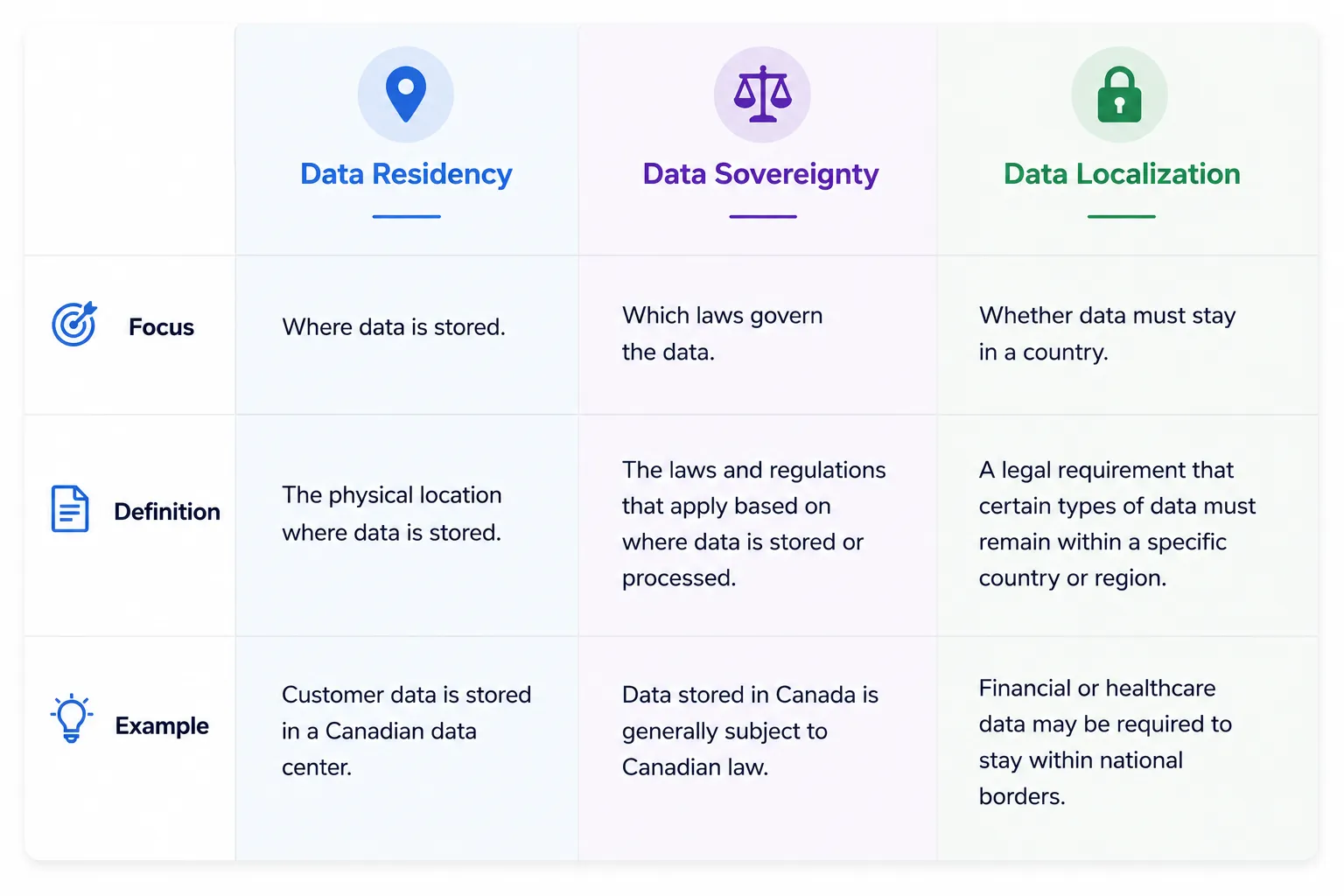
These concepts are closely related, but they are not interchangeable. Storing data in a specific country addresses data residency, but it doesn't automatically satisfy data sovereignty requirements. Organizations must also consider who can access the data, where it is processed, where backups are stored, and which legal jurisdiction governs those activities.
Data sovereignty is becoming a broader infrastructure concern as organizations respond to changing regulations, jurisdictional risk, AI adoption, and growing demand for operational control. The issue is no longer limited to where data is physically stored. Organizations must also consider who controls the infrastructure, which laws apply to the provider, and whether data, backups, or administrative access can cross jurisdictional boundaries.
We examine the legal and infrastructure drivers behind this shift in Why Data Sovereignty Laws Are Forcing a Shift Toward Localized Private Infrastructure. This guide focuses on the practical decisions private cloud teams can make to support their sovereignty requirements.
§3 Infrastructure Decisions That Support Data Sovereignty
Supporting data sovereignty requires more than selecting a cloud provider or deployment location. The technologies that power your infrastructure, how they're deployed, and how they're managed all influence where data resides, who can access it, and which jurisdictions may apply. The following areas should be considered when designing a private cloud that aligns with data sovereignty goals.
Choose a Flexible Deployment Model
Every organization has different operational and regulatory requirements. Some need the control of an on-premises private cloud, while others benefit from a hosted or fully managed environment. Hybrid architectures can also provide the flexibility to keep sensitive workloads in one location while running less regulated applications elsewhere.
VEXXHOST helps organizations design and operate private cloud environments using OpenStack, Kubernetes, and other open-source cloud technologies. With deployment options that include on-premises, hosted, and managed private cloud, teams can choose the model that best aligns with their operational and sovereignty requirements.
Design Storage and Workload Placement Carefully
Data sovereignty extends beyond application data. Storage architecture, backups, snapshots, and disaster recovery strategies all influence where data is stored and whether it crosses jurisdictional boundaries. Ceph can support this by providing a distributed storage layer for block, object, and file data within a private cloud environment, while allowing organizations to retain control over where that data is hosted.
Containerized workloads running on Kubernetes should also be scheduled and managed with data location requirements in mind, particularly when applications rely on persistent storage. Designing Ceph storage, workload placement, replication, and recovery policies around these requirements from the start can help reduce compliance risks while supporting long-term scalability and resilience.
Secure Administrative Access and Platform Operations
Infrastructure control isn't only about data location. Organizations should understand who can administer the platform, how identities are managed, and how privileged actions are audited. Integrating private cloud platforms with existing enterprise identity providers and enforcing role-based access controls can help maintain consistent governance across infrastructure.
Whether managing virtual machines with OpenStack or containerized applications with Kubernetes, operational processes should be designed to provide visibility, accountability, and secure access throughout the platform lifecycle.
Don't Overlook Operational Data
Logs, metrics, monitoring platforms, and telemetry can contain sensitive information and should be considered part of a data sovereignty strategy. Organizations should evaluate where this operational data is collected, stored, and processed, alongside the workloads it supports.
By combining technologies such as OpenStack, Kubernetes, and Ceph into a unified private cloud platform, organizations can maintain greater control over both application and operational data while retaining the flexibility to adapt as business or regulatory requirements evolve.
§4 Why Open Infrastructure Supports Data Sovereignty
Achieving data sovereignty isn't about choosing a single technology. It's about building infrastructure that gives organizations the flexibility to control where workloads run, where data is stored, and how the platform is operated. Open infrastructure provides that flexibility by allowing organizations to deploy, manage, and scale their environments without being tied to proprietary platforms or fixed deployment models.
Technologies such as OpenStack, Kubernetes, and Ceph each play a role in supporting these goals. OpenStack provides the infrastructure foundation for managing compute, networking, and storage resources. Kubernetes enables consistent orchestration of containerized workloads across different environments, while Ceph delivers scalable software-defined storage for block, object, and file services. Together, they allow organizations to build private cloud platforms that can adapt to evolving operational and regulatory requirements.
VEXXHOST builds its private cloud platform on these upstream open-source technologies, helping organizations deploy and operate infrastructure on-premises, in hosted environments, or as a managed cloud service. This approach gives teams the flexibility to maintain greater control over their infrastructure while avoiding unnecessary dependencies on proprietary ecosystems.
§5 Questions to Ask Before Choosing a Private Cloud Platform
Whether you're evaluating a cloud provider or designing your own private cloud, asking the right questions early can help avoid costly changes later. Consider the following:
- Where will my data, backups, and logs be stored?
- Can workloads remain within a specific country or jurisdiction if required?
- Who has administrative access to the infrastructure, and how is that access managed?
- How are disaster recovery and data replication handled across regions?
- Can the platform integrate with existing identity providers such as LDAP, Active Directory, SAML, or OpenID Connect?
- Does the platform rely on proprietary technologies, or is it built on open standards and APIs?
- Can the deployment model evolve as business or regulatory requirements change?
Answering these questions before selecting a platform can help ensure your infrastructure supports both current operational needs and future data sovereignty requirements.
Conclusion
Data sovereignty is about more than where data is stored. It requires thoughtful infrastructure decisions around deployment, storage, access, and operations to ensure organizations maintain control as regulatory and business requirements evolve.
If you're planning a private cloud with data sovereignty in mind, explore VEXXHOST's private cloud solutions or contact our team to discuss how OpenStack, Kubernetes, and Ceph can support your infrastructure goals.