

GPUs
Bare Metal Kubernetes vs. VMs for AI and GPU Workloads
Compare bare-metal Kubernetes and GPU VMs for AI workloads. Learn how hardware access, isolation, provisioning, and operations shape the right architecture.
Read field noteField notes / Latest
Engineering notes from operating open infrastructure: the failures, design decisions, and upstream work that make open infrastructure better.
Browse all field notesCompare bare-metal Kubernetes and GPU VMs for AI workloads. Learn how hardware access, isolation, provisioning, and operations shape the right architecture.
Read field note
Discover why cloud infrastructure costs rise over time and how effective resource management and cost visibility can help control spending.
Read field note
VEXXHOST recaps OpenInfra Day North America 2026 in Chicago, highlighting its headline sponsorship, Mohammed Naser's talks, and the future of OpenStack operations.
Read field note
What a managed cloud SLA's definitions decide: how availability is measured, response and resolution times, severity levels, exclusions, service credit caps and claims, and escalation paths, with one worked outage.
A contract for managed cloud services comes with a service level agreement (SLA): the schedule that says what the provider measures, what it commits to, and what it owes when it misses. A headline figure such as 99.9% availability sits on top of definitions that decide what it is worth.
Those definitions set how availability is measured and over what window, how fast a qualified person responds, which minutes are excluded, and what a missed month pays back in service credits.
Two events this year put those definitions back on the table:
This memo reads each term for how it changes an outage or a payout, runs one hypothetical outage through the exclusions and the credit cap, and ends with the order in which to negotiate. A weak SLA costs twice: a credit that covers a sliver of the loss, and hours of an incident with nobody on the provider's side accountable for moving it forward.
We think response commitments and named escalation paths decide more of an outage's cost than an extra nine.
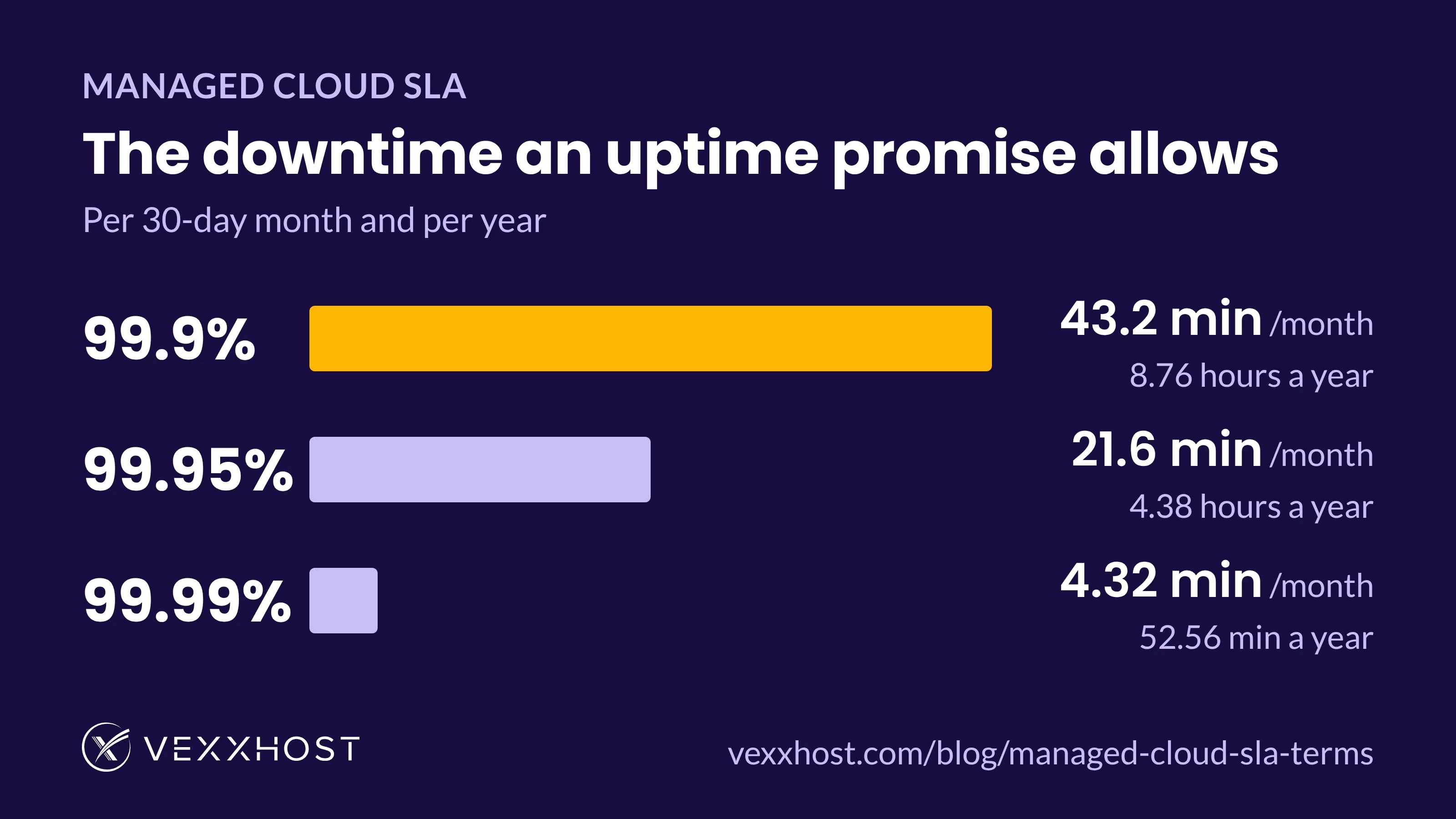
Moving from 99.9% to 99.95% buys back about 22 minutes a month. The October incident above is worth about 40 months of that difference.
The window sets how much of that allowance one month can use.
Two SLAs with the same 99.9% can count one incident very differently.
The SLA should name the source of the availability data: the provider's monitoring, your own synthetic checks, or both, and whether it is the same alerting the on-call engineers work from.
A private cloud runs on two planes: a control plane (the APIs, schedulers and controllers that manage it) and a data plane (the compute, storage and networking your workloads run on).
An SLA measuring only API availability can report a clean month through a storage incident, so ask for the measured components to be named.
Look for the minimum duration before a minute counts, whether degraded performance counts, and whether the target applies per instance or service-wide.
One hyperscaler's compute SLA, last updated May 25, 2022, commits to 99.99% at region level, counted only when all your running instances across two or more availability zones lose external connectivity at the same time. For a single instance, it commits to 99.5%. The figure you are owed depends on how you deploy.
Response time is the time from an alert or ticket to acknowledgement by a qualified engineer. Resolution time is the time until the service is restored. A response commitment on its own ends at acknowledgement, so read whether the SLA says anything about restoration.
For the response commitment, ask:
In a tiered SLA, the fastest response commitment sits at the top severity, so the definitions decide which clock runs.
Atmosphere, our OpenStack distribution, classifies alerts by severity in its monitoring documentation. The levels describe how operators handle alerts and set no contractual response time:
An escalation path names who joins an incident, and when, if service is not restored. Ask for it in the contract or a schedule the provider keeps current:
Each step needs a role, a time trigger and a contact outside the ticket queue. An escalation path is a procedure, and it deserves the same reading as the uptime figure.
Exclusions remove minutes from the count before any credit is calculated.
Rolling upgrades with live migration can keep a window invisible to workloads, so ask how often past windows touched running services.
Expect an exclusion for failures outside the provider's control, such as an upstream carrier, a utility or a third-party service. Ask the provider to list the dependencies it treats as its own, such as its DNS, its storage cluster and its data centre power, so those stay counted.
Watch for clauses that exclude changes you made or configurations you control, and ask whether ignoring a provider recommendation can exclude an incident. Check where the provider's responsibility ends: the cloud infrastructure, or also the guest operating systems and applications running on it. The clause should require evidence, with a joint incident review when the two sides disagree on cause.
A service credit is a percentage of a fee, paid back when availability falls below the target.
The hyperscaler compute SLA cited above shows most of them. Its credits are 10%, 30% and 100% of the affected monthly bill, applied against future payments unless the provider chooses to credit the card used for the affected billing cycle. The claim is due by the end of the second billing cycle and is disqualified if dates, times, resource IDs or logs are missing.
Look for "sole and exclusive remedy" wording too. When the credit is the only remedy, the cap is the most an SLA breach can return to you, so check it against the liability cap in the master agreement.
Ask for credits applied automatically from the provider's own availability reports so the week after an outage goes on the fix.
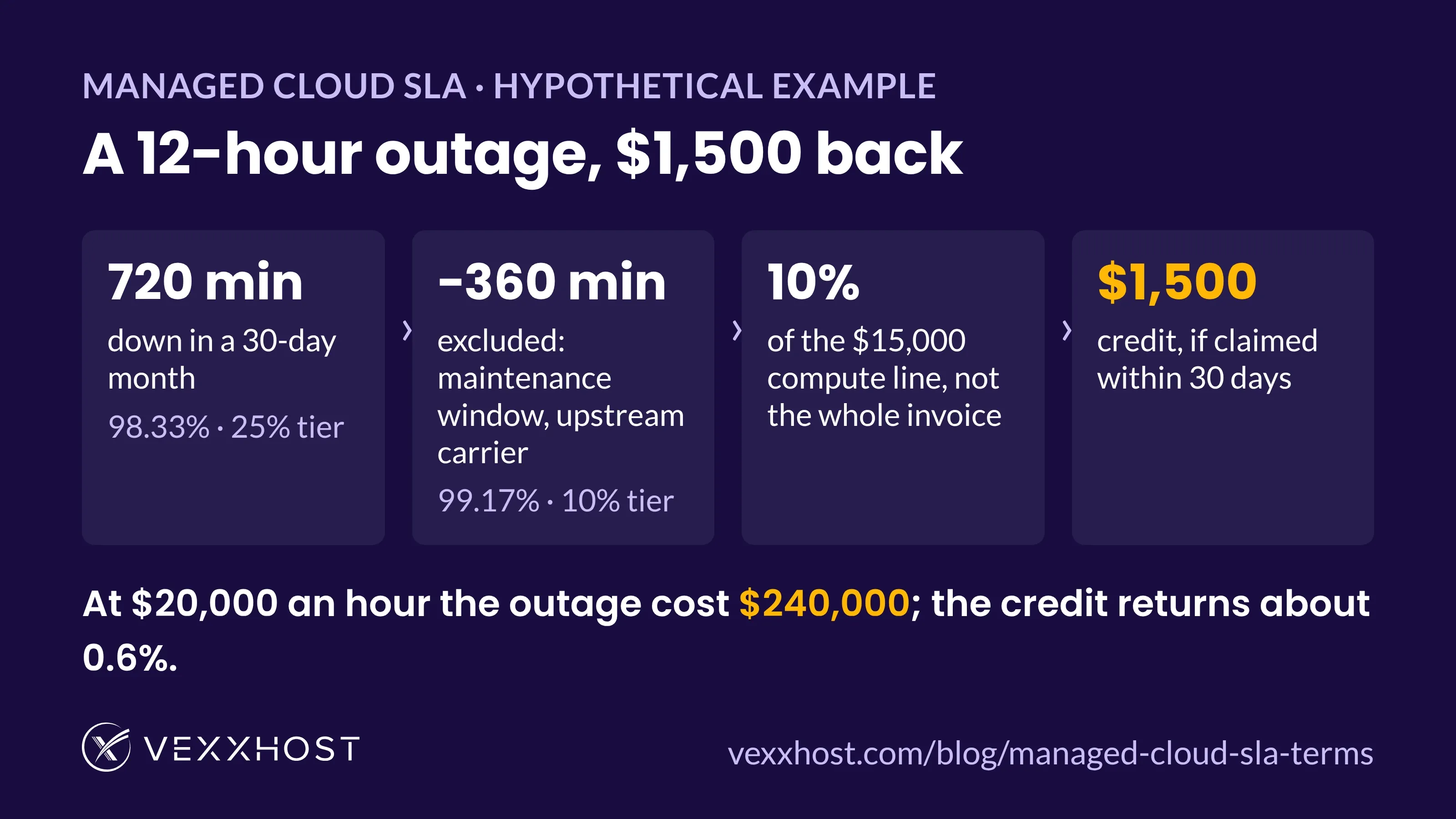
The figures below are a hypothetical example in round numbers. They describe no real provider or customer.
The contract: a managed private cloud at $40,000 a month, of which $15,000 is the compute line. The SLA promises 99.9% monthly availability, with credits of 10% below 99.9%, 25% below 99.0% and 50% below 95.0%, applied to the affected line and capped at 50% of it. Claims are due within 30 days with ticket references.
The incident: a 12-hour outage in a 30-day month, 720 minutes out of 43,200. It started during an announced maintenance window, and part of it traced to an upstream carrier. In this contract, all calendar minutes stay in the denominator, and the two exclusions cover separate minutes.
The cap never bites in this contract: its top tier, 50% below 95.0%, already equals the cap, so $7,500 is the most one billing month can return, however long the outage runs.
No credit term changed how long the outage lasted. In our view, the response clock, the severity call and the escalation path can shorten it. In this example, each hour taken off the outage was worth $20,000 to the business, against a credit that moves only at a tier.
Where credits attach only to availability, as in the compute SLA above, the availability target is the term that puts the provider's money at risk. A higher target with a higher cap then gives the provider a financial reason to build redundancy. A higher target is only as good as the design behind it, so ask separately for the architecture and the failure testing that support it, such as redundant control planes and storage that survives a node loss.
That case holds when:
The argument weakens for stateless workloads already spread across regions, where your own failover decides the outage and the provider's response clock matters less. On standard terms with no room to negotiate, the choice moves to picking the provider whose published definitions already read well.
Negotiate in this order:
Atmosphere's alert classification, from P1 to P5, is public in the project's documentation, including which levels call for action outside business hours, so you can read it before you sign.
Item 2 depends on people being there to escalate to. Our engineering team is spread across time zones for 24/7 coverage, so a critical issue gets urgent attention whenever it occurs, without waiting for a shift to start.
Ask our team how the severity levels, escalation contacts and exclusions in the SLA in front of you would read against your workloads.
Choose from Atmosphere Cloud, Hosted, or On-Premise.
Simplify your cloud operations with our intuitive dashboard.
Run it yourself, tap our expert support, or opt for full remote operations.
Leverage Terraform, Ansible or APIs directly powered by OpenStack & Kubernetes