What Data Sovereignty Means for Kubernetes Infrastructure
Most teams think picking an EU region solves data sovereignty. It doesn't. Learn what sovereign Kubernetes actually requires — and how to get there.

Insights, updates, and stories from our team
Most teams think picking an EU region solves data sovereignty. It doesn't. Learn what sovereign Kubernetes actually requires — and how to get there.

GPUs get the headlines but storage, networking, and scheduling determine real AI performance. Learn what actually matters and how open infrastructure helps.
VEXXHOST's recap of KubeCon Europe 2026 in Amsterdam — key trends in managed Kubernetes, data sovereignty, platform engineering, AI infrastructure, and security.

Private clouds at the edge combine performance, security, and sovereignty, bringing data processing closer to where it happens.
Enterprises are rethinking where their data lives and how quickly they can act on it. From connected hospitals and autonomous factories to financial analytics platforms, organizations are generating more data at the edges of their networks than ever before. Yet, traditional public cloud models—centralized and often distant—struggle to deliver the low latency, sovereignty, and control required for these mission-critical workloads.
To bridge this gap, many are turning to edge private clouds, decentralized environments that extend the principles of private cloud computing directly to the data’s origin. Built on open-source technologies like OpenStack, Kubernetes, and Ceph, these edge-ready clouds combine the agility of cloud with the assurance of local governance.
The result? Real-time performance, compliance by design, and complete ownership of your infrastructure, from core to edge.
The edge is no longer the frontier; it’s becoming the foundation of digital sovereignty.
Data-intensive industries—from healthcare to telecom—require instantaneous processing and absolute trust in data handling. That’s exactly what edge computing delivers. By processing data locally rather than sending it to a distant public cloud, organizations can:
IDC forecasts that by 2026, 75% of enterprise data will be created and processed outside traditional data centers, a shift driven by the need for performance, privacy, and autonomy.
While hyperscalers now offer “edge zones” or “local regions,” they remain extensions of large, shared infrastructures. This setup introduces several limitations for enterprises operating under strict compliance or real-time constraints:
For industries where milliseconds matter or regulatory boundaries are non-negotiable, the public cloud model often becomes a bottleneck.
That’s where private clouds, deployed at the edge, come in: offering enterprise-grade isolation, compliance alignment, and local autonomy without losing the elasticity of cloud operations.
Edge private clouds extend the principles of centralized private clouds into distributed locations—branch offices, manufacturing floors, hospitals, research centers, or telco sites. Each node operates semi-autonomously but remains centrally managed through APIs and orchestration layers.
Key architectural benefits include:
For example, a healthcare provider can run patient imaging analysis on a local private cloud node, maintaining compliance under HIPAA, while syncing only anonymized insights to the central research cloud.
This architecture creates a continuum of control, from centralized oversight to distributed agility, allowing enterprises to scale securely and confidently.
The rise of edge private clouds is closely tied to open-source innovation. Proprietary ecosystems often limit flexibility and drive up licensing costs, while open infrastructure solutions enable modular, vendor-neutral deployments.
This stack offers interoperability and transparency—two critical factors for regulated industries. Organizations gain full control over their infrastructure while avoiding the lock-in and complexity of proprietary “edge clouds.”
With OpenStack and Kubernetes, the edge becomes an extension of your private cloud, not a separate island.
Edge private clouds are already reshaping operations across several key sectors:
These use cases all share one theme: edge private clouds unite proximity, performance, and policy enforcement, empowering industries that can’t afford compromise.
Learn more about how OpenStack meets modern business needs, use cases, and applications.
Implementing distributed private clouds introduces complexity, but modern tools and frameworks help mitigate these challenges:
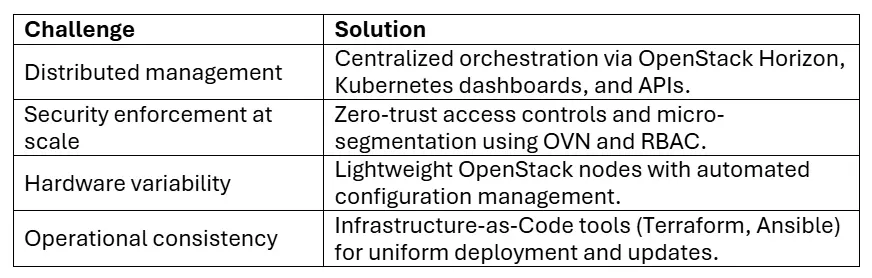
By combining automation with open standards, organizations can manage hundreds of edge sites as easily as a single centralized data center.
Atmosphere brings these edge capabilities to life by extending OpenStack and Kubernetes orchestration into distributed environments.
With multi-site management, Ceph-based storage replication, and network automation, Atmosphere allows enterprises to:
For AI or IoT-heavy workloads, Atmosphere supports GPU-accelerated nodes, SR-IOV networking, and container-native operations, ensuring consistent performance across diverse hardware footprints.
This unified control layer bridges the gap between central and remote environments—delivering cloud agility wherever your data resides.
The fusion of edge computing and private cloud is redefining how enterprises operate in a data-driven world. By processing information where it’s created, organizations gain agility, resilience, and sovereignty, all without losing the flexibility of the cloud.
Atmosphere makes this evolution seamless, extending open-source innovation to every edge location while ensuring consistent security, performance, and governance.
The future of cloud isn’t just centralized, it’s everywhere your data is.
Ready to bring your cloud closer to where your data lives?
Book a call now to explore how open-source private clouds can help you build a secure, edge-ready future with Atmosphere.
Choose from Atmosphere Cloud, Hosted, or On-Premise.
Simplify your cloud operations with our intuitive dashboard.
Run it yourself, tap our expert support, or opt for full remote operations.
Leverage Terraform, Ansible or APIs directly powered by OpenStack & Kubernetes