Learn the differences between data residency, data sovereignty, and data localization, and how they affect cloud compliance and private cloud strategy.
TL;DR Data residency, data sovereignty, and data localization are often confused, but they address different aspects of cloud compliance. Data residency determines where data is stored, data sovereignty determines which laws govern it, and data localization defines whether data is legally required to remain within a specific jurisdiction. Understanding these differences helps organizations choose the right cloud architecture, reduce compliance risk, and meet regulatory requirements.
The terms data residency, data sovereignty, and data localization are often used interchangeably, but they describe different legal and operational requirements. While they are closely related, each addresses a different aspect of how data is stored, governed, and protected. Understanding these distinctions is essential for organizations operating across multiple jurisdictions or handling regulated data.
These considerations are becoming increasingly important. A 2026 survey of more than 500 organizations found that 80.1% already store their data locally, while only 11.7% are comfortable storing organizational data outside their country or continent, reflecting the growing importance of data residency and sovereignty in cloud strategy.
Whether you're deploying workloads in a public cloud or a private cloud, these considerations influence infrastructure design, vendor selection, and regulatory compliance. VEXXHOST’s Atmosphere helps organizations address these challenges by providing a fully managed OpenStack platform that can be deployed in regional environments, giving customers greater control over where data is hosted while supporting compliance and governance requirements.
In this blog, we'll explain the differences between data residency, data sovereignty, and data localization, and discuss how each affects cloud deployments and compliance strategies.
§1 What Is Data Sovereignty?
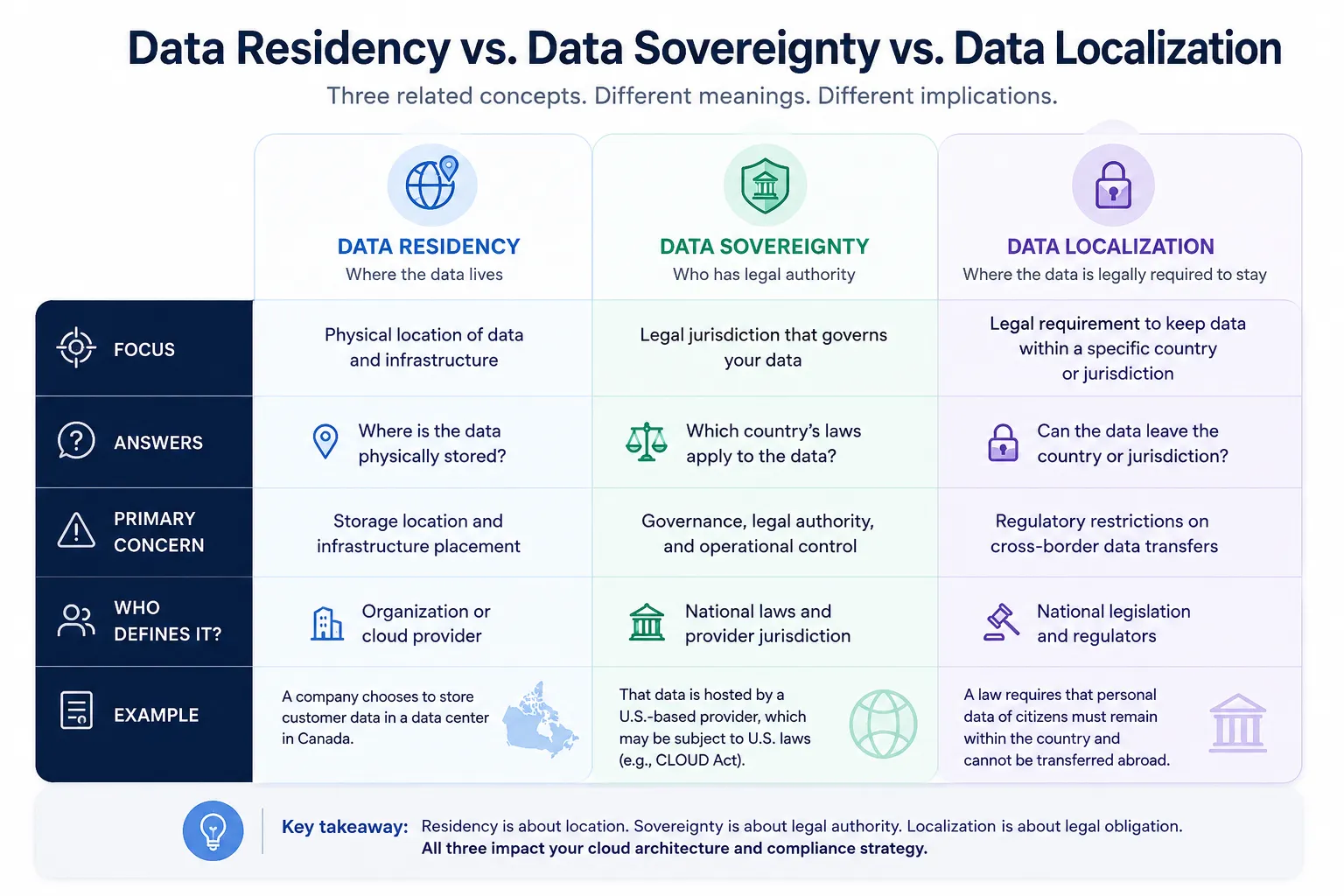
Data sovereignty refers to the legal jurisdiction that governs your data, regardless of where it is physically stored. While data residency answers where data resides, data sovereignty determines which country's laws apply to that data and who may have legal authority to access it.
For example, an organization may store customer data in a Canadian or European data center, but if the cloud provider is headquartered in another country, that provider could still be subject to laws that permit government access under certain circumstances. As a result, choosing a cloud region alone may not satisfy sovereignty requirements. Organizations must also consider provider ownership, operational control, administrative access, and where encryption keys are managed.
This distinction is becoming increasingly important as regulations such as the EU Data Act, NIS2, and DORA place greater emphasis on operational control, portability, auditability, and governance, not just where data is stored. Modern cloud architectures are therefore evaluated on their ability to demonstrate jurisdictional control across the entire platform, including the control plane and supporting services.
For a deeper look at how sovereignty requirements are shaping modern cloud-native platforms, read our CNCF article, How Data Sovereignty Is Changing Cloud Native Infrastructure Design, which explores why operational control, portability, and platform architecture are becoming just as important as data location.
§2 What Is Data Residency?
Data residency refers to the physical location where data is stored and processed. In cloud environments, this is typically determined by the country or geographic region where the underlying data centers, servers, or storage infrastructure are located. Organizations often choose a specific region based on regulatory requirements, customer expectations, business continuity, or latency considerations.
For example, a Canadian organization may choose to store customer data in a Canadian data center, while a business operating across the European Union may deploy workloads in an EU region to support GDPR obligations. It's also important to consider more than production workloads, backups, disaster recovery environments, and replicated storage should all align with your organization's data residency requirements.
However, data residency does not determine which laws govern your data. Storing data in a particular country answers where the data resides, but it does not necessarily determine which jurisdiction has legal authority over it. That distinction belongs to data sovereignty, which we'll cover in the next section.
Organizations with strict residency requirements often choose private cloud infrastructure because it provides greater control over where workloads are deployed and where data is stored. VEXXHOST enables organizations to deploy OpenStack in regional environments, helping align cloud infrastructure with data residency requirements while maintaining operational flexibility.
§3 What Is Data Localization?
Data localization is a legal or regulatory requirement that mandates certain types of data be stored, processed, or remain within a specific country or jurisdiction. Unlike data residency, which refers to where data is stored by choice or operational need, data localization is typically imposed by law and may prohibit or restrict cross-border data transfers.
Data localization requirements vary by country and industry. Some jurisdictions require all personal or sensitive data to remain within national borders, while others permit international transfers if specific safeguards or agreements are in place. As a result, organizations operating globally often need to evaluate each country's regulations before selecting a cloud provider or deployment model.
For cloud environments, meeting data localization requirements often means more than choosing an in-country data center. Organizations must also consider where backups are stored, where disaster recovery workloads are hosted, and whether managed services or support personnel can access data from outside the jurisdiction. These factors all play a role in demonstrating compliance during an audit.
§4 Why It Matters for Cloud Compliance
Understanding the differences between data residency, data sovereignty, and data localization is essential for designing a compliant cloud environment. Regulations such as GDPR, HIPAA, PCI DSS, and industry-specific frameworks may impose requirements on where data is stored, how it is processed, and who has legal authority over it. Failing to account for these distinctions can result in compliance gaps, increased operational risk, or unexpected legal obligations.
Cloud adoption has made these considerations more complex. Workloads, backups, disaster recovery environments, and managed services may span multiple regions or jurisdictions, making it difficult to determine where data resides and which laws apply. Organizations must therefore evaluate not only the physical location of their data, but also the legal jurisdiction of their cloud provider and any restrictions on cross-border data transfers.
For many organizations, meeting compliance requirements begins with selecting a cloud architecture that provides visibility and control over data location and governance. Private cloud deployments can offer greater flexibility in determining where data is hosted, how infrastructure is managed, and how compliance controls are implemented.
To better understand how cloud providers and customers share compliance responsibilities, read our guide Who Is Responsible for Cloud Compliance? Understanding the Shared Responsibility Model. You can also use our Private Cloud Compliance Checklist (2026 Edition) to review the technical and operational controls that support audit readiness.
§5 How Private Cloud Helps Meet Residency and Sovereignty Requirements
Choosing the right cloud deployment model can make it easier to meet data residency and sovereignty requirements. While public cloud providers offer regional deployments, organizations may have limited visibility into where supporting services operate, how data moves between regions, or which jurisdictions may have legal authority over the infrastructure. Private cloud environments provide greater control over these decisions, making them a common choice for organizations in regulated industries.
A private cloud allows organizations to determine where workloads are deployed, where data is stored, and how infrastructure is managed. It also provides greater control over administrative access, networking, encryption, and operational policies—all of which contribute to a stronger governance and compliance posture. This level of control is particularly valuable when organizations need to demonstrate compliance during audits or meet contractual and regulatory requirements.
VEXXHOST helps organizations address these challenges by providing a fully managed OpenStack platform that can be deployed in regional environments. Customers retain control over where their workloads and data are hosted while benefiting from managed operations, integrated Kubernetes, and day-two platform management. This enables organizations to align their cloud infrastructure with residency and sovereignty requirements without taking on the operational burden of managing the underlying platform.
Remember: A private cloud does not automatically guarantee compliance with data residency or sovereignty requirements. Organizations must still understand the regulations that apply to their data, configure their environments appropriately, and implement the necessary governance, security, and operational controls.
§6 Common Misconceptions About Data Residency, Sovereignty, and Localization
Because these concepts overlap, organizations often make assumptions that can lead to compliance gaps or poor infrastructure decisions.
- “Data residency and data sovereignty mean the same thing.”
They do not. Residency refers to where data is physically stored, while sovereignty refers to the legal jurisdiction that governs it. - “If my data is stored in Canada or the EU, only local laws apply.”
Not necessarily. The jurisdiction of the cloud provider, administrative access, contractual arrangements, and applicable foreign laws may also matter. - “Encryption solves data sovereignty concerns.”
Encryption is an important security control, but it does not remove legal or regulatory obligations related to jurisdiction, government access, or cross-border transfers. - “Choosing the right cloud region is enough.”
Organizations should also consider backups, disaster recovery environments, support access, replication, metadata, and managed services that may operate outside the selected region. - “Private cloud automatically guarantees compliance.”
Private cloud can provide greater control over infrastructure location, access, and operations, but compliance still depends on configuration, governance, policies, and the regulations that apply to the organization.
A useful way to evaluate these issues is to look beyond where the primary workload runs and consider the entire data lifecycle, including storage, access, replication, backup, recovery, and deletion.
Conclusion
Data residency, data sovereignty, and data localization are closely related, but they address different aspects of data governance. Understanding the distinction between where data is stored, which laws apply to it, and whether it can cross borders is essential for designing a compliant cloud environment.
As organizations continue to adopt cloud-native infrastructure, these considerations are becoming increasingly important for regulatory compliance, risk management, and customer trust. Selecting the right deployment model, understanding your provider's responsibilities, and implementing appropriate governance controls can help reduce compliance risks while supporting business objectives.
For organizations with strict regulatory or operational requirements, VEXXHOST Atmosphere provides a fully managed OpenStack platform that gives customers greater control over where workloads are deployed, how infrastructure is managed, and how cloud environments align with residency and sovereignty requirements.
Looking to build a compliant private cloud? Explore Atmosphere or contact the VEXXHOST team to discuss your data residency, sovereignty, and compliance requirements.