
OpenStack
Air gapped cloud upgrades with Atmosphere release manifests
Air gapped cloud on OpenStack: how Atmosphere's digest-pinned release manifests move a release across the boundary, and what the manifest leaves out.
Read field noteField notes / Latest
Engineering notes from operating open infrastructure: the failures, design decisions, and upstream work that make open infrastructure better.
Browse all field notesAir gapped cloud on OpenStack: how Atmosphere's digest-pinned release manifests move a release across the boundary, and what the manifest leaves out.
Read field note
Learn when your team needs OpenStack consulting services and how expert support can help with deployments, migrations, upgrades, and operations.
Read field note
Assess enterprise AI readiness before investing in GPUs. Explore 12 key factors covering data, models, infrastructure, governance, operations, and costs.
Read field note
Ceph Squid reaches its target end of life on October 31, 2026. The three options for a production cluster, where each one fails, and what to decide this month.
If your OpenStack cloud keeps its volumes, images and object data on Ceph, and that Ceph cluster runs Squid, you have a date to plan around. The Ceph project has set October 31, 2026 as the target date for Squid's end of life. After that, the bug and security fixes that kept arriving in Squid's point releases stop.
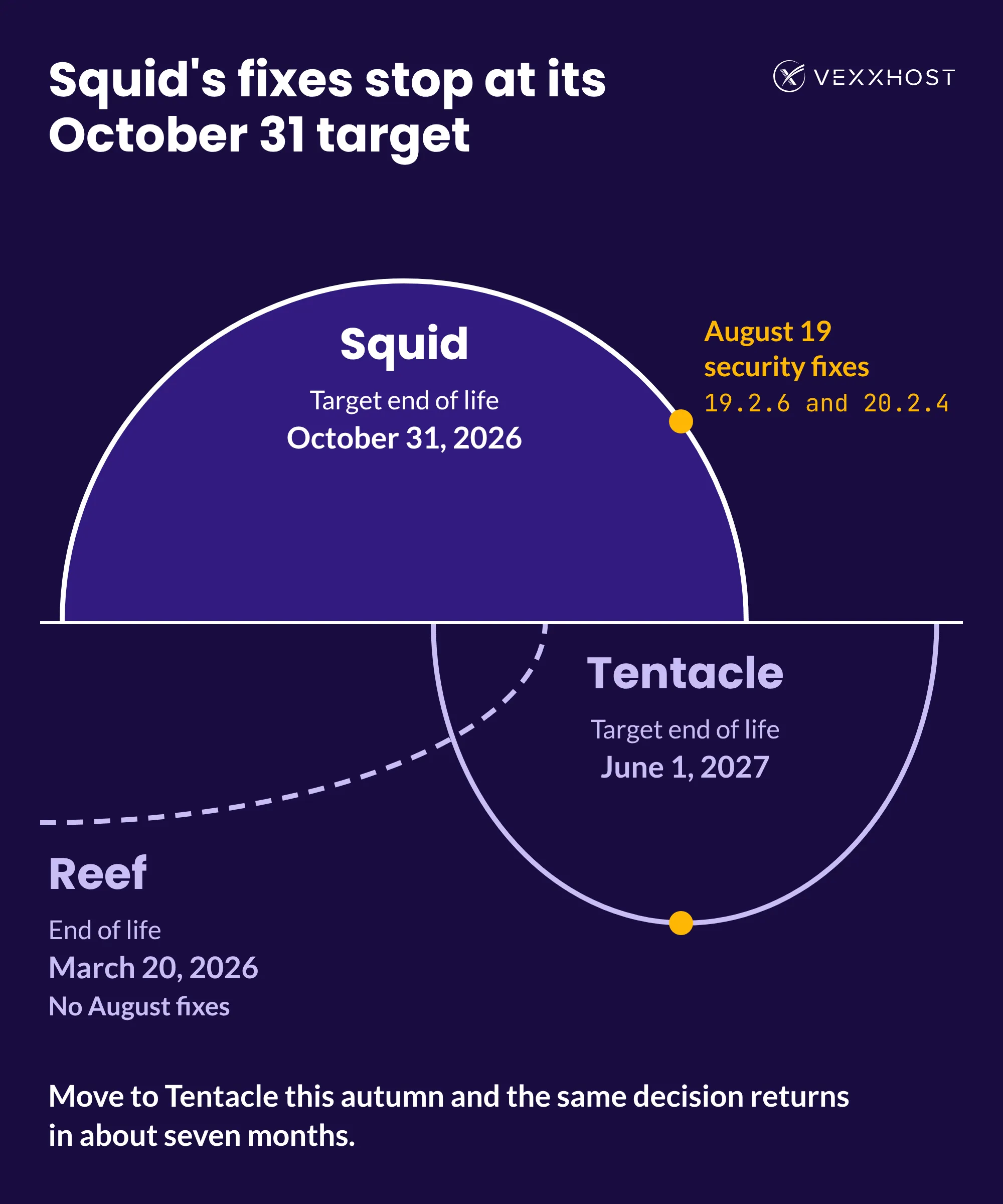
Those fixes have mattered this year. In August, Squid 19.2.6 closed four security flaws, one of them a way around CephX, the protocol Ceph uses to authenticate the clients and services that talk to your storage. A cluster still on Squid in November would get no fix for the next flaw like it.
Upgrading to Tentacle, the release that followed in November 2025, is the natural answer. A major Ceph upgrade has a point after which you can't roll back, though, and a rushed one puts every workload on the cloud at risk.
So if you run infrastructure or own the platform budget, you have a decision to make this month. Your own team can upgrade, you can keep Squid running past its end of life for a set period, or you can hand the work to a support contract or a managed service. This memo looks at what each option costs and where it breaks, so you can pick one, give it an owner and set a date before October 31.
Ceph's release index sorts releases as active or archived. Active releases get periodic backports and security fixes. Archived releases get no bug fixes or backports. A stable series is planned to last about 24 months from its first release, with a point release every four to six weeks while it is active. Squid's run, from 19.2.0 on September 26, 2024 to the October 31 target, is just over 25 months. Its 2026 point releases came on June 1, July 14 and August 19.
Reef shows what end of life looks like for a running cluster. Reef, the 18.2 series, reached end of life on March 20, 2026, the day its last point release, 18.2.8, shipped. The August 19 security fixes went out as Squid 19.2.6 and Tentacle 20.2.4, and no Reef release carried them. Clusters still on Reef are already where Squid clusters will be once Squid reaches end of life.
Tentacle's own target end of life is June 1, 2027. A team that moves to Tentacle this autumn faces the same decision again in about seven months.
No. The Tentacle release notes say that cancelling an upgrade only stops it, and that there is no way to downgrade back to Reef or Squid. Once the upgrade starts, the only way out is forward, so preparation decides the outcome.
Here is what the upgrade asks of your engineers:
Three more items belong in your plan. The Squid 19.2.6 and Tentacle 20.2.4 notes ask operators to review specific upgrade steps for three of the August security fixes. Ceph's notes for one of those fixes say object storage replicated across sites (multisite) needs a gateway setting changed before the upgrade and changed back afterwards, because the new signature checks reject some of the gateway's own replication requests. Rook's upgrade guide marks Tentacle 20.2.0 as not recommended, because of a data corruption issue when read affinity is enabled.
This option is strongest when your engineers already run the cluster and have staging hardware to rehearse on. Tentacle has had four point releases since its first release in November 2025, the latest on August 19, so you would adopt a release first shipped more than ten months ago. It also gives your engineers a skill they will need again before June 2027. A healthy cluster under cephadm or Rook, serving block storage only, is the easiest case.
This option goes wrong when your engineers have never done a major Ceph upgrade and their first one is on production, with no way back. Some clusters need work first. Health problems have to be fixed before the upgrade can start, and Ceph's upgrade notes add steps for CephFS with several active metadata servers and for object storage replicated across sites. An OpenStack upgrade or hardware refresh in the same quarter puts two risky changes on the same few people.
Budget for the engineering work: a staging rehearsal, clearing health warnings, the upgrade window, closer monitoring afterwards, and the same project again before Tentacle's end of life. If you keep the upgrade in-house and want a second set of eyes, we can support your engineers directly while they keep running the cluster: our Ceph engineers help plan the upgrade and troubleshoot it with them.
The case for staying is stronger than it looks. Squid 19.2.6 is recent and includes the August security fixes, and nothing stops working on November 1. Installing 19.2.6 is only part of that work: the CephX fix adds a new key type, and Ceph's notes describe a procedure for rotating existing keys to it. Finish that rotation before you count on staying. If a hardware refresh, a data center move or an OpenStack upgrade is already booked for early 2027, upgrading Ceph now can mean two large storage changes within a few months.
This option breaks down at the next advisory. Once Squid is archived, new fixes ship only for active releases, as Reef showed in August. If you backport patches and build your own packages, you are maintaining a private build of Ceph. A bug you hit after end of life that needs a code fix will also be fixed only in newer releases.
This option needs an end date to work. Pick the month the cluster leaves Squid, and until then, check each new Ceph security advisory against how your cluster is exposed. An object gateway reachable from the internet, for example, shortens the time you can safely wait. If the wait runs into 2027, confirm which releases accept a direct upgrade from Squid at that point, since Ceph supports jumps from the last two stable releases.
Outside help comes in two forms. A support contract gives your engineers someone to call, from a vendor-supported Ceph distribution or a consultancy. A managed service operates the cluster for you, upgrades included.
Experience is the reason to do it. Your engineers run a major Ceph upgrade every year or two. A team that runs them across many clusters has seen more of the ways they fail.
Outside help has limits too. A support contract does not move your cluster off Squid. Someone still has to run the upgrade, and the contract decides who answers when it goes wrong. A vendor distribution on a separate support lifecycle may mean moving onto that distribution first. A managed service needs onboarding time for access, monitoring and the cluster's history, so if it starts in late October, the provider's first job may be your upgrade. The wider trade-offs are in managed and self-managed on-premise cloud compared.
We offer both forms for Ceph. Under a fully managed contract, the Ceph cluster sits on our hardware or yours, and our engineers own its deployments, upgrades and incidents 24/7. Our engineers have run production Ceph since the Hammer release in 2015. If you are comparing a managed or supported upgrade with doing it yourself, you can ask one of our storage engineers how the upgrade would run on your cluster before you commit to a date.
Match your situation to one option:
Clusters still on Reef can skip the second option. They are already past end of life, and Ceph supports a direct upgrade from Reef to Tentacle. On Rook, check the operator first: Rook's v1.20 guide lists Squid and Tentacle as supported, and Reef is not on that list.
Two things would change the call. An advisory that affects how your cluster is exposed turns a planned wait into an upgrade as soon as it is rehearsed. A failed staging rehearsal moves an in-house plan toward outside help.
Make the decision this month. By October 31, your storage plan should name an owner and the date the cluster leaves Squid. If that date is after October 31, the plan should also name who reads each Ceph security advisory until then and which advisory would bring the upgrade forward.
Choose from Atmosphere Cloud, Hosted, or On-Premise.
Simplify your cloud operations with our intuitive dashboard.
Run it yourself, tap our expert support, or opt for full remote operations.
Leverage Terraform, Ansible or APIs directly powered by OpenStack & Kubernetes