

Kubernetes
Private Cloud as a Service: PCaaS vs. Building Your Own
Learn when Private Cloud as a Service (PCaaS) makes sense. Compare managed private cloud, self-built infrastructure, costs, operations, and provider options.
Read field noteField notes / Latest
Engineering notes from operating open infrastructure: the failures, design decisions, and upstream work that make open infrastructure better.
Browse all field notesLearn when Private Cloud as a Service (PCaaS) makes sense. Compare managed private cloud, self-built infrastructure, costs, operations, and provider options.
Read field note
Learn the difference between Canadian sovereign cloud and data residency, including jurisdiction, infrastructure control, provider ownership, private cloud, and OpenStack.
Read field note
Evaluate OpenStack as a VMware alternative, including networking, storage, hardware reuse, migration methods, downtime, workload waves, and Day 2 operations.
Read field note
Training and inference have fundamentally different infrastructure needs. Learn what your Kubernetes platform must handle for GPU scheduling, storage, networking, and autoscaling across the full MLOps lifecycle.
Most conversations about AI infrastructure start with GPUs. How many you need. Which generation. What your cluster looks like. But the harder infrastructure problem isn't the accelerators themselves — it's what happens around them.
The heaviest AI workloads on Kubernetes will be the machine learning operations (MLOps) platforms, demanding the coordination of bursty, resource-intensive Jobs (data processing and training) with high-volume, continuously running Services (real-time inference). These two workload types have fundamentally different infrastructure profiles. They compete for the same physical resources. And most Kubernetes environments aren't designed to handle both well.
The infrastructure around those GPUs isn't designed to use them efficiently. The real bottleneck in AI infrastructure isn't always GPU supply. Often, it's GPU utilization.
If you're building — or planning to build — an MLOps platform on Kubernetes, this post breaks down the infrastructure requirements for training and inference separately, explains where they diverge, and covers what your platform needs to get right so neither workload starves the other.
Training is the phase that builds your model. It's compute-heavy, data-hungry, and typically runs as a Kubernetes Job — a finite workload that consumes massive resources for hours, days, or weeks, then releases them.
Here's what training workloads demand from your infrastructure:
AI training jobs often require massive scale, needing to coordinate thousands of specialized hardware like GPUs and TPUs. Reliability is critical, as failures can be costly for long-running, large-scale training jobs.
Training doesn't just need GPUs — it needs groups of GPUs scheduled together on the same set of nodes, at the same time. This is gang scheduling. A distributed training job that requests 8 GPUs across 4 nodes is useless if only 6 GPUs are available. The job can't partially start. It either gets everything it needs, or it waits.
Standard Kubernetes schedulers don't handle this natively. You need tools like Kueue for job queueing and priority-based scheduling, or the JobSet API for coordinating co-scheduled, interdependent groups of Pods. Google has been instrumental in developing features like JobSet within the Kubernetes community (SIG Apps). This provides robust orchestration for co-scheduled, interdependent groups of Pods.
The training-inference gap is widening: training demands 800G+ interconnects while inference runs on commodity Ethernet. Distributed training is dominated by east-west traffic — gradient synchronization between GPUs across nodes. Every communication round is a synchronization barrier. If one node is slow, every node waits.
This means:
Training clusters centralize in single locations to minimize network latency. You don't distribute training geographically. You build dense, tightly connected clusters and keep everything as close together as physics allows.
If you're running Atmosphere on-premise, this is where the underlying OpenStack networking layer matters. Atmosphere's robust networking service offers virtual routers, full network topology building, and supports high-performance options and off-loading for up to native 100Gbps speeds.
Training workloads read terabytes of data. They write checkpoints — full model state snapshots — at regular intervals so a job can resume if a node fails after running for 72 hours. Your storage layer needs to handle both patterns:
AI workloads are storage intensive. Datasets, checkpoints, embeddings, model artifacts — they all require high-performance storage. Ceph remains one of the strongest open-source answers here, especially when integrated into OpenStack and Kubernetes environments.
Training infrastructure consumes millions of dollars over months to create a model. A single GPT-4 training run costs $100 million and requires 25,000 A100 GPUs running for 90 days. At that scale, hardware failures aren't edge cases — they're expected. A training platform needs:
Training uses specialized schedulers like Slurm or Ray for gang scheduling across hundreds of nodes. Job preemption and checkpointing enable efficient cluster sharing.
Training is not a steady-state workload. A team might submit a job that consumes 64 GPUs for a week, then nothing for three weeks. Then four jobs in a single day. The infrastructure needs to handle this without leaving expensive accelerators idle between runs.
This is where node pool autoscaling, scale-to-zero worker pools, and priority-based queue management become essential. Without them, a 30 percent utilization rate on a $100 million GPU investment means $70 million is sitting idle.
Inference is the phase that serves your model. It takes incoming requests — a text prompt, an image, a sensor reading — and returns predictions. Unlike training, inference runs as a Kubernetes Service (typically a Deployment behind a Service and Ingress): a long-lived, continuously available workload that must respond in real time.
The infrastructure requirements are fundamentally different.
Where training optimizes for throughput (process as much data as possible per hour), inference optimizes for latency (respond to each request as fast as possible).
As AI models grow beyond 70B parameters and up, serving a single inference may require multiple GPUs working in concert, with high-speed backend links shuttling data between them. Unlike training's all-to-all synchronization, large-model inference often involves pipeline-oriented communication: sequential, latency-sensitive, and highly variable depending on the model's architecture.
For production inference, your platform needs:
Training typically requires full GPU allocation. Inference is different — many inference workloads don't saturate a full GPU, which means you waste expensive capacity with one-GPU-per-model allocation.
NVIDIA's MIG technology lets you slice a single A100 or H100 into isolated partitions, each running a different model. Time-slicing offers another option for workloads that can tolerate shared access. Getting GPU sharing right at the Kubernetes level — through device plugins, resource quotas, and scheduling constraints — is one of the most impactful things you can do for inference cost efficiency.
Inference deployments distribute globally across 20-50 points of presence. Edge inference pushes models to 5G base stations or CDN nodes for sub-10ms latency. This distribution requires sophisticated model synchronization and version management.
While training centralizes, inference distributes. Users are everywhere, and latency is a function of distance. Production inference often requires model serving across multiple regions with consistent versioning, canary rollouts, and traffic-aware load balancing.
Training jobs can tolerate a restart. Inference endpoints cannot — if your model serving layer goes down, user-facing applications break. This means rolling updates with readiness probes that verify model loading before traffic routing, liveness probes for stuck processes, PodDisruptionBudgets to maintain replica counts during maintenance, and service mesh integration for canary releases and observability.
The real infrastructure challenge isn't running training or inference in isolation. It's running both on the same Kubernetes platform, which is exactly what an MLOps platform demands.
Kubernetes gives teams a common control plane to schedule, scale, and govern these AI components side by side, instead of running training and inference on disconnected stacks.
The preference for unified clusters with node-level separation challenges conventional wisdom about workload isolation. The community appears to favor consolidation with proper orchestration over complete separation.
Running separate clusters for training and inference sounds clean on a whiteboard. In practice, it doubles your operational surface area: two sets of monitoring, two upgrade paths, two security postures, two autoscaling configurations.
The better approach: unified clusters with strong workload isolation.
Training workloads and inference workloads behave very differently: best practice is to build separate infrastructure paths for each. On an open infrastructure platform, OpenStack makes this easier by enabling distinct instance flavors, storage tiers, and network segmentation.
Both workloads touch the same data — but differently. Training reads datasets and writes checkpoints. Inference reads model artifacts and writes logs. Your storage architecture needs to serve both:
With Atmosphere's integrated Ceph storage, both block and object storage tiers are available natively through CSI drivers in Kubernetes — Kubernetes GPU workloads can access persistent data through native CSI drivers, making it easier to handle large datasets in production environments.
Training monitoring focuses on loss curves, gradient statistics, and hardware utilization. Weights & Biases or MLflow track experiments across hundreds of training runs. Inference monitoring emphasizes latency percentiles, error rates, and capacity metrics.
You need unified observability — a single Prometheus stack collecting GPU metrics (via NVIDIA DCGM exporter), Kubernetes resource usage, and application-level signals — but with workload-specific dashboards and alerting rules. Training alerts on stalled jobs and degraded GPU memory. Inference alerts on latency spikes and scaling failures.
Atmosphere ships with Prometheus monitoring, Grafana dashboards, log aggregation, and vulnerability scanning by default. That integrated observability layer matters when you're running both training and inference and need a single pane of glass to understand what's happening.
Kubernetes is the orchestration layer. But Kubernetes itself runs on infrastructure — compute, storage, networking, identity. The quality of that foundation determines whether your MLOps platform actually works at scale.
GPUs get the headlines but storage, networking, and scheduling determine real AI performance.
Here's the summary matrix:
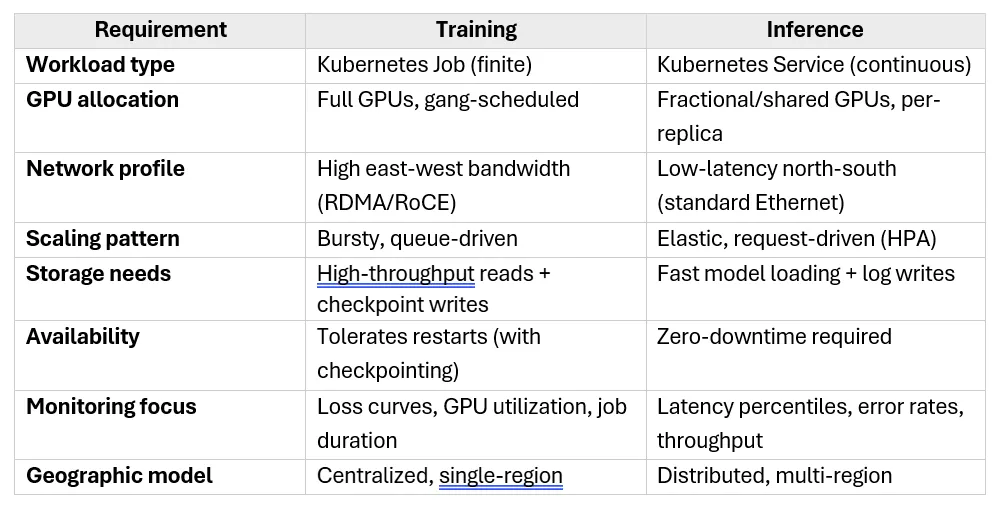
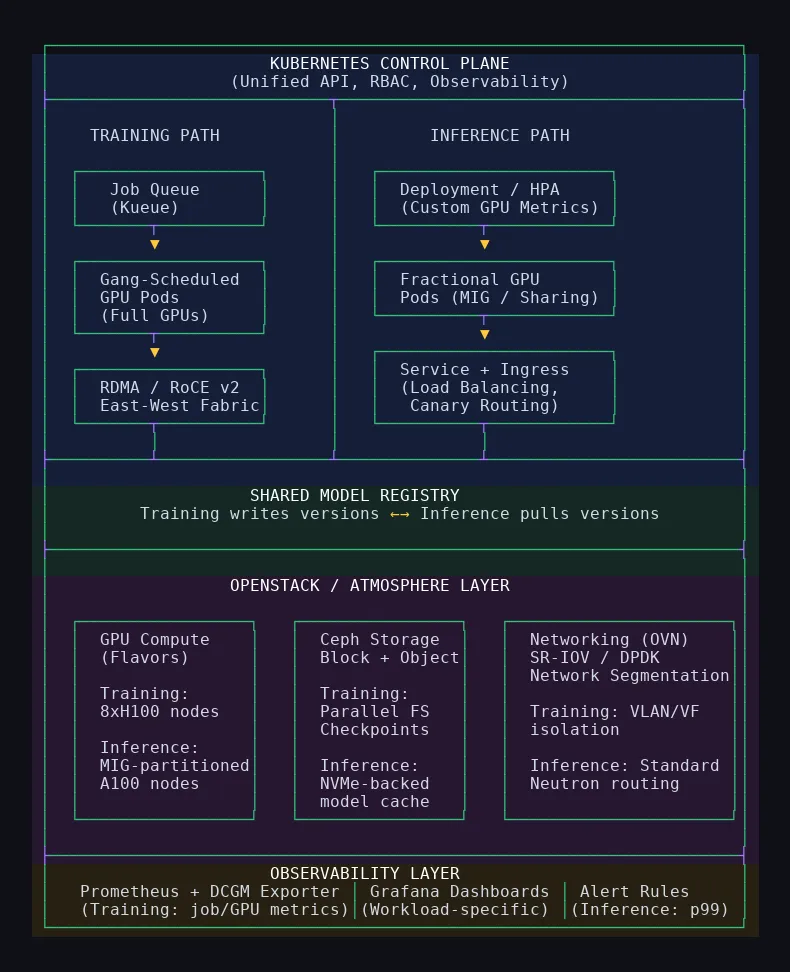
Figure 1: Training and inference follow separate infrastructure paths — different GPU allocation, networking, and storage profiles — but converge through a shared model registry and a unified Kubernetes control plane, all running on the Atmosphere OpenStack layer.
Inference workloads will account for roughly two-thirds of all AI compute in 2026. Industry reports indicate that inference can account for 80% to 90% of the lifetime cost of a production AI system because it runs continuously.
At that cost profile, infrastructure decisions compound. Proprietary lock-in on the compute layer, opaque storage pricing, unpredictable egress fees — these aren't minor annoyances. They're structural risks to AI programs that run for years.
Enterprises realized that keeping AI workloads in public cloud was no longer financially viable at scale. This led to a significant shift toward private, dedicated GPU infrastructure configured for AI/ML workloads.
This is why the foundation matters as much as the orchestrator. An open, auditable infrastructure layer — where you control compute scheduling, storage tiering, network segmentation, and identity — gives you the ability to tune each layer for the specific workload running on it.
Deploy GPU clusters on any cloud or on-premise in your data center — with consistent APIs and management whether you run NVIDIA A100s, H100s, or AMD MI300X. That flexibility is what allows you to build training and inference paths that are optimized independently but managed through a single platform.
100% upstream Kubernetes with GPU operator support. No proprietary forks, full compatibility with your existing ML tools.
The gap between a model that works in a notebook and a model that runs in production is almost entirely an infrastructure problem. Only 54% of AI projects reach production. The bottleneck is infrastructure, not models.
Training and inference aren't two separate problems. They're two halves of the same MLOps lifecycle, and they need a platform that handles both — with the right scheduling primitives, the right storage tiers, the right network architecture, and the right observability layer.
If you're evaluating how to build that platform — or trying to figure out why the one you have isn't scaling — let's talk. Our engineers have deployed GPU clusters for AI companies, debug CUDA issues at 3 AM, and understand what it takes to run training and inference side by side on open infrastructure. Our team has deployed GPU clusters for leading AI companies. We understand CUDA, driver management, and GPU scheduling at a deep level.
Choose from Atmosphere Cloud, Hosted, or On-Premise.
Simplify your cloud operations with our intuitive dashboard.
Run it yourself, tap our expert support, or opt for full remote operations.
Leverage Terraform, Ansible or APIs directly powered by OpenStack & Kubernetes