

OpenStack
Why Infrastructure Documentation Is Never Really Finished
Learn why infrastructure documentation becomes outdated, the operational risks it creates, and how automation helps keep it accurate.
Read field noteField notes / Latest
Engineering notes from operating open infrastructure: the failures, design decisions, and upstream work that make open infrastructure better.
Browse all field notesLearn why infrastructure documentation becomes outdated, the operational risks it creates, and how automation helps keep it accurate.
Read field note
Learn when Private Cloud as a Service (PCaaS) makes sense. Compare managed private cloud, self-built infrastructure, costs, operations, and provider options.
Read field note
Learn the difference between Canadian sovereign cloud and data residency, including jurisdiction, infrastructure control, provider ownership, private cloud, and OpenStack.
Read field note
VMware costs up 800–1,500% post-Broadcom. Compare the 5 best alternatives — Proxmox, Hyper-V, Nutanix, KubeVirt & OpenStack — with pros, cons, and a migration path.
If you're reading this, your VMware renewal quote probably gave you sticker shock, and you're not alone.
Gartner has predicted that more than a third of workloads currently running under VMware will run on another platform by 2028. The product catalog shrank from 168 editions and bundles to just four subscription packages, perpetual licensing is gone, and per-core pricing with minimum core requirements means smaller deployments pay for capacity they'll never use. According to the EU cloud association CISPE, member companies have experienced price increases of 800 to 1,500 percent, and AT&T went as far as suing Broadcom, alleging a 1,050% cost hike.
This guide cuts through the noise. We'll cover the five most viable VMware alternatives in 2026, where each one fits, and which one we'd recommend depending on your environment.
Before diving into platforms, get clear on non-negotiables. For production environments, most teams can't live without VM High Availability, live migration, dynamic resource balancing, RBAC and auditability, and multi-tenancy.
Beyond features, ask yourself:
Best for: Organizations that need a complete, open-source cloud infrastructure platform at scale
OpenStack operates at a different level entirely. It's not just a VMware alternative – it’s a full cloud infrastructure platform designed for scale. That distinction matters. OpenStack is best suited for organizations building large private clouds or service-provider environments, where flexibility and scalability outweigh simplicity.
Where the other alternatives on this list replace your hypervisor, OpenStack replaces your entire infrastructure stack: compute, storage, networking, identity, load balancing, and Kubernetes – all API-driven, all open-source.
Pros:
Cons:
This is exactly the gap that managed OpenStack providers fill, and it's where VEXXHOST comes in.
Best for: Small to mid-sized environments, labs, edge deployments
Proxmox VE is an open-source server virtualization platform built on KVM and LXC. It provides a web-based management interface, live migration, clustering, integrated backup, and high availability support, available at no license cost with optional paid enterprise support subscriptions.
Proxmox is the platform most VMware admins evaluate first and for good reason. It's similar to VMware in operation if you know how to use VMware, you'll know how to use Proxmox.
Pros:
Cons:
The bottom line: Proxmox is excellent for straightforward hypervisor replacement. For teams that used vSphere primarily as a hypervisor without heavy reliance on vSAN or NSX, Proxmox VE covers the core use case. But if you need a full cloud platform, you'll outgrow it.
Best for: Windows-centric shops already in the Microsoft ecosystem
Microsoft Hyper-V is a type 1 hypervisor integrated into the Windows OS. With Server Manager, Windows Admin Center, and Failover Clustering, Windows Server offers a comprehensive virtualization platform. Hyper-V is a strong option for Windows-centric shops that already live in Active Directory and Microsoft's management ecosystem.
Pros:
Cons:
The bottom line: If you're already a Microsoft shop, Hyper-V is the path of least resistance. But it's a hypervisor swap, not a modernization play.
Best for: Enterprises wanting a fully integrated HCI experience
Nutanix remains the most "enterprise-proven" direct replacement for those running full-stack VMware Cloud Foundation (VCF). As organizations reach their 2026–27 renewal windows, Nutanix's AHV hypervisor is the primary beneficiary for teams seeking a migration experience that mirrors VMware's maturity.
Pros:
Cons:
The bottom line: Nutanix is the closest thing to a like-for-like VMware replacement. But if cost and vendor independence are what drove you to look in the first place, this may not solve the root problem.
Best for: Cloud-native teams already running Kubernetes
KubeVirt lets you run VMs inside Kubernetes clusters, bridging the gap between legacy workloads and container-native infrastructure. Red Hat packages this as OpenShift Virtualization for enterprise use.
Pros:
Cons:
The bottom line: If you're already deep into Kubernetes and want to converge everything, KubeVirt makes sense. For most traditional VMware shops, it's a bigger leap than necessary.
The complexity concern is valid if you're deploying OpenStack from scratch. But you don't have to.
VEXXHOST has been building and operating OpenStack clouds for over a decade. Our open-source platform, Atmosphere, deploys production-ready OpenStack with Kubernetes, Ceph storage, and full observability built in – on your hardware, in your data center, or hosted by us.
That means you get:
You get the power of OpenStack without the operational burden. That's the difference between "OpenStack is complex" and "OpenStack is handled."

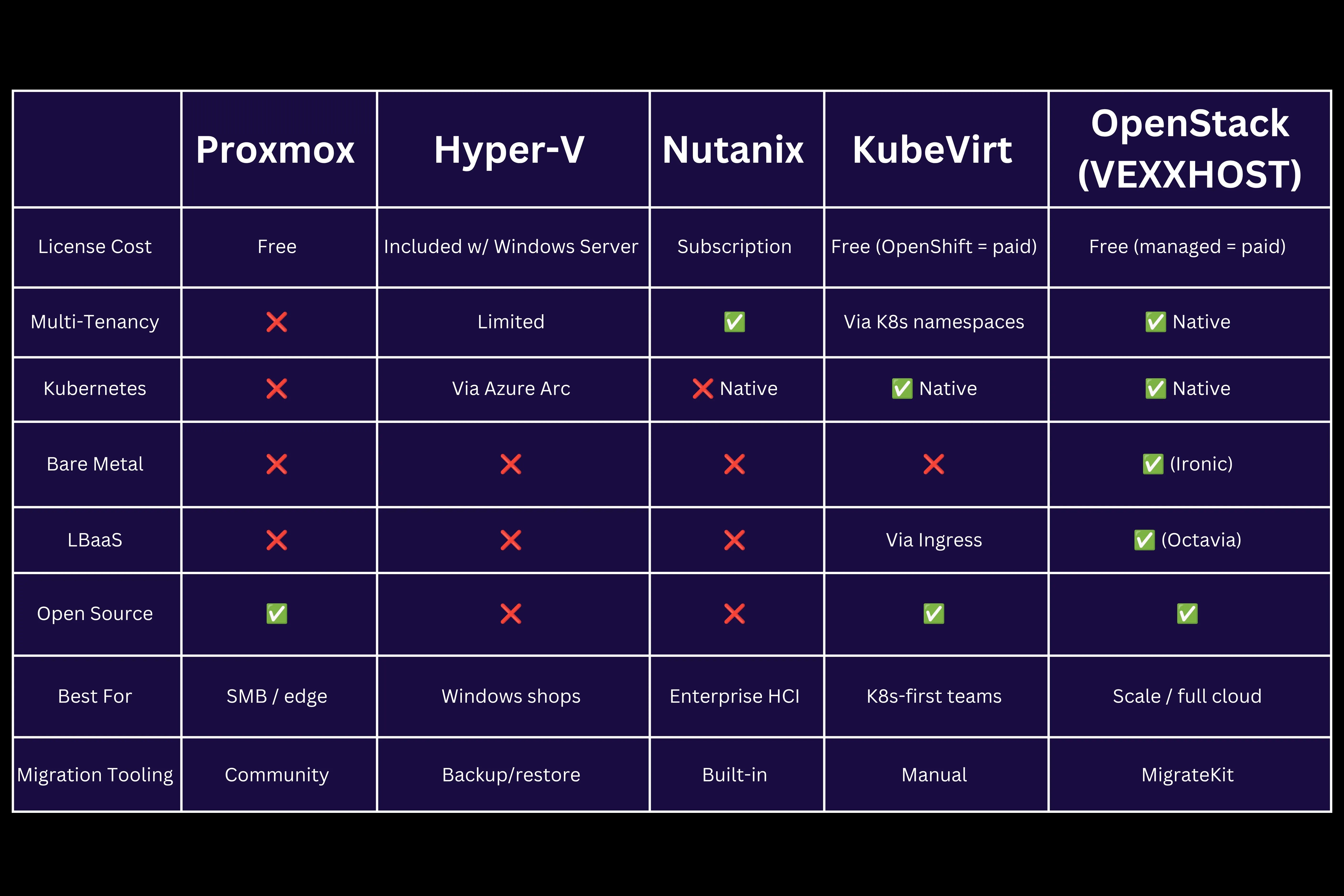
There isn't one best VMware replacement. The right pick depends on whether you're optimizing cost, operational simplicity, vendor support, or Kubernetes-first direction.
But if you want a platform that replaces VMware's full stack, not just the hypervisor, without creating new vendor dependency, OpenStack is the answer. And VEXXHOST is the fastest way to get there.
Choose from Atmosphere Cloud, Hosted, or On-Premise.
Simplify your cloud operations with our intuitive dashboard.
Run it yourself, tap our expert support, or opt for full remote operations.
Leverage Terraform, Ansible or APIs directly powered by OpenStack & Kubernetes