Indonesia’s DevOps teams feel the day 2 debt. This guide shows how to steady legacy clouds, meet PDP Law audits, and modernize OpenStack without going dark.
Engineering groups across Indonesia have described the same loop to us - weekend incidents, ticket queues that never empty, and month-end costs that don’t match what was actually used. Environments that grew organically, VMware estates, DIY OpenStack, or heavy public-cloud footprints, now carry day-2 debt.
Upgrades are risky. GPU capacity is unpredictable. Storage keeps creeping up, and basic changes require a maintenance window.
Older OpenStack releases add API drift and missing features; custom scripts and one-off fixes make every change feel delicate. Teams want more control without pausing delivery.
Start by stabilizing what you already have
Most organizations we meet aren’t ready to “flip.” They need help with the estate that’s keeping the lights on, for instance, patch windows that slip, clusters that drift, and upgrades that haven’t been attempted in a while.
For Indonesian teams, there’s an additional dimension - the new Personal Data Protection (PDP) Law is now in force, making documentation, audit trails, and change control more than nice-to-have.
We keep the platform running
We support your current environment (OpenStack or a mix of VM/K8s) so the production backlog keeps moving. That matters in a market where hiring senior platform engineers is competitive and the skills gap is real.
The first engagement usually looks like this:
Operational triage
Patch hygiene for hypervisors and control-plane services, backup verification, and configuration baselining so you can prove what’s running and why.
Visibility pass
Prometheus/Grafana for metrics, plus a log stack (Loki or ELK) so API errors, queue depth, and storage latency are visible during incidents, not just after.
Risk register
A small set of concrete “stop the bleeding” items (e.g., Keystone token expiry issues, Neutron/OVN agent flaps, snapshot failures) with owners and dates.
This step reduces noise and frees cycles for the conversion work.
If you’re on an older OpenStack release..
Older clouds usually fail in predictable ways: token caching quirks, fragile upgrades, and image sprawl. Atmosphere’s value here is structure:
- Staging that mirrors production so upgrades are rehearsed with your real user journeys.
- Blue/green control-plane patterns where appropriate, with in-place upgrades for data planes (e.g., OVN/Galera) to avoid split-brain.
- Rollback boundaries agreed ahead of time, paired with the more important part which means fewer rollbacks because the plan was validated in staging.
With Indonesia’s AI push accelerating and the wider adoption of AI expected to add about $366 billion to Indonesia’s GDP in the coming decade, the pressure to modernize is rising. You want an upgrade path that won’t pull engineers off product work for months.
Then plan the Atmosphere conversion (without going dark)
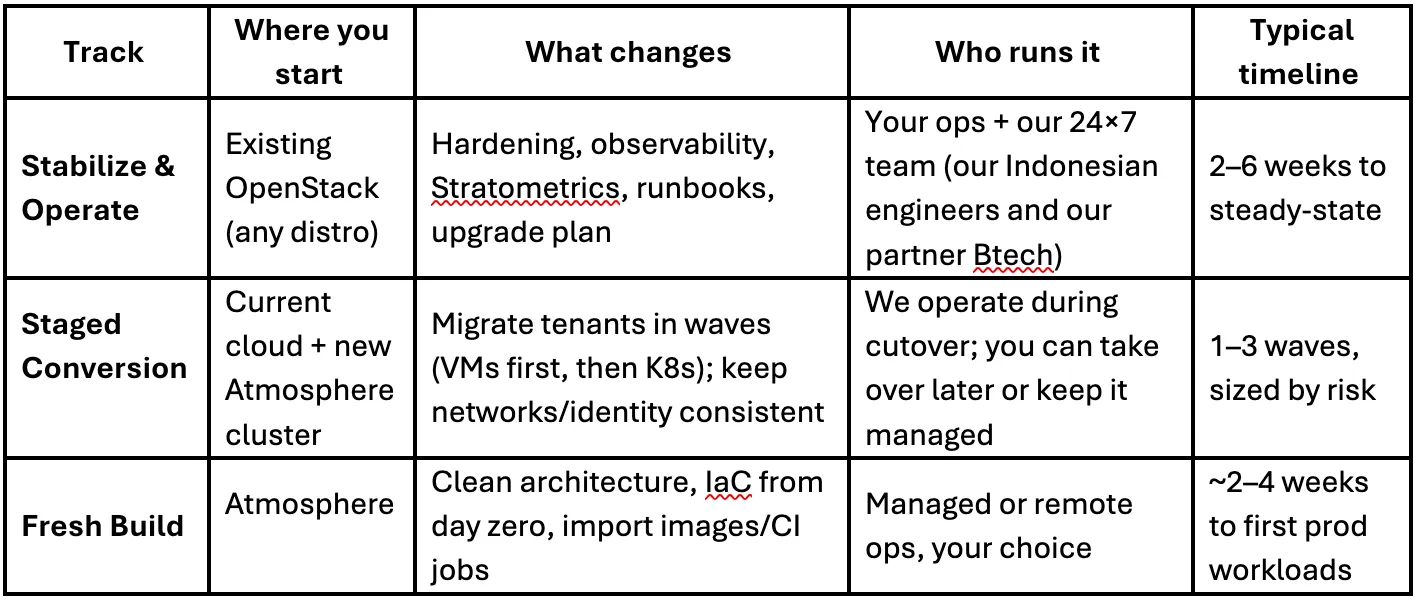
Our shared goal should be to migrate by service boundary while supporting your existing environment offering. The pattern below has worked well for Indonesian enterprises that want predictable changes and clear rollback points.
- Stand up a parallel Atmosphere stack.
Deploy an Atmosphere environment sized for a few pilot workloads. Because it’s built and operated with Infrastructure-as-Code (OpenStack-Helm + Ansible), you get repeatable control-plane rollouts, version pins, and a tested upgrade path you can reuse later. (If Kubernetes is central to your apps, we enable CNCF-certified clusters through Magnum/Cluster API with CSI-backed persistent volumes.) - Move by workload class.
Start with something low-risk, e.g., a stateless web tier behind Octavia, a CI runner fleet, or an analytics pipeline that benefits from custom flavors and local NVMe. Add stateful tiers (Cinder/Ceph, Manila, or object storage) once monitoring and backups are proven. - Operate both while you cut over.
Run a short dual-run so the team can compare metrics side by side. Tie all of it to the “evidence bundle” you’ll share internally - change tickets, pre/post screenshots, backup logs, and a short incident summary (even if the incident count is zero).
This “support now, convert steadily” model addresses the Indonesian market’s two biggest realities at once:
- fast-moving digital projects
- scarce senior platform capacity
Free to deploy with IaC
“Free to deploy” here means you’re not buying a proprietary installer or adding license debt to get going. Atmosphere installations are chart- and playbook-driven: the same templates create dev, staging, and prod; the same pins define image versions; and the same pipelines apply upgrades and security fixes.
Indonesia’s data-residency and audit needs are rising under the PDP Law, so we also recommend enabling:
- Stratometrics usage reporting for tenant- and project-level visibility (useful for chargeback or grant reporting later).
- Immutable image pins and Git-backed config so changes are reviewable, attributable, and easy to roll back.
Cost control that matters in year 1 and year 5
Teams often ask, “Is this cheaper than our current public-cloud setup?” The honest answer is it depends on workload shape and time horizon.
Many Indonesian organizations run steady, always-on services (portal traffic, ERP, data pipelines). Those benefit from custom flavors, right-sized storage pools, and predictable CapEx/OpEx mix.
Where the 15–30% ongoing savings come from
We’re not promising a magic number. But across Indonesian and Asia-Pacific environments, we generally see 15–30% lower* ongoing run costs versus a DIY OpenStack stack of equivalent size. This is mostly from reduced staffing burden, fewer incidents, and sane defaults around cleanup and quotas.
*Savings vary by hardware, energy rates, and how aggressively you enforce TTL/idle policies.
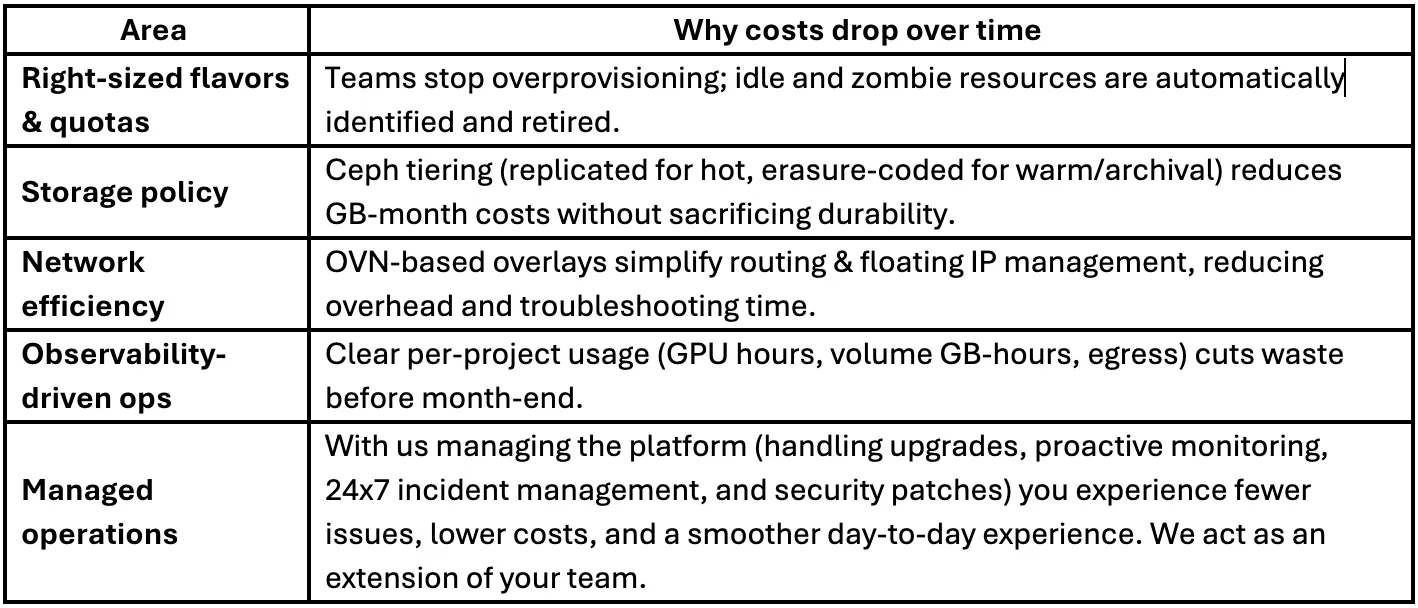
With us managing the platform (handling upgrades, proactive monitoring, 24x7 incident management, and security patches) you experience fewer issues, lower costs, and a smoother day-to-day experience. We act as an extension of your team.
Why the urgency
Three key reasons:
Indonesia’s talent market
The developer community is large, but senior cloud/SRE capacity remains tight. That's why a staged conversion with managed operations keeps delivery moving while you hire and train.
Investment & infrastructure
Major cloud/AI investments are landing locally, and the data-center market is expanding. Your architecture should be ready to take advantage of closer regions and better interconnects as they come online.
Regulatory clarity
The PDP Law is active; IaC, usage reporting, and solid backups make audits routine rather than disruptive.
What gets built first (use-case sketches)
- Developer platforms - self-service projects with quotas, TTL on ephemeral volumes, and custom flavors for CI runners—good early wins that demonstrate stability and cost control.
- Data/AI pipelines - GPU-capable flavors where needed, NVMe-backed pools for ingest, and object storage for durable datasets—useful as the country’s AI initiatives and training programs scale.
- Citizen-facing portals - multi-AZ design with Octavia and OVN, plus usage reporting scoped to each business unit for budget visibility.
Common questions we hear in Indonesia (and straightforward answers)
“Do you have people here?”
Yes, we have Indonesian engineers and local partners so you’re not waiting overnight for help.
“Can we keep parts of our current setup?”
Yes. We often keep your image catalog, IP addressing, and security group model intact while we clean up the control plane beneath it.
“Do we need to buy new hardware first?”
Not necessarily. We stabilize first and prove the path in staging. Hardware changes come later if they’re truly warranted.
“Will this change how our developers deploy?”
Only for the better. APIs stay standard. CI/CD works the same, with clearer quotas and more predictable provisioning times.
“How do we avoid another painful upgrade?”
By keeping everything as code, rehearsing in staging, and performing small, observable changes. You’ll also have a local/on-region team to lean on.
“Will this lock me into the OpenStack ecosystem?”
Everything runs on upstream OpenStack, Kubernetes, and your chosen storage backend (Ceph is common; Pure and others are options). You keep API access, logs, and the ability to fork or extend.
Indonesia’s market momentum supports the long view. Data-center capacity is growing and global cloud investment is flowing in, which means better hardware options and local interconnects over time. Building on open tooling now keeps you flexible as that landscape evolves.
If you’re hesitant to switch
These are your next low-risk steps:
- Pick one workload that is noisy or fragile (for example, a GPU training pool or a busy web tier).
- Let us stabilize it where it sits—observability, quotas, storage policy—then capture it as code.
- Run the first staged migration to Atmosphere OpenStack during a quiet window and measure the before/after.
If it’s calmer, cheaper to run, and easier to upgrade, you keep going. If not, you still gained a cleaner, supported environment without committing the whole estate.
In case, you’re wrestling with maintenance today but want the freedom and economics of OpenStack tomorrow, we can help you stabilize first, then convert on your schedule. Ping us when you’re ready to review a health snapshot or pilot plan with our Indonesian team.