

OpenStack
Air gapped cloud upgrades with Atmosphere release manifests
Air gapped cloud on OpenStack: how Atmosphere's digest-pinned release manifests move a release across the boundary, and what the manifest leaves out.
Read field noteField notes / Latest
Engineering notes from operating open infrastructure: the failures, design decisions, and upstream work that make open infrastructure better.
Browse all field notesAir gapped cloud on OpenStack: how Atmosphere's digest-pinned release manifests move a release across the boundary, and what the manifest leaves out.
Read field note
Learn when your team needs OpenStack consulting services and how expert support can help with deployments, migrations, upgrades, and operations.
Read field note
Assess enterprise AI readiness before investing in GPUs. Explore 12 key factors covering data, models, infrastructure, governance, operations, and costs.
Read field note
If Broadcom did not renew your hosting provider's VCSP contract, a move is the likely outcome. How to pick a destination that avoids a second forced move.
If Broadcom did not renew your hosting provider's VMware Cloud Service Provider (VCSP) contract, expect to change providers or platforms when that provider's commitment term with Broadcom ends. A move is the likely outcome, so we think you should pick a destination that does not depend on one vendor keeping your provider on its partner list.
This post is for IT and infrastructure leads, and CTOs, whose VMs run on a hosting provider's VMware cloud. The timing matters because your provider's contract with Broadcom sets a date your service can end. If you learn that date late, you either move on someone else's schedule, possibly with less time than a migration needs, or sign another term under a partner program you do not control. The sections below cover what to ask your provider, how a transfer compares with leaving VMware, and when to sign.
Our view comes from how Broadcom has run the VCSP program. In 2025, it sent non-renewal notices to providers it did not invite into its new program. On January 26, 2026, it told another group of partners, many of them in Europe, that it would not renew "any of your VCSP partner contracts."
A provider that Broadcom did not renew can keep serving its existing customers until its current commitment term with Broadcom ends. It cannot renew that commitment. Under the January 2026 notices, any new customer contract must also end when that commitment ends. So your service can run until the term ends, if your provider chooses to keep it running.
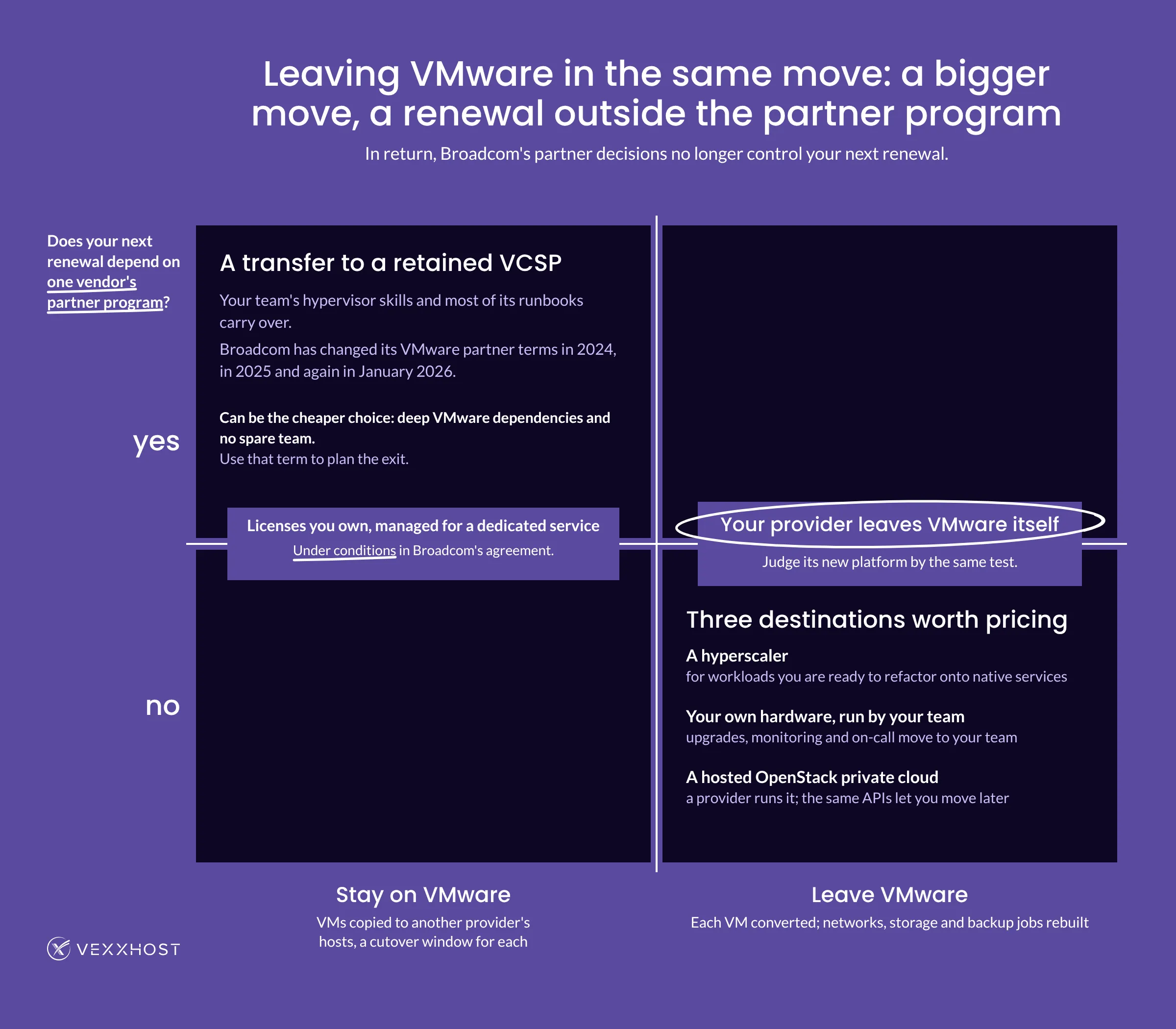
Broadcom tells these providers to work with retained VCSP partners to move their customers across. It also ended its white label model for partners. One more route is worth checking before you plan a move: Broadcom's 2025 transition guidance lets a provider manage VMware licenses you own for a dedicated service, under conditions in Broadcom's agreement.
Your plan runs to the end of that commitment term. The date is in your provider's contract with Broadcom, and your own agreement with the provider may end earlier or later.
Ask your provider for that end date in writing, along with its plan for that day. An excluded provider can hand its customers to a retained VCSP, as Broadcom recommends, or move its own platform off VMware. At least one European provider has said it is building that alternative.
Both plans change something under your workloads. Unless the retained provider takes over your current provider's hardware, a transfer still copies your VMs from one provider's hosts to another's, with a cutover window for each.
A transfer keeps you on VMware. Your team's hypervisor skills and most of its runbooks carry over. Console access, backup jobs and integrations depend on the new provider, so check each one in the transfer offer.
The price of the next term is the weak point. Gartner clients report that per-core subscription licensing "has resulted in significant cost increases." If your retained provider's own VMware costs go up, expect to see that on its next price list.
A transfer also leaves your hosting tied to the partner program that just pushed your provider out. Broadcom has changed its VMware partner terms in 2024, in 2025 and again in January 2026. Broader lock-in costs, from negotiating power to skills, follow the same pattern.
Leaving VMware at the same time as you leave your provider makes the move bigger. Each VM is converted to a different hypervisor, and networks, storage and backup jobs are rebuilt on the new platform. In return, Broadcom's partner decisions no longer control your next renewal. Three destinations are worth pricing:
Our VMware to OpenStack migration guide shows how networks and storage map across.
Whether you transfer, export or use a sync tool, you start from the VMware environment your provider runs. List the access you already have as a tenant and the access your provider has to grant.
For moves to OpenStack, we build MigrateKit, an open-source migration tool under the Apache 2.0 license. It syncs a VM's disks while the VM keeps running, so the VM only goes offline for a short cutover. It reads those disks through your current provider's VMware environment.
MigrateKit needs three things to read disks. First, a VMware endpoint that exposes the API, either an ESXi host or a vCenter server. Second, an account on that endpoint; for vCenter, the README lists the privileges, including disk access, change tracking, snapshots and powering off the VM. Third, VMware's Virtual Disk Development Kit (VDDK), which MigrateKit does not ship. Its README tells users to download VDDK 8.0.2 with a Broadcom developer account and accept the EULA.
That third item is now harder to get, because Broadcom no longer offers VDDK as a free public download. On a hosted service, ask your provider whether it holds a licensed VDDK copy and who will supply it.
Put the endpoint, the account and the VDDK question in the same written request as the term end date. Our professional services team builds the dependency view your migration order is based on and validates that order. Building it early means your request goes out while the provider still has time to answer it.
Moving once makes less sense in these cases:
If you also hold your own vSphere 8 licenses outside the hosted service, our vSphere 8 end of support post covers that separate date.
Sooner or later your provider will put a transfer in front of you: a retained VCSP's name, a next-term length and a price. That document is the decision point, because signing it sets how long you stay on VMware hosting and under whose partner status.
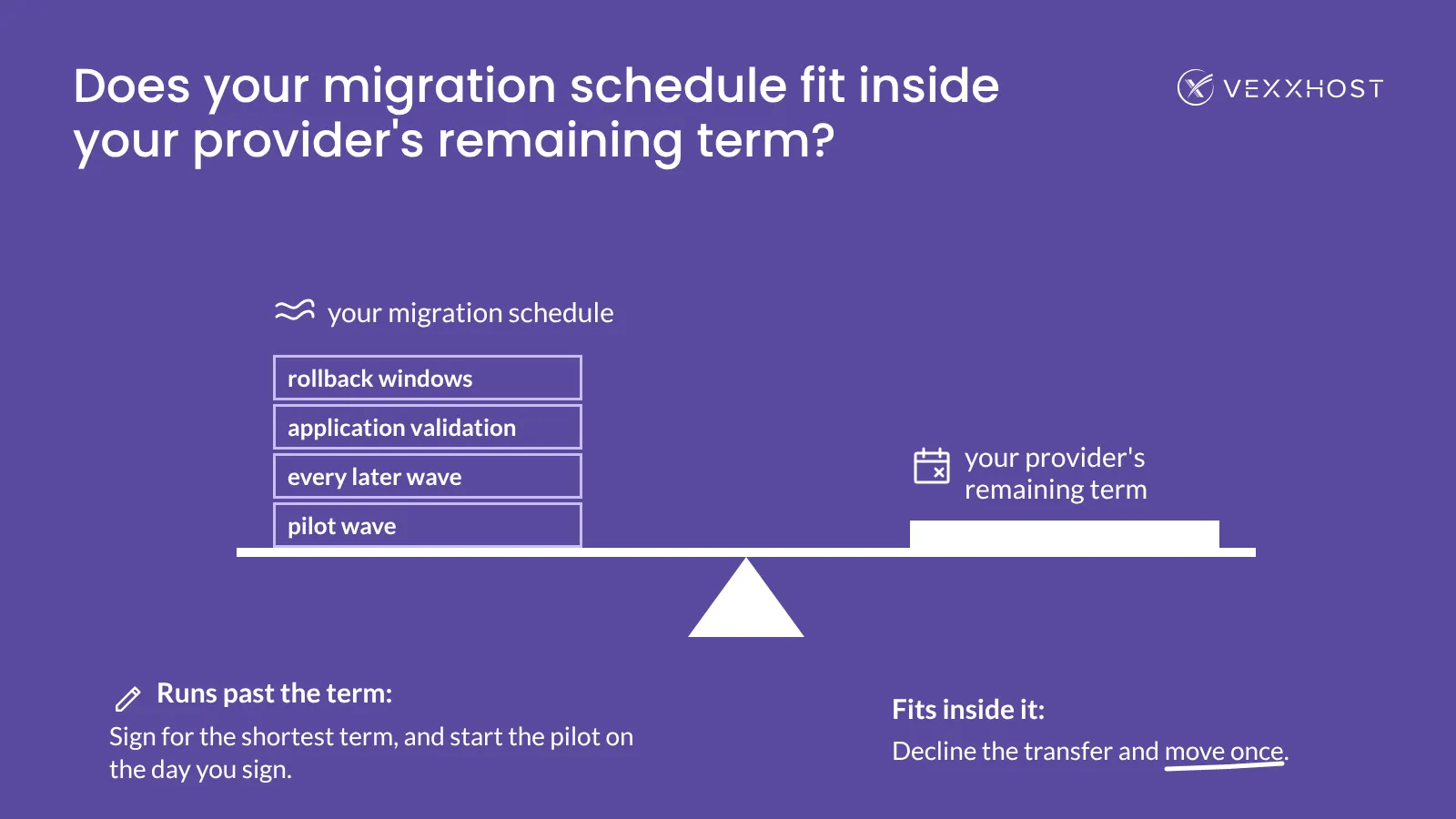
Measure the offer against a migration schedule built from your own estate: the pilot wave, every later wave, application validation and a rollback window for each. If that whole schedule fits inside your provider's remaining term, decline the transfer and move once. If it does not, sign for the shortest term the retained provider will accept, and start the pilot on the day you sign.
Your provider's contract with Broadcom sets a date your service can end, so the exit runs on a clock whatever you decide. For exits that involve moving VMs, plan the inventory, cutovers and validation, whichever destination you choose. Moving from VMware to OpenStack can add conversion and network and storage reconfiguration on top of that work, and in exchange it takes your destination outside Broadcom's VCSP partner program.
Atmosphere, the OpenStack platform we build, is one such destination. It comes in Cloud, Hosted and On-Premise editions, so your estate can stay in a hosted model or come back to hardware you own while keeping the same OpenStack APIs. You can run it yourself, use our expert support or hand us full remote operations. MigrateKit moves the VMs across on the path described above. If you want an expert's read on your estate and your provider's dates before the offer arrives, you can talk it through with someone on our team.
Choose from Atmosphere Cloud, Hosted, or On-Premise.
Simplify your cloud operations with our intuitive dashboard.
Run it yourself, tap our expert support, or opt for full remote operations.
Leverage Terraform, Ansible or APIs directly powered by OpenStack & Kubernetes