
OpenStack
Air gapped cloud upgrades with Atmosphere release manifests
Air gapped cloud on OpenStack: how Atmosphere's digest-pinned release manifests move a release across the boundary, and what the manifest leaves out.
Read field noteField notes / Latest
Engineering notes from operating open infrastructure: the failures, design decisions, and upstream work that make open infrastructure better.
Browse all field notesAir gapped cloud on OpenStack: how Atmosphere's digest-pinned release manifests move a release across the boundary, and what the manifest leaves out.
Read field note
Learn when your team needs OpenStack consulting services and how expert support can help with deployments, migrations, upgrades, and operations.
Read field note
Assess enterprise AI readiness before investing in GPUs. Explore 12 key factors covering data, models, infrastructure, governance, operations, and costs.
Read field note
The EU Data Act bans switching charges, including exit egress fees, from January 12, 2027. Notice-period fees, ongoing egress and early termination penalties stay.
The EU Data Act's ban on switching charges takes the one-time charges for the switch itself off the bill, including the egress fees for moving your data out. Service fees through the notice period, egress from day-to-day operations and early termination penalties all stay chargeable, so the exit terms that matter are the ones you agree when you sign.
The ban takes full effect on January 12, 2027, and the rules around it have applied since September 12, 2025. This post reads Regulation (EU) 2023/2854 the way a CIO or finance lead reads an invoice. It is not legal advice, and your counsel should read your own contracts against the text.
Article 29 of the Data Act sets two periods. From January 11, 2024 to January 12, 2027, a provider may charge for switching, but only a reduced charge that does not exceed its costs directly linked to the switching process. From January 12, 2027, it may not charge for the switching process at all.
The definitions in Article 2 decide how far that reaches. Switching charges include data egress charges. They exclude two things by name: standard service fees and early termination penalties.
The rules apply to any provider of data processing services serving customers in the EU, wherever the provider is established.
Article 25 also puts a clock on the exit. The notice period to start a switch can be at most two months, and the switch has to finish within a transitional period of 30 calendar days after it. If 30 days is technically unfeasible, the provider has 14 working days from your switching request to justify that and propose an alternative of up to seven months, and you may extend the transitional period once. You then get at least 30 calendar days to retrieve your data, and the contract stays in force until the switch is done.
Each of these can still be billed after January 12, 2027 under the text as written:
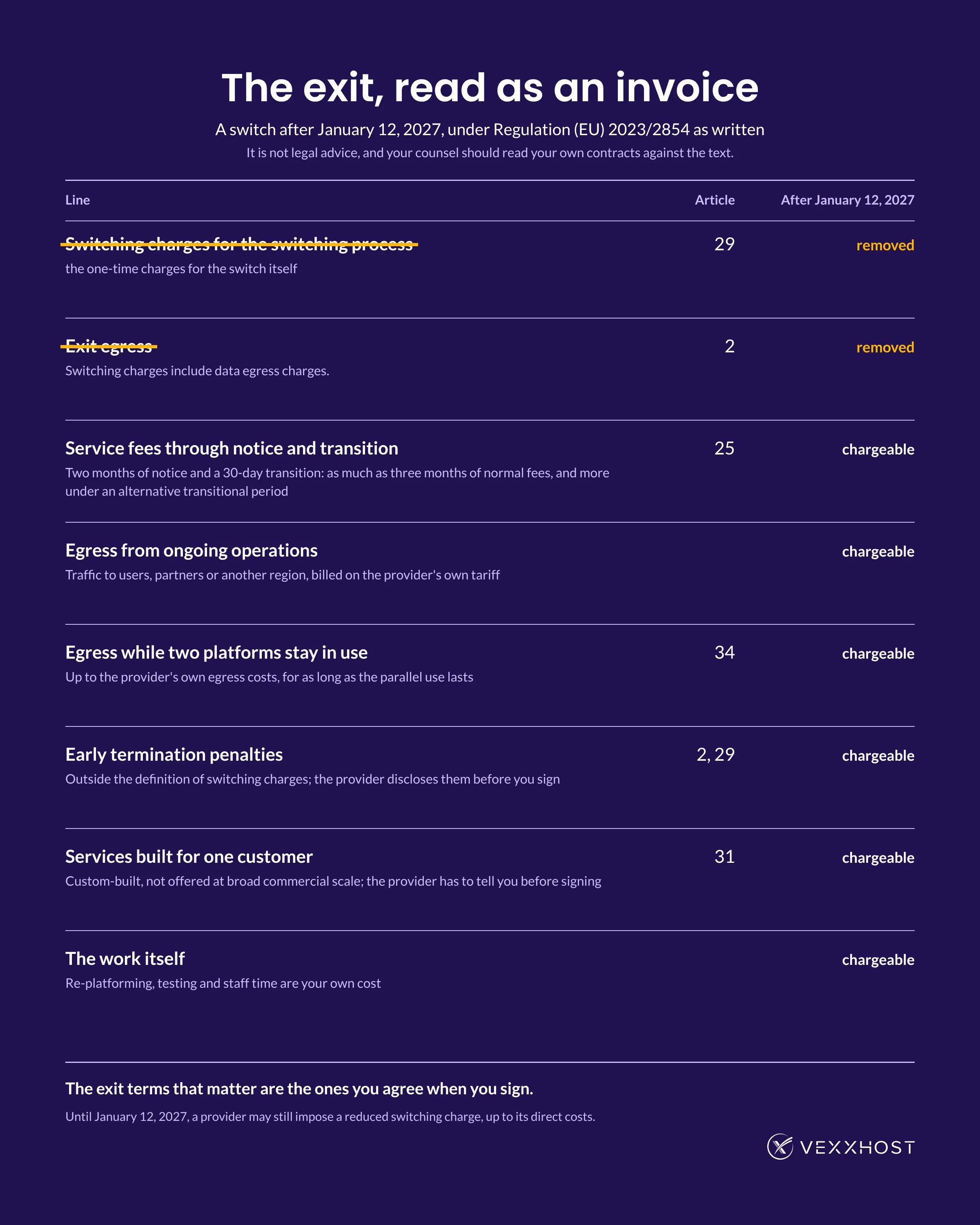
Proposed changes could widen one of these lines. Amendments under the Digital Omnibus, first put forward by the Commission in November 2025, would, in the Council's compromise text as reported in July 2026, expressly allow proportionate early termination penalties in fixed-term contracts. At that point the amendments were still a proposal under negotiation.
Three of the largest providers gave up exit egress before the main rules applied in September 2025. Google Cloud announced free data transfer for customers leaving it on January 11, 2024. Within nine weeks, AWS and Microsoft did the same with conditions of their own: AWS from March 5, 2024, with credits for the migrated data on request, and Microsoft, announced March 13, 2024, with an invoice credit once every Azure subscription on the account is cancelled. For their EU customers, the 2027 ban turns a waiver with conditions into a legal rule.
The strongest case for the Data Act sits in Article 25. A two-month notice ceiling, a default transition of 30 calendar days, at least 30 days to retrieve data and erasure after a successful switch, written into every covered contract, turn an exit into a schedule. A finance lead can budget a schedule.
That gain is real, and it is a gain in time and certainty. The service fees for those months on the old platform still arrive.
For a large archive that rarely leaves its provider, the one-time move can be the biggest egress line it will ever pay. Until January 12, 2027, a provider outside the waivers above may still charge for it, up to its direct costs.
For that customer, the date of the switch matters. Which side of January 12, 2027 a given switching process falls on is a question for counsel.
The balance also shifts on a contract with no fixed term and no termination penalty, where notice-period fees and the move itself make up most of the exit cost. Our public cloud is billed per minute with no contract or commitment.
A customer outside the EU, which Article 1 does not cover, gets none of these protections from the Data Act.
Contracts signed or renewed before January 12, 2027 deserve the closest read: until that date a provider may still impose a reduced switching charge, and the ban does not touch the notice fees or termination penalties a multi-year contract sets.
Article 29 already obliges the provider to disclose its standard service fees and any early termination penalties before you sign. Add two figures of your own: the egress rate the provider charges for traffic that is not part of a switch, and whether any service you buy is classed as custom-built under Article 31. Then set the total against the one-time exit egress the ban removes.
When the remaining lines outweigh that egress, the sum points at term length and the penalty schedule, which are among the decisions that are hardest to undo once signed. Our private cloud is priced per node, and quotes reflect your footprint and commitment. If you want to see how the commitment changes that price before you choose one, our team can take you through a private cloud quote line by line.
An archive-heavy estate, which holds far more data than it moves, reads the same sum the other way and puts the start date of its switch first. Either way, the ban leaves term length and the penalty schedule in place, so settle both before you sign.
Choose from Atmosphere Cloud, Hosted, or On-Premise.
Simplify your cloud operations with our intuitive dashboard.
Run it yourself, tap our expert support, or opt for full remote operations.
Leverage Terraform, Ansible or APIs directly powered by OpenStack & Kubernetes