

OpenStack
OpenStack Support: In-House vs. Managed Services
Compare in-house OpenStack operations, expert support, and managed services. Learn who should handle upgrades, incidents, and ongoing cloud operations.
Read field noteField notes / Latest
Engineering notes from operating open infrastructure: the failures, design decisions, and upstream work that make open infrastructure better.
Browse all field notesCompare in-house OpenStack operations, expert support, and managed services. Learn who should handle upgrades, incidents, and ongoing cloud operations.
Read field note
Air gapped cloud on OpenStack: how Atmosphere's digest-pinned release manifests move a release across the boundary, and what the manifest leaves out.
Read field note
Learn when your team needs OpenStack consulting services and how expert support can help with deployments, migrations, upgrades, and operations.
Read field note
US regulators rescinded SR 11-7 in April 2026 and left generative AI out of the replacement, while OSFI's E-23 covers AI from May 2027. Three ways banks can govern generative AI models now, and where each one breaks.
Large banks now run generative AI in daily work. Employees use internal assistants, advisors get meeting notes drafted, and software agents help process payments. These tools run on large language models, often supplied by an outside vendor, and a vendor update can change their behavior.
For 15 years, SR 11-7, the Federal Reserve's 2011 guidance on model risk management, sat at the core of how US banks governed their models. On April 17, 2026, the Fed, the OCC and the FDIC rescinded it and issued revised guidance, SR 26-2. Its footnote 3 takes generative and agentic AI out of scope, calling them "novel and rapidly evolving."
Canadian banks face the opposite move. OSFI, Canada's federal regulator of banks and insurers, finalized Guideline E-23 in September 2025. From May 1, 2027, it applies to every model at every federally regulated institution and covers AI and machine learning explicitly.
The questions have not gone away. US examiners are asking banks whether they can track and audit AI agent decisions and how they would shut those systems down. A board will ask who approved each model, what it was tested against, who supplies it, and whether the bank can explain a decision after a customer complains. A bank without answers pays twice: once for the wrong output, and again when it cannot show an examiner why it happened.
How to govern these models has to be decided now. US guidance leaves them to each bank's own risk management, and E-23 takes effect in about six and a half months. This memo sets three options side by side, with where each one fails: waiting for regulators, folding generative AI into your existing model risk framework, or building a separate governance layer for it.
SR 26-2 is narrower than the letter it replaced. It is expected to be most relevant to banking organizations with over $30 billion in total assets; when the FDIC adopted the earlier guidance in 2017, it left out most banks under $1 billion. The OCC says it sets no enforceable standards and that not following it will not draw supervisory criticism. The letter adds that supervisory action can still follow unsafe or unsound practices that stem from weak model risk management.
Generative AI is out, but two signals remain. The guidance still treats validation of vendor products, by internal or outside parties, as part of model risk management. A vendor's language model raises the same problem. The agencies also said they would issue a request for information on banks' use of AI, including generative and agentic AI. Until then, footnote 3 leaves governance of these models to each bank's own risk management and governance practices.
OSFI's E-23 goes further on each point. OSFI says its expected outcomes do not vary by algorithmic approach, so a language model sits in the same framework as a credit score. In its letter on the final guideline, OSFI says it expects:
European supervisors point in the same direction. The ECB has asked euro zone banks to map their AI use across businesses and third-party providers and to confirm they can shut down and restart systems in a controlled way. Under DORA, supervisors designated 19 critical technology providers in November 2025, including the hyperscalers.
Banks that publish details run generative AI on shared internal platforms with many models behind them.
BNY reported in October 2025 that 99% of its employees were trained and onboarded on Eliza, its enterprise AI platform with a menu of models from several providers. It runs over 100 "digital employees," each given a persona, credentials and a human supervisor, and had 75% more AI solutions in production at the end of the third quarter than a quarter earlier.
In July 2025, Bank of America said 90% of its more than 210,000 employees had used its Erica for Employees assistant and 17,000 programmers use AI coding tools. The bank said it has created over 250 AI and machine-learning models. The same month, InvestmentNews reported that Morgan Stanley had extended its Debrief meeting notetaker beyond advisors to other wealth management staff.
RBC built Lumina, an enterprise data and AI platform, and expects its AI investments to produce between C$700 million and C$1 billion in revenue and cost savings by 2027.
Whichever approach you pick, the questions examiners and boards ask come back to the same records. We recommend having the platform produce them as it runs, so nobody has to reconstruct them later.
Inventory. One entry per use case: owner, model and exact version, prompt template version, data sources, risk rating and, for agents, the systems they may act on. A vendor update behind an API changes that entry, and E-23 expects criteria for deciding when a model modification is material.
Validation and evaluation. A fixed test set per use case, scored before go-live and rerun whenever the model, prompt or retrieval data changes. For a model whose code you cannot inspect, those scores become a central part of the validation evidence.
Monitoring. Output quality sampled in production, plus how often human reviewers override or edit the output. A rising edit rate is worth an alert.
Logging and the audit trail. For each request: user or agent identity, model version, prompt template, documents retrieved, output, tools called and the approving human. Keep the records under your own retention policy, in storage your bank controls.
Shutdown and fallback. A switch that disables one use case without taking down the platform, and a fallback such as the previous model version. E-23 expects contingency plans for model failure, and OSFI expects retired models kept for a period as a benchmark or fallback.
Third parties and residency. With inference on an outside API, prompts and outputs pass through the provider, and what it keeps depends on its terms and the service you buy. In a November 2024 Bank of England and FCA survey, the top three cloud providers accounted for 73% of the cloud providers UK financial firms named, and the OSFI-FCAC report of September 2024 warned that AI models increase dependency on cloud computing. Banks have used cloud for years, and generative AI deepens that dependency.
Where inference should run is a decision of its own, between managed AI inference and self-hosted LLMs. For sensitive use cases, the other route is inference on GPUs you control. Our GPU infrastructure runs on Atmosphere and OpenStack, on your premises or hosted by us. That way the storage behind model versions, prompts and request logs can sit where your bank decides.
For some banks, the case for waiting is real. SR 26-2 is not enforceable, generative AI is outside it, and the promised request for information could lead to expectations that differ from what you build now. A US bank under $30 billion in assets, using generative AI only for internal drafting checked by a person, gains little from building early.
Waiting breaks down the first time anyone asks. Examiners already raise AI in routine exams. A federally regulated Canadian bank faces E-23 on May 1, 2027, and a euro zone bank may already have the ECB's mapping request. Evidence is hard to create later: without a logged model version, a past decision is much harder to investigate.
For most banks this is the strongest starting point. The inventory, validation team, model owners and board reporting already exist. For a Canadian bank, E-23's position that outcomes do not change with the algorithm makes this the route the guideline already describes.
It breaks on volume and on vendors. Validation built for statistical models with fixed code assumes the model stays the same between reviews. A vendor's language model called by a general model name can change whenever the vendor updates it, and one platform can serve a hundred use cases. If every prompt change goes to the validation queue, the queue stalls the business. If changes skip the queue, the inventory stops matching what runs. Agents add a gap of their own: their risk depends on what their credentials let them do, and a model inventory does not record that.
Here generative AI runs behind one internal platform: a gateway for every request, versioned prompts, evaluations on every change, an identity per agent and automatic logs. BNY's digital employees, each with its own credentials and a human supervisor, show part of this pattern. Evidence becomes a by-product of running the platform.
Two things go wrong here. If it runs apart from the main framework, it builds a second inventory that drifts from the official one, and the CRO has to reconcile the two. It is also a platform someone must build and run for years, from gateway and GPUs to log retention and upgrades. Atmosphere, the open source OpenStack platform we build, ships Prometheus and Grafana for monitoring and Loki for logs, with Vector collecting host logs into Loki. That covers the infrastructure side of the record. The log of prompts and outputs must come from your gateway.
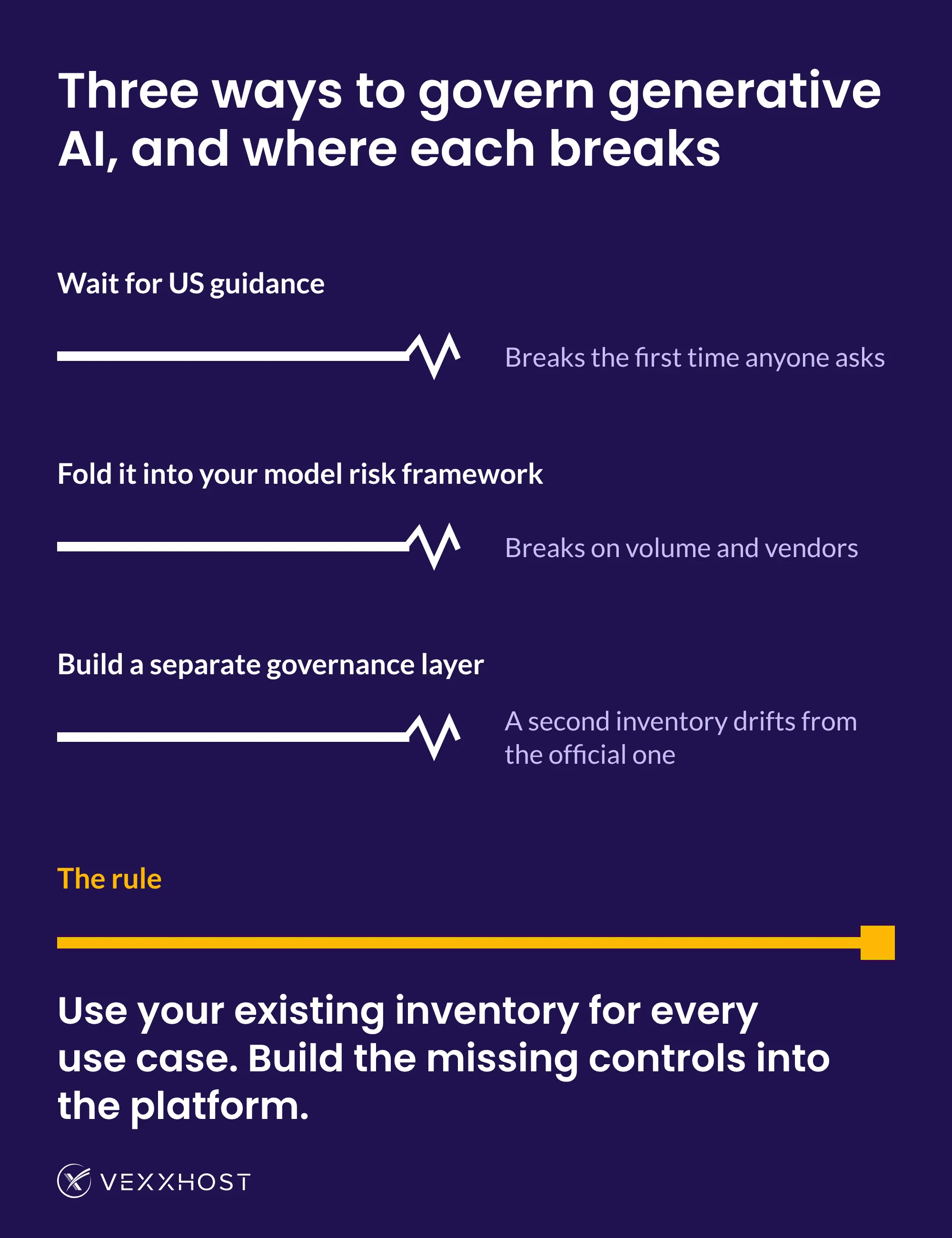
Put every generative AI use case into the model inventory you already have, and build the controls the framework lacks into the platform that runs the models. Anything that informs a customer decision, or acts in a system without a person approving it, goes through validation and runs on a pinned, logged model version before production. Internal drafting with human review gets a lighter tier, with an inventory entry and logs all the same. Waiting suits only a US bank under $30 billion with no customer-facing or autonomous use and no Canadian or euro zone operations, and even that bank should start logging now. Revisit the rule if interagency guidance follows the promised request for information, or when OSFI says more about vendor language models under E-23.
This rule makes infrastructure part of model risk. Pinned versions, evaluation records and request logs depend on where inference runs and who can reach the storage behind it. For a Canadian bank preparing for E-23, our GPU infrastructure can run on its own premises or in our Montreal data center, with Canadian data residency. Access to the cloud can follow the bank's existing directory, since Atmosphere's identity service connects to an LDAP directory. Our seven verification gates for building a bare-metal GPU cloud on Atmosphere each have an owner, an observable result and a stopping condition, and end in an acceptance test run through the same path users get. A validation team can use that record as evidence about the environment where it approves models.
We are a Canadian-operated company, and we have been building open source cloud infrastructure since 2006. For a bank, our part of this decision is the infrastructure layer: the GPUs, the cloud they run in and the storage that holds model files and logs. We can build that platform on Atmosphere and OpenStack in your data center, or run your GPUs in our Montreal data center. We have validated Atmosphere on bare-metal H200 servers, where a whole eight-GPU server, handed to a user without virtualization, passed an AI workload. Logs and model files can sit on Ceph, which we have run in production since 2015.
Who runs the platform is your choice. If your team wants to operate it, we give them expert support. If you want to keep the hardware in your facilities and hand over the work, we run the cloud's operations, patching, monitoring and incident response there for you. Our professional services cover the architecture and deployment of the platform, and we are SOC 2 Type II compliant.
Model validation stays with your bank. Bring your list of generative AI use cases to a conversation with our team, and we will map out with you where each one's models, logs and audit trail should live and who should run them.
Choose from Atmosphere Cloud, Hosted, or On-Premise.
Simplify your cloud operations with our intuitive dashboard.
Run it yourself, tap our expert support, or opt for full remote operations.
Leverage Terraform, Ansible or APIs directly powered by OpenStack & Kubernetes