

GPUs
AI Infrastructure Landing Zones: Scaling Enterprise GPU Access
Build an AI infrastructure landing zone for secure, repeatable GPU access across teams with standardized compute, storage, networking, quotas, and operations.
Lire la noteNotes de terrain / Dernières nouvelles
Des notes d’ingénierie issues de l’exploitation d’infrastructures ouvertes : pannes, décisions de conception et travail upstream qui améliorent l’infrastructure ouverte.
Parcourir toutes les notesBuild an AI infrastructure landing zone for secure, repeatable GPU access across teams with standardized compute, storage, networking, quotas, and operations.
Lire la note
Compare dedicated GPUs, MIG, vGPU, and time-slicing for enterprise AI. Learn how isolation, performance, utilization, and workload type affect GPU allocation.
Lire la note
Why infrastructure flexibility matters and how open cloud technologies can help organizations adapt as workloads and business needs change.
Lire la note
Build an AI infrastructure landing zone for secure, repeatable GPU access across teams with standardized compute, storage, networking, quotas, and operations.
Giving one team access to a GPU is straightforward. Give them a GPU-enabled VM, attach storage, configure network access, and let them start building.
Giving many teams reliable, secure, and repeatable access is an architecture problem.
As AI adoption spreads across an organization, infrastructure teams need consistent answers: Who can provision GPUs? How are teams isolated? Where does data live? How is consumption measured? Who owns the platform?
An AI infrastructure landing zone answers those questions before workloads arrive. It creates a standardized foundation so teams consume GPUs, compute, storage, networking, and orchestration through known patterns instead of one-off environments.
An AI infrastructure landing zone is a standardized infrastructure environment that defines how teams access and consume AI resources.
It typically establishes:
The goal is not to slow developers down. It is to make AI infrastructure repeatable.
When a new team requests GPU capacity, its network, permissions, storage, monitoring, and deployment process should already exist as reusable patterns.
Early AI projects are often provisioned manually. A team receives a GPU VM. An engineer creates a Kubernetes cluster. Storage is attached. Network rules and credentials are configured case by case.
That works for a few experiments. At scale, it creates infrastructure drift:
The problem is no longer getting a GPU. It is defining a consistent way for many teams to consume scarce infrastructure.
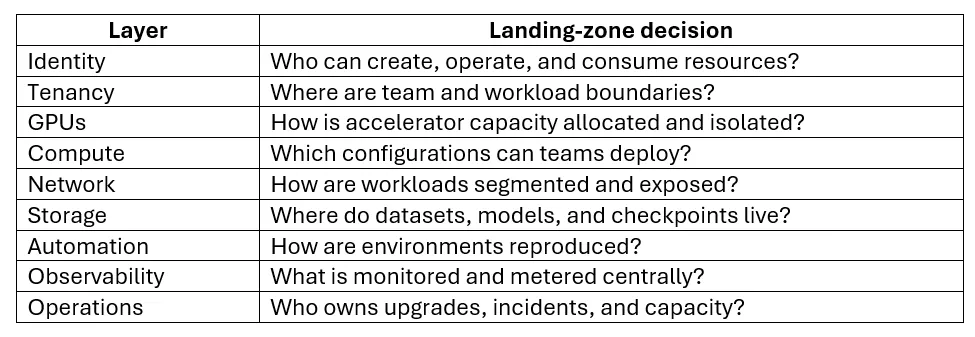
A multi-team AI platform needs an explicit isolation model.
Boundaries may use OpenStack projects, separate Kubernetes clusters, Kubernetes namespaces, dedicated compute pools, or dedicated and shared GPU pools.
A research environment may tolerate more shared infrastructure. A customer-facing inference service may require stronger isolation. Sensitive datasets may justify separate network or storage boundaries.
The appropriate model depends on security, performance, compliance, team autonomy, and cost allocation.
GPU isolation is one part of this decision. Organizations comparing full-GPU assignment, partitioning, and sharing can refer to VEXXHOST's guide to shared vs. dedicated GPUs for enterprise AI rather than treating that choice as the entire landing-zone architecture.
Shared AI infrastructure should not depend on shared administrator credentials or manually maintained access lists.
A landing zone should connect infrastructure access to centralized identity and define roles for administrators, platform engineers, developers, ML/MLOps teams, and service accounts.
OpenStack can scope infrastructure permissions through projects and role-based access. Kubernetes adds RBAC for clusters, namespaces, workloads, and service accounts.
The principle is least privilege: a developer deploying an inference workload should not automatically be able to modify the underlying GPU nodes or cloud network.
GPUs are scarce infrastructure resources. Their allocation should be explicit.
A landing zone can define GPU and VM quotas, Kubernetes resource requests and limits, GPU-specific node pools, scheduling policies, dedicated versus shared accelerator pools, and capacity reservations for critical workloads where appropriate.
The platform should also show which project, namespace, or business unit is consuming capacity, creating a predictable resource model for experimentation, training, and production.
Networking should be designed as part of the landing zone instead of rebuilt independently for each project.
Standards may cover private networks, tenant segmentation, security groups, external ingress, load balancing, Kubernetes networking, east-west connectivity, API access, and connectivity to data sources.
Training and inference can create very different traffic patterns. Distributed training may generate substantial east-west traffic between workers and storage, while inference often depends more on predictable request paths and load balancing.
For environments where network topology is becoming part of GPU performance, VEXXHOST's guide to AI networking for GPU infrastructure covers those considerations in more depth.
A GPU is useful only if the workload can reach its data.
The landing zone should define approved patterns for datasets, model artifacts, checkpoints, Kubernetes persistent volumes, object data, shared files, and backups.
Different workloads may require different interfaces. Kubernetes applications may use persistent block volumes. Training pipelines may use object storage. Some workflows require shared file access.
Ceph can provide block, object, and file storage within a distributed storage layer, making it one option for environments that need multiple storage interfaces.
The objective is to standardize available storage patterns, durability expectations, and how teams request them—not force every workload onto one tier.
Unlimited configuration choice creates infrastructure drift.
Platform teams can publish approved profiles such as:
Profiles can define CPU-to-GPU ratios, memory, storage, networking, GPU allocation, and operational expectations.
Standard profiles make environments easier to automate, troubleshoot, document, and include in capacity planning.
A landing zone that exists only in an operations document will eventually drift.
Infrastructure should be reproducible through automation. Depending on the environment, that may include Terraform or similar infrastructure-as-code tooling, Kubernetes manifests, GitOps workflows, automated cluster provisioning, standardized images, and declarative network and storage configuration.
The exact toolchain is secondary to the principle: the same approved request should produce the same infrastructure repeatedly.
Experimental AI infrastructure should not become production infrastructure by default.
Landing zones should define different expectations for development, testing, and production across availability, security, GPU allocation, storage durability, access, monitoring, change control, and cost sensitivity.
Development may prioritize flexible access and sharing. Production inference may require stricter change control, stronger isolation, persistent monitoring, and reserved capacity. Long-running training may need checkpointing and scheduling policies designed around extended jobs.
Central observability becomes much harder after every team has built its platform differently.
Before broad access is enabled, infrastructure teams should be able to see:
Metering is especially important when groups compete for the same GPU pool. Without shared visibility, capacity decisions become guesswork.
A landing zone should also define operational ownership.
Responsibilities may span infrastructure, platform, ML/MLOps, application, and security teams. The operating model should assign responsibility for GPU capacity, monitoring, platform upgrades, Kubernetes lifecycle, storage operations, security updates, incident response, and capacity expansion.
What matters is that ownership is defined before an incident exposes the gap.
OpenStack and Kubernetes solve different parts of AI infrastructure architecture.
OpenStack can provide the infrastructure layer:
Kubernetes can provide the workload orchestration layer:
Used together, OpenStack can define how infrastructure is provisioned and isolated, while Kubernetes controls how containerized AI workloads consume resources.
Organizations that do not want to operate the Kubernetes layer themselves can also use Managed Kubernetes while retaining standard Kubernetes APIs and an open infrastructure model.
Before expanding GPU access, verify.
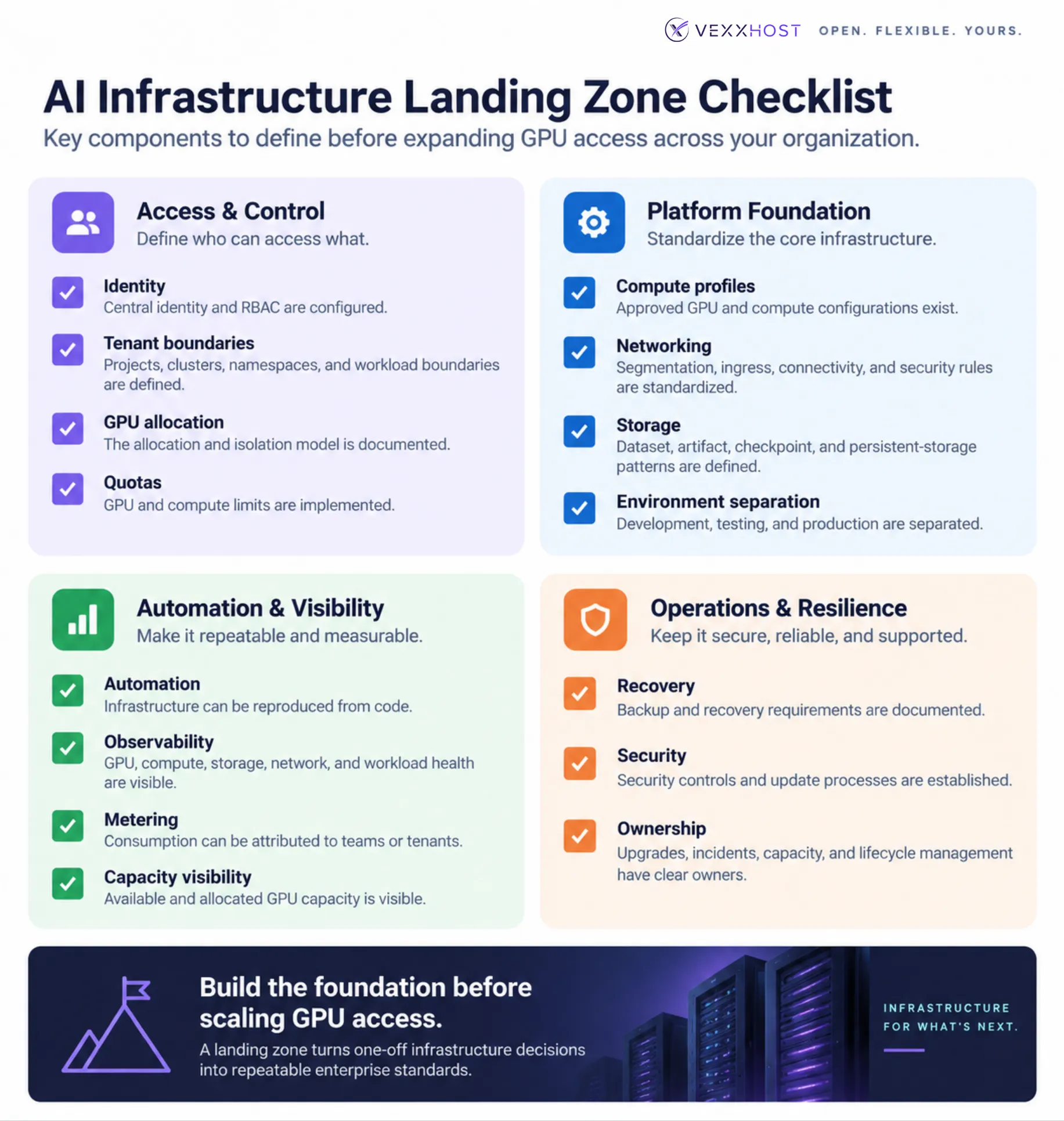
If these decisions are still being made manually for each new AI project, workloads may be scaling faster than the infrastructure foundation supporting them.
An AI infrastructure landing zone needs to make the important infrastructure decisions repeatable.
That means defining who can consume GPUs, which environments they receive, how networks and storage connect, how resources are controlled, how infrastructure is reproduced, and who operates it once deployed.
VEXXHOST can support this foundation through GPU Infrastructure, OpenStack, Managed Kubernetes, Ceph, and private cloud environments. Teams that prefer not to own every Day 2 responsibility can also use managed infrastructure services for ongoing operations.
The goal is not simply more GPU access. It is a consistent, supportable infrastructure model that lets multiple teams consume AI resources without turning every new workload into a new architecture project.
Planning to expand GPU access across teams? Talk to VEXXHOST about the infrastructure architecture, deployment model, and operating requirements behind your AI workloads.
Choose from Atmosphere Cloud, Hosted, or On-Premise.
Simplify your cloud operations with our intuitive dashboard.
Run it yourself, tap our expert support, or opt for full remote operations.
Leverage Terraform, Ansible or APIs directly powered by OpenStack & Kubernetes