Sovereign by Architecture: Building AI Infrastructure for the EU AI Act
The EU AI Act takes effect August 2026. Compliance starts at the infrastructure layer. Learn why sovereign AI needs OpenStack, Kubernetes, and Atmosphere.

Perspectives, mises à jour et histoires de notre équipe
The EU AI Act takes effect August 2026. Compliance starts at the infrastructure layer. Learn why sovereign AI needs OpenStack, Kubernetes, and Atmosphere.
Learn how a lightweight keystoneauth1 plugin brings your existing browser-based MFA and SSO to the OpenStack CLI, with no changes to any client tools.

Hyperscaler AI looks fast but hides long-term lock-in and rising costs. See how OpenStack and Kubernetes deliver GPU infrastructure you actually control.

What happens when research outgrows its cloud? See how UB revamped its HPC with Atmosphere OpenStack for better scalability, automation, and performance.
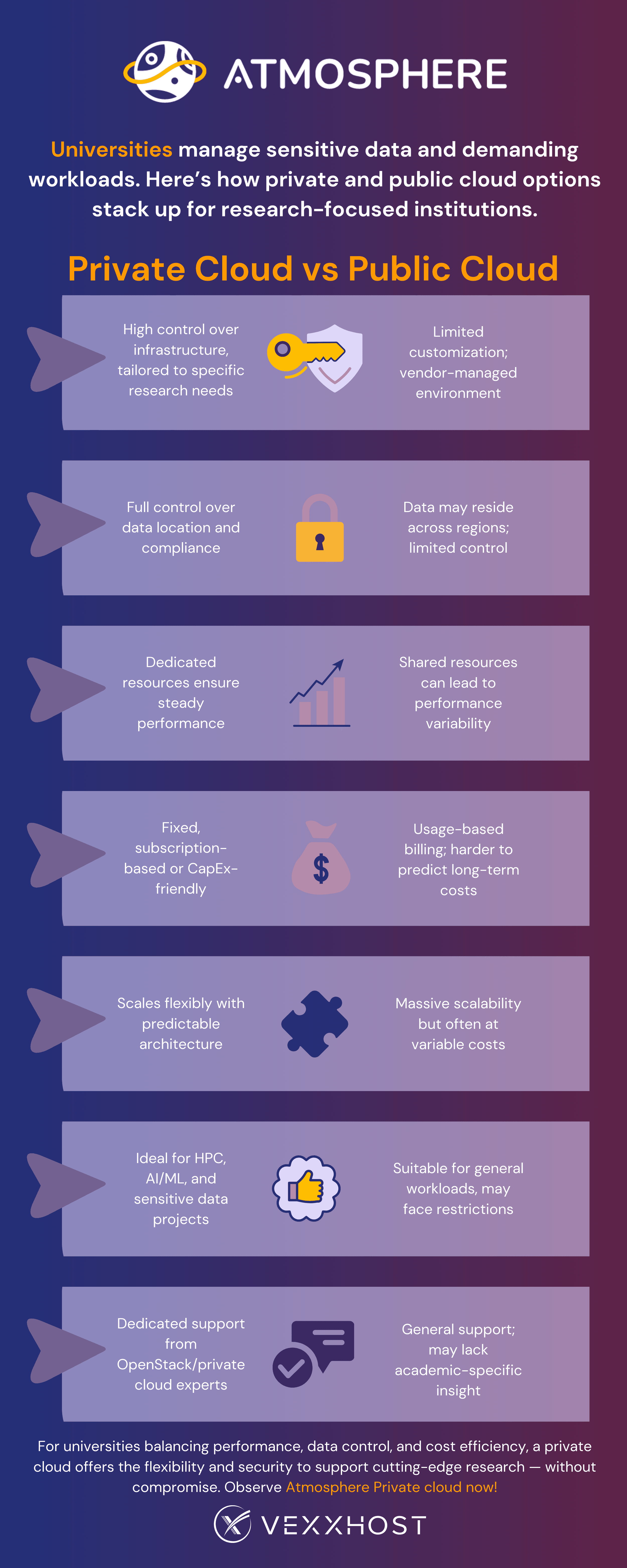
As a leading public research institution and part of the State University of New York (SUNY) system, the University at Buffalo (UB) has long been committed to academic excellence, innovation, and student success. To support its growing research initiatives, UaB required an advanced cloud infrastructure that could meet the demands of high-performance computing (HPC) while maintaining efficiency, scalability, and security. As a result, now UB has a secure and scalable infrastructure, and overall increased efficiency in IT operations.
Initially, UB deployed an on-premises research cloud using OpenStack to augment its HPC capabilities. However, as demand increased, challenges related to system upgrades, Kubernetes cluster management, and resource optimization began to surface. To address these concerns and enhance its infrastructure, UB transitioned its cloud environment to Atmosphere OpenStack.
Before transitioning to Atmosphere, UB encountered significant challenges in maintaining and upgrading its OpenStack private cloud:
These challenges hindered UB’s ability to provide researchers with a seamless and efficient computing environment, necessitating a more robust and automated cloud solution.
As the University at Buffalo's research demands grew, it became clear that their existing cloud infrastructure needed a significant upgrade. The university required a solution that could not only support high-performance computing but also streamline operations and reduce maintenance overhead.
With these goals in mind, UB set out to find a private cloud solution that offered:
After evaluating several cloud providers, UB selected Atmosphere OpenStack for its expertise in managing and optimizing OpenStack environments. This decision marked a strategic shift towards a fully supported, high-performance private cloud solution.
Migrating to a new cloud infrastructure is a complex process, but with careful planning and expert collaboration, we ensured a smooth transition for UB. Working closely with OpenStack engineers, the university took a structured approach to minimize disruptions and maximize efficiency.
The key steps in this migration included:
By following this methodical approach, UB successfully transitioned to Atmosphere OpenStack, maintaining business continuity while unlocking new efficiencies in cloud operations.
The conversion of UB’s cloud infrastructure focused on:
These enhancements allowed UB to optimize its cloud operations and provide a more efficient research environment for faculty and students.
The shift to Atmosphere OpenStack brought significant improvements to UB’s cloud infrastructure, enhancing performance, scalability, and efficiency. By automating key processes and optimizing resource management, the university unlocked new opportunities for its research community.
Here’s how UB benefited from the transition:
By migrating to Atmosphere OpenStack, UB has built a future-ready cloud infrastructure designed to support its growing research and academic initiatives. This transformation ensures long-term efficiency, security, and scalability, empowering the university to stay ahead of technological advancements.
Key benefits of this transition include:
By transitioning to Atmosphere OpenStack, the University at Buffalo successfully modernized its research cloud infrastructure. The migration resolved legacy system challenges for UB enabling them to focus on academic research and technological innovation.
As universities worldwide seek to enhance their IT ecosystems, UB’s journey demonstrates the transformative power of a well-executed private cloud migration. Institutions facing similar challenges can explore how Atmosphere OpenStack can support their digital transformation efforts. Want to eliminate cloud maintenance headaches and scale effortlessly? Get in touch with us to see how Atmosphere OpenStack can transform your research cloud.
Is your institution struggling with legacy system limitations? Discover how Atmosphere OpenStack can enhance your IT infrastructure with seamless upgrades, improved scalability, and automated cloud management. Contact us today to explore a tailored solution for your research and computing needs.
Choose from Atmosphere Cloud, Hosted, or On-Premise.
Simplify your cloud operations with our intuitive dashboard.
Run it yourself, tap our expert support, or opt for full remote operations.
Leverage Terraform, Ansible or APIs directly powered by OpenStack & Kubernetes