

OpenStack
OpenStack Support: In-House vs. Managed Services
Compare in-house OpenStack operations, expert support, and managed services. Learn who should handle upgrades, incidents, and ongoing cloud operations.
Lire la noteNotes de terrain / Dernières nouvelles
Des notes d’ingénierie issues de l’exploitation d’infrastructures ouvertes : pannes, décisions de conception et travail upstream qui améliorent l’infrastructure ouverte.
Parcourir toutes les notesCompare in-house OpenStack operations, expert support, and managed services. Learn who should handle upgrades, incidents, and ongoing cloud operations.
Lire la note
Air gapped cloud on OpenStack: how Atmosphere's digest-pinned release manifests move a release across the boundary, and what the manifest leaves out.
Lire la note
Learn when your team needs OpenStack consulting services and how expert support can help with deployments, migrations, upgrades, and operations.
Lire la note
Compare in-house OpenStack operations, expert support, and managed services. Learn who should handle upgrades, incidents, and ongoing cloud operations.
Running OpenStack in production requires more than deploying compute, networking, and storage services. Organizations must also manage upgrades, troubleshoot incidents, monitor infrastructure health, and maintain specialized expertise as their environments evolve.
For teams with experienced OpenStack engineers, handling these responsibilities internally can make sense. But as infrastructure grows, maintaining that expertise may compete with other engineering priorities.
The decision is not simply whether to manage OpenStack internally or outsource everything.
Organizations generally have three options: fully self-managed operations, internal operations backed by expert OpenStack support, or fully managed services.
Choosing between them depends on technical capabilities, operational risk, coverage requirements, and how an organization wants to use its engineering resources.
OpenStack support services can cover several areas of infrastructure operations:
The scope varies significantly between providers and service agreements.
Community resources offer documentation, technical discussions, and troubleshooting guidance. Commercial OpenStack support adds contractual commitments, defined escalation procedures, and access to specialists for covered issues.
For organizations running business-critical workloads, that distinction becomes important when incidents require timely intervention.
In a self-managed environment, the internal team owns the infrastructure lifecycle, including monitoring, upgrades, incident response, security maintenance, and capacity planning.
This model works well when an organization has experienced OpenStack engineers, established automation, and sufficient operational coverage.
It offers direct control over technical decisions and maintenance schedules. However, the organization must also maintain specialist knowledge and ensure engineers are available when problems occur.
Under this model, internal engineers continue operating the environment but can escalate complex issues to external specialists.
An OpenStack support provider may assist with:
This approach preserves internal operational ownership while providing access to expertise when needed.
It is particularly useful for teams that understand their infrastructure but lack the capacity or specialized knowledge to address every issue independently.
With managed OpenStack services, a provider assumes responsibility for defined operational activities, such as monitoring, maintenance, upgrades, and incident response.
Internal teams can focus more on applications, automation, and business requirements rather than maintaining the underlying cloud platform.
Importantly, managed operations do not necessarily mean transferring ownership of infrastructure.
The OpenStack Marketplace recognizes remotely managed private clouds, where organizations can retain infrastructure in their own facilities while external specialists manage the environment.
The key difference is who performs and remains accountable for operational work.
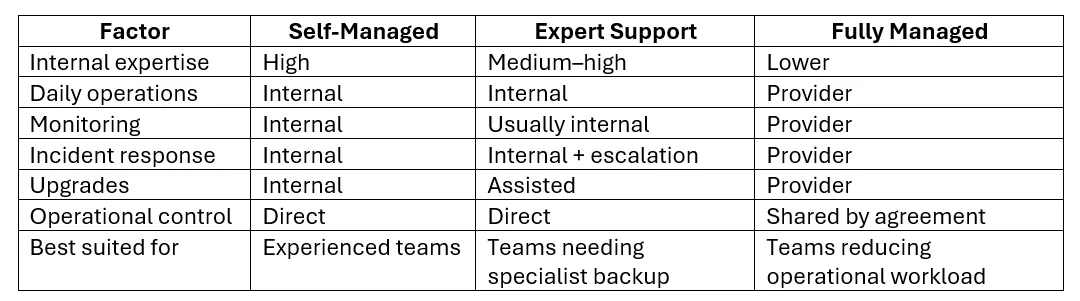
These are typical responsibility models. Actual coverage depends on the agreement.
The question is not necessarily whether your team can operate OpenStack.
It is whether maintaining deep OpenStack operational expertise is the best use of that team's time.
Several warning signs suggest that external OpenStack support may be worth considering.
When only one or two engineers understand the deployment architecture, operational continuity depends heavily on their availability.
Specialist support can provide another escalation path while the organization improves documentation and knowledge-sharing.
OpenStack upgrades require compatibility checks, testing, and coordination across services.
Repeatedly postponing upgrades because engineers lack time or specialized expertise can increase maintenance risk.
A failed VM deployment may involve Nova scheduling, Neutron networking, Ceph storage, or supporting control-plane services.
Troubleshooting such incidents requires understanding how those components interact, not simply how each one works individually.
Business-critical infrastructure may require incident response outside standard working hours.
Maintaining reliable internal coverage means staffing an on-call rotation, documenting procedures, and ensuring escalation paths are available.
If infrastructure maintenance continually delays application development or higher-priority projects, it may be time to reassess how operational responsibilities are distributed.
External support is not automatically more economical. Its value depends on whether it improves coverage, reduces operational risk, or frees internal capacity for more important work.
One of the most important distinctions between OpenStack support and managed operations is responsibility during infrastructure changes and failures.
Consider an OpenStack upgrade.
A support-only provider might review the upgrade plan, advise on compatibility, and help troubleshoot failures. The customer's engineers still execute the upgrade.
Under a fully managed agreement, the provider typically plans and performs covered platform upgrades, coordinating maintenance windows and validation with the customer.
The same distinction applies to incidents.
If Nova becomes unavailable, Neutron networking fails, or Ceph storage experiences degradation, the support agreement should clearly identify who detects the incident, begins troubleshooting, and coordinates recovery.
A typical responsibility matrix looks like this:
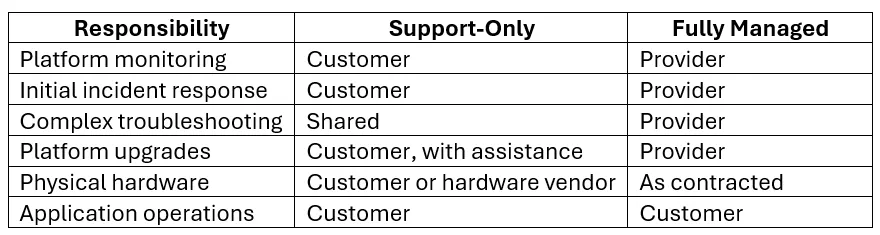
This is an illustrative model, not a substitute for contractual terms.
24/7 technical support does not automatically mean 24/7 proactive monitoring or full incident ownership.
Organizations should confirm response commitments, escalation procedures, maintenance responsibilities, and service boundaries before selecting a provider.
Fully managed operations are not always the best choice.
Self-management may remain appropriate when an organization has:
For these organizations, occasional OpenStack consulting or a support-only agreement may provide sufficient assistance without transferring daily operations.
The objective should be to select the right level of expertise, not the most comprehensive service package.
Before choosing an OpenStack support provider, consider these questions:
1. What responsibilities are included? Determine whether the agreement covers troubleshooting, upgrades, monitoring, architecture reviews, or ongoing operations.
2. What happens during a critical incident? Confirm coverage hours, response commitments, escalation procedures, and who takes responsibility for remediation.
3. Does the provider understand your infrastructure? OpenStack support may require expertise across networking, storage, Kubernetes, automation, and physical infrastructure.
4. Who owns upgrades? Establish who plans, tests, executes, and validates platform changes, including recovery procedures if problems occur.
5. Can the operating model evolve? A team may initially require consulting or specialist escalation and later decide to transfer selected operational responsibilities.
A good support arrangement makes responsibilities clear before they become urgent.
The right operating model depends on your team's capabilities and infrastructure requirements.
Choose self-managed OpenStack when internal expertise, staffing, and operational processes are sufficient.
Choose expert OpenStack support when your team can manage the platform but needs specialist assistance for complex issues, upgrades, or critical incidents.
Choose fully managed OpenStack when transferring routine infrastructure operations creates more value than maintaining those responsibilities internally.
The goal is not to eliminate internal expertise. It is to ensure that the people responsible for your infrastructure have the capabilities, time, and support required to operate it reliably.
VEXXHOST provides OpenStack support and managed services for organizations running private cloud infrastructure.
Our OpenStack engineers support architecture, deployments, upgrades, troubleshooting, and Day 2 operations.
Organizations can retain control of their infrastructure with expert support or choose fully managed operations, whether their cloud runs on-premises or in VEXXHOST's data centers.
We also offer OpenStack professional services for organizations requiring targeted architecture, deployment, or upgrade assistance.
Not sure which OpenStack operating model fits your team?
Talk to a VEXXHOST OpenStack expert to discuss your infrastructure, operational requirements, and support options.
Choose from Atmosphere Cloud, Hosted, or On-Premise.
Simplify your cloud operations with our intuitive dashboard.
Run it yourself, tap our expert support, or opt for full remote operations.
Leverage Terraform, Ansible or APIs directly powered by OpenStack & Kubernetes