

Kubernetes
SaaS Infrastructure: Shared Kubernetes, Clusters or VMs?
Compare shared Kubernetes, tenant namespaces, dedicated clusters, and VMs for SaaS infrastructure. Learn how isolation, costs, and operations shape your choice.
Lire la noteNotes de terrain / Dernières nouvelles
Des notes d’ingénierie issues de l’exploitation d’infrastructures ouvertes : pannes, décisions de conception et travail upstream qui améliorent l’infrastructure ouverte.
Parcourir toutes les notesCompare shared Kubernetes, tenant namespaces, dedicated clusters, and VMs for SaaS infrastructure. Learn how isolation, costs, and operations shape your choice.
Lire la note
Learn why backups alone don't guarantee recovery and how RTO, RPO, infrastructure dependencies, and recovery testing improve disaster readiness.
Lire la note
Compare private AI inference, managed endpoints, and public AI APIs. Learn when data control, latency, model flexibility, and cost justify a change.
Lire la note
A multi-cloud infrastructure involves two or more cloud computing platforms or providers handling various business-related tasks. Read on.
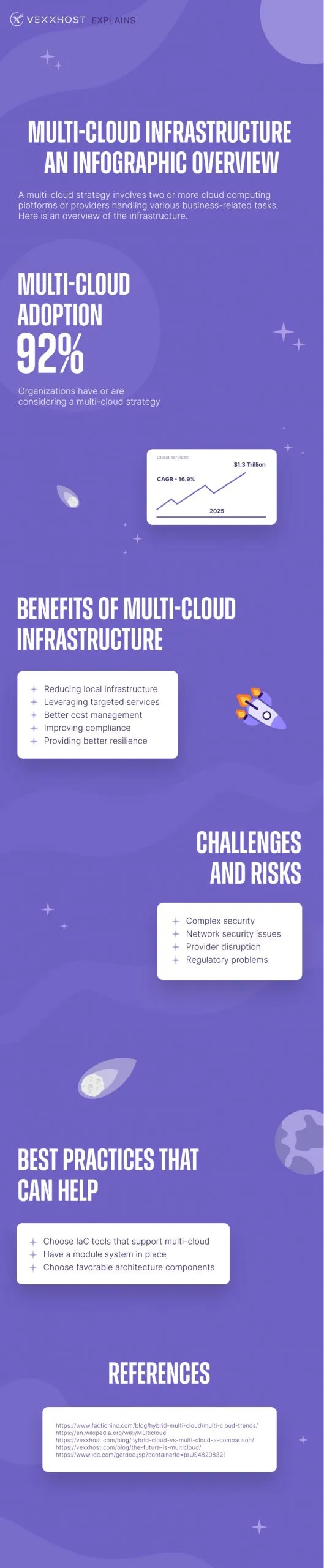
Multi-cloud infrastructure is attracting companies small and large. Most companies with a cloud provider are also thinking about integrating a multi-cloud strategy. Ultimately, it all comes down to the business, the product you are offering, and your users' expectations. These factors will determine whether multi-cloud is of importance or not. In this context, here is an overview of the topic.
A multi-cloud strategy involves two or more cloud computing platforms or providers handling various business-related tasks. Such an approach can be extensive and complex depending on the number of clouds within and how a business uses each cloud resource or service. The latest studies show that around 92% of cloud adopters have already implemented or are considering a multi-cloud infrastructure. Furthermore, cloud service adoption is projected to reach a market share of $1.3 trillion by 2025 with a compound annual growth rate (CAGR) of 16.9%.
Why do businesses need multi-cloud infrastructure? Well, because it comes with various benefits – such as:
Organizations with a multi-cloud environment also face some new risks and challenges such as:
Enterprises with a multi-cloud approach must understand the configurations of the resources and services it uses and monitor their performance using the tools at their disposal.
As we have seen, multi-cloud infrastructure comes with certain pros and cons. Now it's worth looking at some best practices to tackle the challenges and leverage the benefits to their full potential. Here are three of them:
Hybrid cloud and multi-cloud strategies differ in their aim and infrastructure. They have several similarities and differences among them. The similarities include:
Now, here are the key differences;
Given these similarities and differences, both strategies are seen as separate approaches with distinct purposes. However, hybrid, they can coexist.
Multi-cloud infrastructure requires careful planning from the beginning including avoiding lock-ins with cloud providers. As a reputed IaaS provider, we ensure that our clients get the best multi-cloud services through our OpenStack-based clouds. At VEXXHOST, we provide cloud solutions for a multitude of clients worldwide. We provide public clouds and dedicated and highly secure private cloud environments, ensuring utmost security and agility.
Take advantage of our limited-time deal just to set up a one-time, OpenStack-based private cloud deployment – at 50% off! The cloud will be running on the latest OpenStack release, Wallaby, which allows you to run Kubernetes and VMs in the same environment, and can be deployed in your own data centers with your hardware. Furthermore, all these will be deployed and tested in under a month!
What are you waiting for? Learn more!
Choose from Atmosphere Cloud, Hosted, or On-Premise.
Simplify your cloud operations with our intuitive dashboard.
Run it yourself, tap our expert support, or opt for full remote operations.
Leverage Terraform, Ansible or APIs directly powered by OpenStack & Kubernetes