

OpenStack
Air gapped cloud upgrades with Atmosphere release manifests
Air gapped cloud on OpenStack: how Atmosphere's digest-pinned release manifests move a release across the boundary, and what the manifest leaves out.
Lire la noteNotes de terrain / Dernières nouvelles
Des notes d’ingénierie issues de l’exploitation d’infrastructures ouvertes : pannes, décisions de conception et travail upstream qui améliorent l’infrastructure ouverte.
Parcourir toutes les notesAir gapped cloud on OpenStack: how Atmosphere's digest-pinned release manifests move a release across the boundary, and what the manifest leaves out.
Lire la note
Assess enterprise AI readiness before investing in GPUs. Explore 12 key factors covering data, models, infrastructure, governance, operations, and costs.
Lire la note
Explore on-premises Kubernetes architecture, costs, and operational challenges. Learn when managed Kubernetes makes sense for production workloads.
Lire la note
Assess enterprise AI readiness before investing in GPUs. Explore 12 key factors covering data, models, infrastructure, governance, operations, and costs.
Investing in AI infrastructure before understanding the workload can be an expensive mistake.
An organization might purchase GPU capacity, select a large language model, or build a private AI environment, only to discover that its data is difficult to access, its applications cannot integrate with the system, or its team is unprepared to operate it in production.
The challenge is not always computing power. It is knowing what the AI system needs to accomplish and whether the organization has the foundations to support it.
An AI readiness assessment helps answer these questions before significant investments are made. For enterprise teams, that means evaluating business objectives, data, models, infrastructure, security, operations, and costs together.
The goal is straightforward: identify which AI workloads are worth pursuing, what they require, and what needs to change before deployment.
An enterprise AI readiness assessment evaluates whether an organization has the business, technical, and operational capabilities needed to implement AI successfully.
It goes beyond determining whether GPUs are available or whether employees have experimented with generative AI.
Microsoft's AI Readiness Assessment evaluates preparedness across business strategy, governance, data foundations, organizational capabilities, infrastructure, and model management.
For infrastructure decision-makers, an assessment should translate these considerations into an actionable plan: which workloads to prioritize, which deployment approaches to evaluate, and what investments are justified.
Before investing in AI infrastructure, organizations should evaluate the following areas.
Every AI investment should begin with a defined business problem.
An internal knowledge assistant, an automated document-processing system, and a customer-facing inference application have different requirements.
Identify the intended workflow, business owner, expected benefits, and measurable success criteria. Relevant metrics might include processing time, answer quality, task completion rate, or cost per successful outcome.
Key question: What measurable improvement should this AI system deliver?
AI systems depend on accessible, reliable, and relevant data.
Enterprise information is often distributed across databases, documents, applications, and departments. Inconsistent formats, outdated records, and fragmented access permissions can limit model effectiveness.
Before selecting infrastructure, identify the required data sources, their owners, quality issues, and retrieval requirements.
Key question: Is representative, reliable data available to support the intended workload?
Not every workload requires the largest available model.
Evaluate potential models against actual business tasks, considering accuracy, reasoning capabilities, context length, language support, licensing, and operational requirements.
A smaller model may handle a specialized task efficiently, while a more complex application may justify a larger model.
Selection should follow evaluation results rather than model popularity.
Key question: Has the organization tested suitable models against defined acceptance criteria?
Different AI approaches have different infrastructure requirements.
Inference runs an existing model. Retrieval-augmented generation (RAG) connects models to external information. Fine-tuning adapts an existing model, while training develops model capabilities through substantially more computationally intensive processes.
An internal document assistant may require retrieval and inference rather than dedicated training infrastructure.
Understanding this distinction can prevent unnecessary GPU spending.
Key question: Does the workload require model training, or can an existing model meet its needs?
Organizations handling sensitive information must determine where data is processed, who can access it, and what retention policies apply.
These requirements may influence whether the workload uses a public AI API, managed private inference, or infrastructure deployed on-premises.
Data residency is only one consideration. Provider access, processing locations, contractual obligations, and operational controls also matter.
Key question: Can the deployment model satisfy the organization's data-handling and compliance requirements?
A successful pilot does not automatically translate into production readiness.
Inference workloads should be evaluated against realistic request volumes, peak concurrency, response-time targets, and context lengths.
Training workloads may require additional consideration of distributed computing, network bandwidth, and checkpointing.
Capacity planning should reflect measured workloads rather than theoretical hardware performance.
Key question: Can the proposed environment meet performance requirements under realistic production demand?
GPU capacity is one component of an AI system.
Storage must support model artifacts, datasets, and retrieval indexes. Networking must accommodate application traffic and data movement. The platform must provide appropriate provisioning, isolation, and monitoring.
Infrastructure assessment should also consider whether existing resources can support the workload or dedicated accelerated compute is necessary.
Key question: Have compute, storage, networking, and platform requirements been evaluated together?
An AI model delivers limited value if it cannot connect to the workflows employees or customers already use.
Enterprise applications may require integration with identity systems, internal APIs, CRM platforms, databases, or document repositories.
Authentication, permissions, data synchronization, and failure handling should be considered early, especially when AI systems initiate actions rather than simply generate responses.
Key question: Can the AI workload integrate securely with existing applications and business processes?
AI introduces security considerations beyond conventional application infrastructure.
Organizations must address access controls, sensitive data exposure, model evaluation, logging, prompt injection, and third-party dependencies.
The NIST AI Risk Management Framework provides guidance for identifying and managing AI-related risks throughout the system lifecycle.
Key question: Are appropriate security controls, evaluation procedures, and risk responsibilities defined?
Deploying a model is different from maintaining a reliable AI service.
Production systems require monitoring, incident response, upgrades, capacity management, and ongoing evaluation.
Responsibilities should be established across infrastructure, application, security, and business teams.
Managed services can reduce the operational burden, but organizations still need ownership of business outcomes, application quality, and governance.
Key question: Who is accountable for operating and improving the AI system after deployment?
Production AI systems need documented availability requirements, recovery procedures, and support arrangements.
Organizations should consider how the environment responds to hardware failures, unexpected traffic, model changes, and service interruptions.
They also need processes for monitoring output quality and responding when model behavior no longer meets expectations.
Key question: Can the organization maintain the required service quality when infrastructure or models change?
GPU acquisition or rental is only part of AI infrastructure spending.
Total costs can include compute, storage, networking, software integration, monitoring, support, and operational staffing.
Inference economics should consider actual utilization, token consumption, concurrency, and the cost of successful business outcomes.
Dedicated infrastructure becomes easier to justify when demand, utilization, and performance requirements are sufficiently predictable.
Key question: Does the organization understand the expected operating cost and business value of the workload?
Not every organization, or every workload within it, is ready for production AI.
A practical assessment can classify individual workloads into four stages.
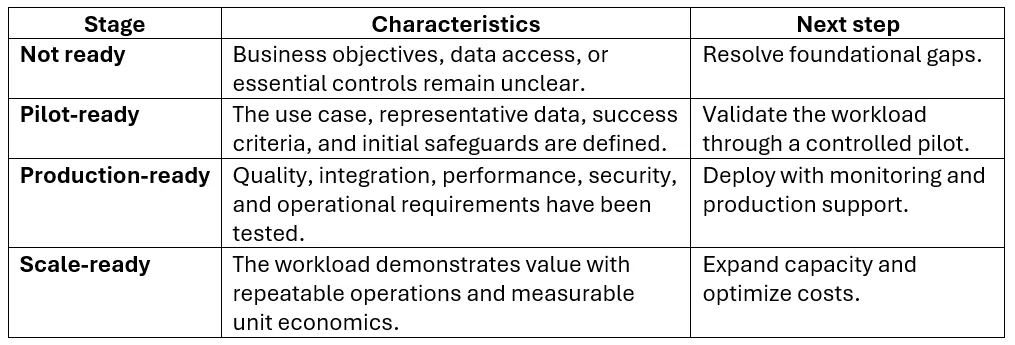
These are practical planning categories rather than formal certifications.
Importantly, readiness should not be determined by an average score alone. A workload with excellent model performance, but unresolved security or data-access issues should not be considered production-ready.
Consider an enterprise planning an AI assistant that answers employee questions using internal documentation.
The initial assumption might be that the organization needs a dedicated GPU environment to run a private language model.
However, an AI readiness assessment could reveal that the primary challenges are outdated documents, inconsistent permissions, and a lack of integration with existing systems.
A more effective initial approach may involve organizing the data, implementing retrieval, and testing a suitable model through a managed inference endpoint.
Only after measuring response quality, concurrency, latency, privacy requirements, and operating costs can the team determine whether dedicated GPU infrastructure is justified.
The assessment changes the purchasing question from "Which GPUs should we buy?" to "What architecture does this workload actually need?"
Dedicated AI infrastructure becomes easier to justify when an organization has established workload requirements and can demonstrate a need for greater deployment control, sustained capacity, predictable performance, or specific data-handling arrangements.
For some organizations, managed inference is sufficient. Others may require dedicated GPUs for training, specialized models, consistently high inference volumes, or tightly controlled deployments.
The decision should follow a practical sequence:
This approach helps organizations avoid overprovisioning while preserving flexibility as demand grows.
For a deeper comparison of model-serving economics, see our guide to reducing LLM inference costs.
At VEXXHOST, AI adoption can begin with understanding the business problem rather than purchasing infrastructure.
Our AI Advisory services help organizations identify practical AI opportunities, evaluate technical requirements, choose appropriate models, and integrate AI into existing workflows.
When workloads are ready for deployment, VEXXHOST offers additional options:
The appropriate starting point depends on what the workload needs and what the organization is ready to operate.
An assessment should evaluate business objectives, data quality, model requirements, infrastructure, integration, security, governance, operating responsibilities, and costs. It should produce prioritized actions and a practical implementation roadmap.
Not necessarily. Many enterprise AI applications can begin with existing models and managed inference services. Dedicated GPUs may become appropriate when workload scale, performance, privacy, or deployment requirements justify them.
Enterprise AI readiness evaluates the organization's broader preparedness, including strategy, data, governance, and skills. AI infrastructure readiness focuses on the technical and operational capabilities needed to deploy and maintain a specific AI workload.
AI infrastructure is a long-term operational investment. Making that decision before understanding the workload can introduce unnecessary costs, complexity, and risk.
An AI readiness assessment provides a foundation for deciding which applications to prioritize, how they should be deployed, and what infrastructure they actually require.
Before investing in GPUs or private AI infrastructure, establish what the workload needs to succeed.
Choose from Atmosphere Cloud, Hosted, or On-Premise.
Simplify your cloud operations with our intuitive dashboard.
Run it yourself, tap our expert support, or opt for full remote operations.
Leverage Terraform, Ansible or APIs directly powered by OpenStack & Kubernetes