

OpenStack
Why Infrastructure Documentation Is Never Really Finished
Learn why infrastructure documentation becomes outdated, the operational risks it creates, and how automation helps keep it accurate.
Lire la noteNotes de terrain / Dernières nouvelles
Des notes d’ingénierie issues de l’exploitation d’infrastructures ouvertes : pannes, décisions de conception et travail upstream qui améliorent l’infrastructure ouverte.
Parcourir toutes les notesLearn why infrastructure documentation becomes outdated, the operational risks it creates, and how automation helps keep it accurate.
Lire la note
Learn when Private Cloud as a Service (PCaaS) makes sense. Compare managed private cloud, self-built infrastructure, costs, operations, and provider options.
Lire la note
Learn the difference between Canadian sovereign cloud and data residency, including jurisdiction, infrastructure control, provider ownership, private cloud, and OpenStack.
Lire la note
Questions linger around essential features such as high availability for VMs, entering maintenance mode, the efficiency of DRS, the nuances of storage integration, and among others, the simplicity of updates.
Embarking on the cloud migration journey from VMware to OpenStack brings with it a mix of anticipation and apprehension, particularly when it comes to the functionality that may be compromised in the process.
Questions linger around essential features such as high availability for VMs, entering maintenance mode, the efficiency of DRS, the nuances of storage integration, and among others, the simplicity of updates. All these critical aspects require thorough understanding and careful consideration. Each element plays a vital role in ensuring a robust and reliable infrastructure, tailored to meet the dynamic needs of your business.
So, what can you rely on in this pivotal shift, and what are the key considerations to account for?
#learning OpenStack
It's crucial to first acknowledge the learning curve that often accompanies a transition into the OpenStack ecosystem. For those embarking on this journey, the breadth of OpenStack components may initially appear overwhelming, but with time and exploration, it becomes a landscape rich with opportunity and potential.
The power of OpenStack is amplified by a strong community committed to innovation and collaboration, so there is nothing to fear. This collective endeavour not only enhances the platform but also provides a wealth of knowledge and support to help ease the adoption process for newcomers.
#adapting to the OpenStack
However, adapting to the dynamic nature of OpenStack's ecosystem is also a significant challenge, as new versions of its components are traditionally released on a semi-annual basis. This fast-paced cycle of evolution can be a considerable hurdle, especially when attempting to align with the migration goals and timelines of clients. Furthermore, maintenance adds another layer of responsibility—one that is manageable but still contributes additional demands to the workload.
#out-the-box?
When considering the transition to OpenStack, it's important to understand that the platform might not deliver the immediate, out-of-the-box functionality that users have come to expect from VMware. Features that are often a click away in VMware, such as high availability for VMs, straightforward maintenance mode activation, efficient resource management with DRS, and hassle-free updates, can necessitate a deeper dive into configurations and manual operations within an OpenStack environment.
A key consideration in the shift to OpenStack is the recognition that it may not offer the same 'ready-to-use' experience as VMware. Features such as high availability for VMs, maintenance mode, DRS , and streamlined updates – all typically managed with a single click in VMware – often demand extensive setup and hands-on management in OpenStack. Additionally, integrating storage solutions requires careful planning within OpenStack, as not all supported drivers may perform as seamlessly as one might experience with VMware.
Moreover, the task of integrating storage solutions stands out as a significant concern. A well-thought-out design is essential, as the compatibility and ease of use of declared storage drivers in OpenStack may not match the near-effortless integration found in VMware's ecosystem.
OpenStack has a robust set of projects that cover these functionalities. It's worth noting that OpenStack's community actively develops and maintains these projects, and while they might require more initial configuration, they offer a powerful and flexible infrastructure once set up.
Once properly configured, these projects can provide a level of customization and scalability that can adapt to the evolving needs of businesses. Furthermore, the open-source nature of these tools means that they are continually being improved upon, with updates and new features regularly added to enhance performance and user experience.
Transitioning to OpenStack can also lead to significant cost savings, with its open-source licensing model eliminating the need for expensive proprietary software licenses.
VEXXHOST is deeply rooted in the OpenStack community, with active contributions tracing back to the Bexar release. The company actively engages in the ecosystem by contributing upstream code, as well as providing insights and feedback directly to Project Team Leads (PTLs) and fellow developers. Encountered bugs are not only reported but also meticulously diagnosed, with collaborative efforts made alongside the community to devise comprehensive solutions.
Moreover, VEXXHOST maintains a strong presence on community offering valuable feedback and contributing to the resolution of issues, so if you find yourself in need of guidance, please explore our solutions, or consider Atmosphere, a fully integrated distribution of OpenStack, that streamlines the complex transition process, providing tools and support that rival the efficiency of VMware's solutions.
This is where Atmosphere steps in to bridge the gap and help you navigate these challenges. As a fully integrated distribution of OpenStack, Atmosphere streamlines these complex processes. It simplifies the transition by providing robust tools and support that facilitate the high availability of VMs, enabling maintenance modes that rival the efficiency of VMware's solutions, and offering an experience akin to DRS for effective resource management.
Atmosphere also stands as a versatile, open-source OpenStack deployment tool, catering to a comprehensive range of cloud infrastructure management requirements. Designed to accommodate Cloud, Hosted, and On-Premise editions, it excels in a wide array of deployment scenarios, emphasising both flexibility and scalability. The automation provided by Kubernetes and OpenStack-Helm streamlines the deployment process, enabling an efficient and consistent provisioning of OpenStack resources.
In terms of updates, Atmosphere leverages the OpenStack community's innovations while ensuring that these enhancements are delivered in a user-friendly manner, reducing the need for extensive manual intervention. The platform's approach to storage integration is similarly user-centric, offering a more straightforward experience that aligns more closely with users' expectations coming from VMware's environment.
By adopting OpenStack with Atmosphere, organizations can future-proof their infrastructure, ensuring it remains adaptable to emerging technologies and scalable to meet future demands.
Atmosphere's commitment to providing a seamless transition and operational experience showcases the potential of OpenStack when supplemented with the right tools and expertise. It underscores the platform's adaptability and readiness to support businesses in their growth, without the added complexities and costs often associated with open-source solutions.
Here is a comparative chart that outlines the features available in Atmosphere, juxtaposed against other platforms. This overview provides a clear perspective on how Atmosphere stacks up, offering a comprehensive glimpse into the functionalities you can expect when choosing our platform for your cloud needs.
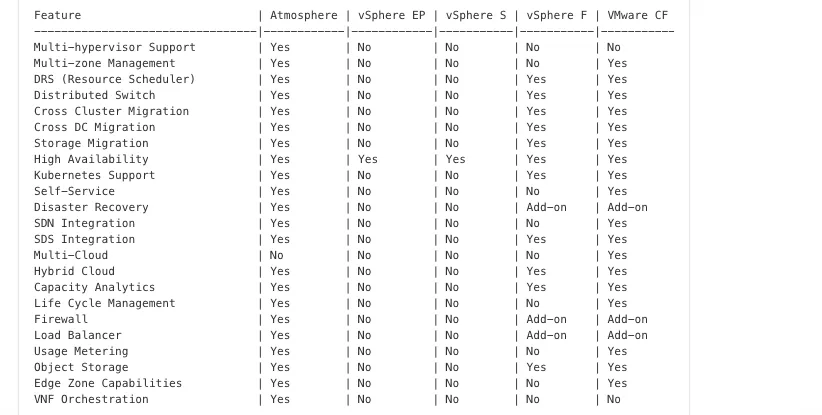
When it comes to storage, Atmosphere is designed to integrate with a wide range of storage solutions, including existing systems you may already have in place. Whether you're looking to continue using your current setup or considering a transition to a robust and scalable option like Ceph, Atmosphere has the flexibility to accommodate your storage requirements. We provide various scenarios to align with your business needs, ensuring a smooth integration path for your storage into the cloud infrastructure.
To learn more about how Atmosphere handles storage integration and to explore the storage options that best fit your business needs, visit our detailed blog post: Deploying Atmosphere: A Guide to Storage Integration. Here, you'll find in-depth information about integrating existing storage systems, transitioning to Ceph, and how Atmosphere can support your storage strategy.
Atmosphere's breadth of capabilities demonstrates our commitment to providing a full-fledged, open-source OpenStack deployment tool that spans the full spectrum of cloud infrastructure management. But we understand that navigating and managing such a comprehensive platform can be a complex task. That's where our fully managed services come into play.
By choosing our fully managed Atmosphere solution, you can leave the heavy lifting to us. Our team of experts takes on the responsibility of managing your cloud infrastructure, from initial deployment to ongoing maintenance and scaling. This not only frees up your internal resources to focus on your core business operations but also ensures that your cloud environment is optimized, secure, and up-to-date at all times.
With a fully managed Atmosphere service, you gain the benefits of our proactive monitoring, real-time alerts, and swift issue resolution, all while enjoying the peace of mind that comes with having a dedicated team ensuring your cloud infrastructure is performing at its best. Plus, you'll have direct access to our support and expertise, including strategic advice on how to best leverage Atmosphere's features to meet your unique business challenges.
To facilitate a seamless transition of workloads to OpenStack and minimize any disruption to your business operations, we offer managed migration services tailored to streamline the process and optimize the migration timeline. Our MigrateKit tool is specifically designed to support these services, simplifying OpenStack migrations by addressing common challenges and ensuring a smooth pathway to your new cloud environment.
Discover more about how MigrateKit can assist with your migration needs by visiting Simplified OpenStack Migrations: Introducing MigrateKit.
In conclusion, while the path from VMware to OpenStack presents its set of challenges, the rewards in flexibility, scalability, and community support are substantial. Atmosphere serves as a powerful ally in this transition, providing the necessary tools and services to ensure a successful migration and the ongoing success of your cloud infrastructure.
If you’d like to bring Atmosphere into your organization with the help of our team of experts, our team can provide you with professional services for deployment, a subscription to provide full 24x7x365 support for Atmosphere (including OpenStack, & more), or a full hands-free remote operations, reach out to our sales team today!
Choose from Atmosphere Cloud, Hosted, or On-Premise.
Simplify your cloud operations with our intuitive dashboard.
Run it yourself, tap our expert support, or opt for full remote operations.
Leverage Terraform, Ansible or APIs directly powered by OpenStack & Kubernetes