Managing corporate data through cloud-based DBMS is highly efficient. Let's see why businesses are increasingly opting for DBaaS as a solution.
Innovations in Database Management Systems (DBMS) are welcome by organizations that operate in the cloud. On-premise database infrastructure is the expensive alternative that businesses are slowly stepping away from. Therefore, cloud service providers are the default platforms for DBMS now.
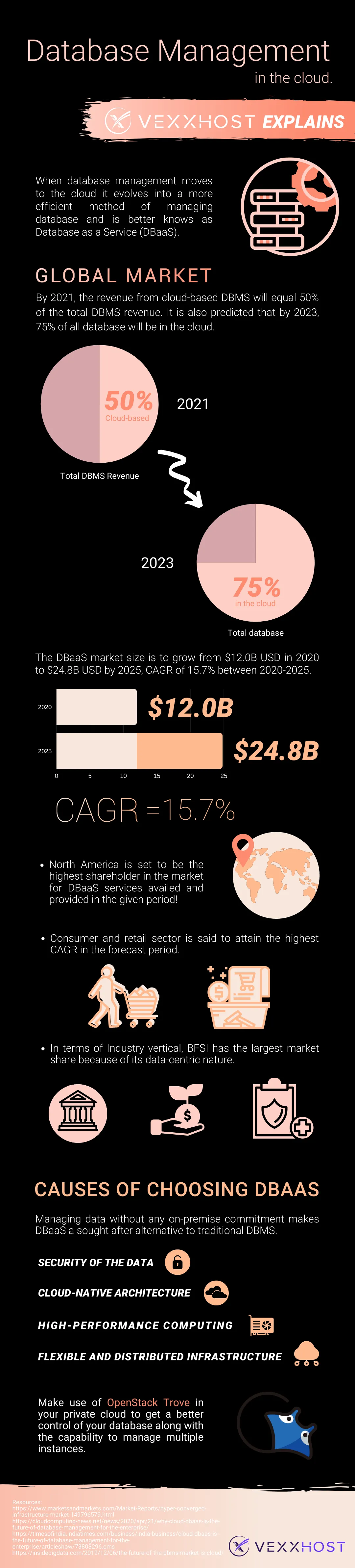
The transition from enterprise, on-premise DBMS promises significant growth in the revenue of cloud-based service in the years to come. According to researchers, by 2021, the revenue from cloud-based DBMS will equal 50% of the total DBMS revenue. It is also predicted that by 2023, 75% of all database will be in the cloud.
What is DBaaS?
Cloud-based DBMS is better known as Database as a Services (DBaaS). DBaaS allows users to access, edit and manage corporate data without any on-premise facility. It frees up capacity in terms of capital investment required to maintain and run the facility. Having your database cluster in the cloud lets your cloud provider take care of everything related to the infrastructure. Thus, your organization can focus on core business objectives.
The DBaaS market size is to grow from USD 12.0 billion in 2020 to USD 24.8 billion by 2025. The Compound Annual Growth Rate (CAGR) is said to reach 15.7% during that period. Other than being a cost-effective method of managing database, DBaaS fulfils other essential roles too. The desire to run a self-driven cloud database is one of the major factors of DBaaS adoption. Let us have a look at what other factors are causing enterprises to move to DBaaS:
- #### Cloud-Native Architecture: As more and more organizations adopt cloud computing they move both generic operations and mission-critical data and applications. To support their existing cloud-native architecture, businesses are looking for reliable ways to manage their database in the cloud. This is where solutions like DBaaS come in. Automating complex administrative tasks from deployment to configuration to patches and even monitoring, all accomplished with one tool.
- #### High-Performance Computing: With changing times, enterprises are taking to high-speed computing options that provide faster compute, analytics and insight. This further promotes rapid innovation opportunities, keeping the competitive edge alive. Choosing DBaaS will boost your organization's ability to innovate faster and stay agile with technological advancements.
- #### Flexible and Distributed Infrastructure: The infrastructure that businesses deploy these days are scalable in terms of availability of resources. So the solutions that accompany such infrastructure also need to be just as flexible. DBaaS is highly elastic and can be adjusted to match the scale of your requirements. Your cloud provider can guide you in picking the suitable cloud-based DBMS which can spin nodes up or down as per your business' needs.
- #### Security of the Data: It is no secret that confidential information and datasets reside in the cloud of most organizations. Keeping such database secure is a top priority for cloud providers and users alike. Using an efficient DBaaS ensures this security with built-in features like standard security measures and encryption that keep data safe.
VEXXHOST and DBaaS
On one hand, DBaaS is one of the many services made available to you by the means of OpenStack projects. On the other, VEXXHOST provides cloud infrastructure services based on OpenStack. Looks like you found yourself a cloud provider! Trove is the DBaaS designed to run entirely on OpenStack. It allows users to provision and manage multiple database instances. It is also a scalable and reliable provisioning functionality for both relational and non-relational database engines.
The team of experts here at VEXXHOST can deploy Trove in your OpenStack Private Cloud environment to help your business get a better grip of database management. Contact us to learn how you can customize your OpenStack Private Cloud with the OpenStack projects best suited for your business needs.