
Sovereign by Architecture: Building AI Infrastructure for the EU AI Act
The EU AI Act takes effect August 2026. Compliance starts at the infrastructure layer. Learn why sovereign AI needs OpenStack, Kubernetes, and Atmosphere.

Perspectives, mises à jour et histoires de notre équipe
The EU AI Act takes effect August 2026. Compliance starts at the infrastructure layer. Learn why sovereign AI needs OpenStack, Kubernetes, and Atmosphere.
Learn how a lightweight keystoneauth1 plugin brings your existing browser-based MFA and SSO to the OpenStack CLI, with no changes to any client tools.
Hyperscaler AI looks fast but hides long-term lock-in and rising costs. See how OpenStack and Kubernetes deliver GPU infrastructure you actually control.

In 2026, enterprises are rethinking public cloud dependency. Explore sovereign cloud, compliance, control, and hybrid strategies.
Sovereign cloud has entered the boardroom. Here's why enterprises are rethinking their relationship with hyperscalers and what that means for infrastructure strategy.
A few years ago, "sovereign cloud" lived mostly in policy documents and EU working groups. That's no longer the case. In 2026, we're seeing it show up in RFPs, architecture reviews, and multi-year infrastructure planning across Europe, North America, and regulated industries worldwide.
This isn't a rejection of public cloud. Public cloud worked — and still works — for many use cases. But the conversation has shifted. Enterprises are no longer just asking "should we move to the cloud?" They're asking something harder: who controls our infrastructure, our data, and the legal framework it operates under?
That shift matters, and it's worth unpacking.
AI workloads depend on large, often sensitive datasets — healthcare records, financial data, citizen information, intellectual property. As enterprises move beyond AI experimentation and into production, they're running into real questions:
These aren't hypothetical concerns anymore. Data sovereignty is directly shaping where and how AI infrastructure gets deployed.
European regulatory frameworks continue tightening requirements around data locality, infrastructure transparency, cross-border transfers, and compliance reporting. European regulatory initiatives, such as the European Data Strategy, continue shaping how enterprises approach infrastructure sovereignty. For organizations operating in the EU, sovereignty has moved from compliance checkbox to risk mitigation strategy — and it's influencing architecture choices accordingly.
Hyperscalers have delivered speed and elasticity over the past decade. No one's disputing that. But many enterprises that went all-in now face a different reality:
In 2026, multi-cloud strategy isn't just about performance optimization. It's about maintaining strategic independence.
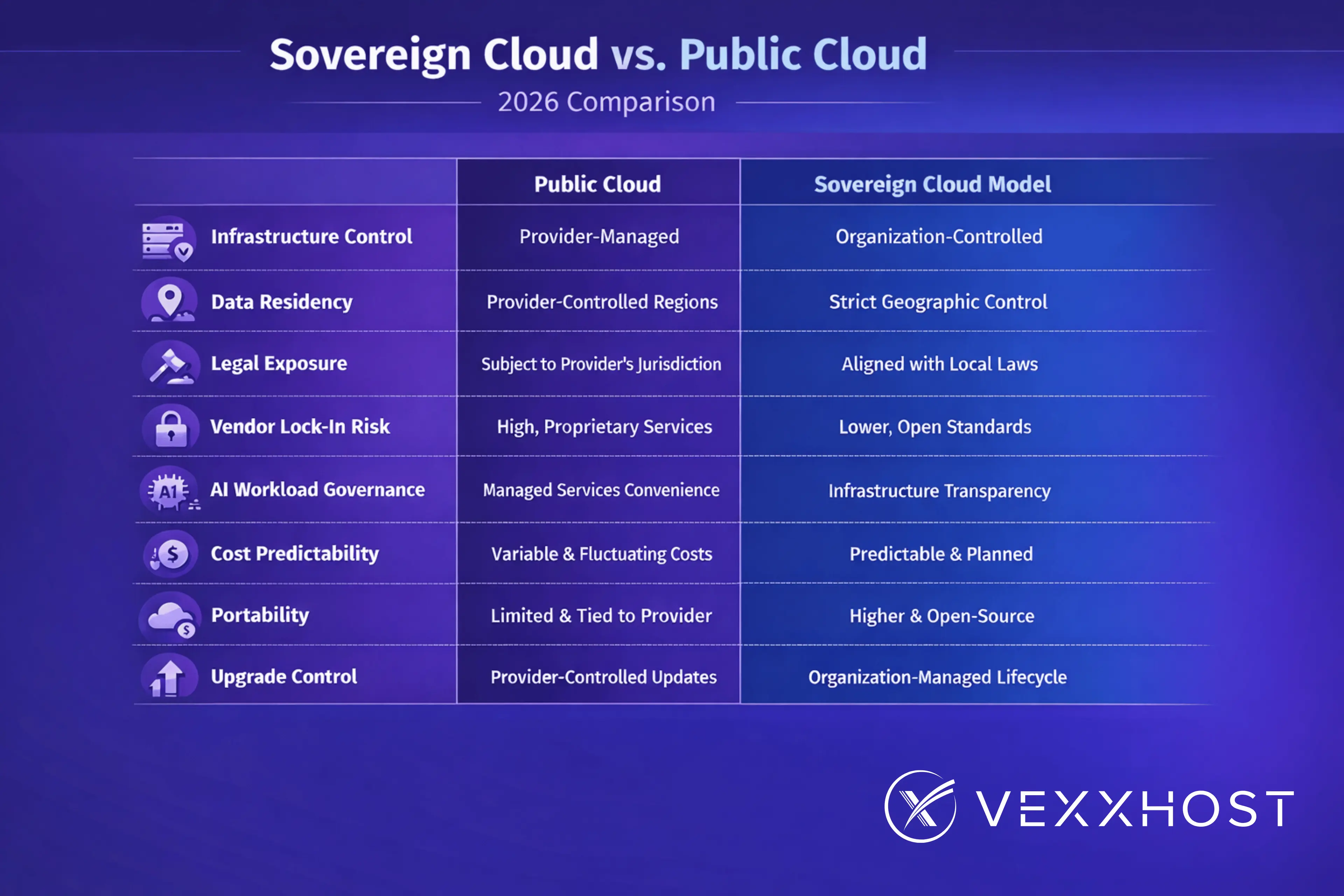
The term gets thrown around loosely, so it's worth being specific. Sovereignty is a set of infrastructure properties:
An important distinction: sovereign cloud is not "we host in Europe." It's about control across the full stack — from hypervisor to API endpoint. If you don't own the layers beneath your workloads, your sovereignty has limits.
We talk to a lot of teams that assume Kubernetes handles sovereignty because it provides orchestration portability. It does — at the application layer. In fact, the CNCF Annual Survey consistently shows widespread Kubernetes adoption in production environments, underscoring how cloud-native platforms have become foundational to enterprise infrastructure strategy. But Kubernetes doesn't inherently give you:
If the compute, storage, and networking underneath your Kubernetes clusters are controlled by a hyperscaler, your workloads might be portable in theory, but your sovereignty is constrained in practice.
Kubernetes solves application orchestration. Sovereignty requires owning what's beneath it.
This is where open infrastructure starts to matter a lot.
OpenStack gives organizations the ability to operate private or hosted sovereign environments with full control over compute, networking, and storage — without proprietary hypervisor dependencies. You can enforce regional data boundaries, align upgrades with internal policy timelines, and maintain complete visibility into every layer of the stack.
When you combine OpenStack with Kubernetes, you get something that's genuinely hard to replicate on hyperscaler platforms:
That layered model is what makes it possible to run cloud-native workloads with real sovereignty — not just marketing sovereignty.
At VEXXHOST, this is exactly how we've built Atmosphere. It's an open-source, OpenStack-based cloud platform that runs upstream Kubernetes and gives organizations full control over their infrastructure. Whether you're running it hosted or on-premise, you maintain visibility and authority over the entire stack. No proprietary hooks. No vendor lock-in.
Let's be practical — full isolation from public cloud isn't the goal for most organizations, and it doesn't need to be.
What we're seeing more of are hybrid sovereignty strategies:
The goal isn't to eliminate public cloud from the picture. It's to stop being strategically over-dependent on it — especially for workloads where control, compliance, and cost predictability really matter.
There's a financial dimension here too, and it's getting harder to ignore.
Public cloud GPU pricing, data egress fees, and long-term AI infrastructure costs are forcing enterprises to re-examine the math. Sovereign infrastructure, when it's designed well, offers:
We've written about this before — OpenStack-powered infrastructure delivers the kind of cost visibility that hyperscalers structurally can't match, because you own the full picture. For teams running serious AI workloads, this is becoming a deciding factor.
At KubeCon + CloudNativeCon Europe 2026, sovereignty, AI infrastructure control, and hybrid independence are going to be central themes. We expect to see real conversations around:
As a Silver Sponsor at KubeCon Europe 2026, we'll be at Booth #797 in Amsterdam — come talk to us about how open cloud infrastructure can support real sovereignty without giving up the innovation speed your teams need.
Public cloud reshaped infrastructure over the past decade. But in 2026, the smartest enterprises are shifting from cloud-first to strategy-first.
Sovereign cloud isn't about turning your back on hyperscalers. It's about answering a set of questions that didn't feel urgent five years ago:
For teams building AI platforms, operating in regulated environments, or running multi-region infrastructure, these questions can't wait.
Sovereignty is an architectural decision. And the architectural decisions you make now are the ones you'll live with for the next decade.
Want to explore how open infrastructure supports sovereign cloud strategy? Talk to our team — we'll help you design the right approach for your environment.
Choose from Atmosphere Cloud, Hosted, or On-Premise.
Simplify your cloud operations with our intuitive dashboard.
Run it yourself, tap our expert support, or opt for full remote operations.
Leverage Terraform, Ansible or APIs directly powered by OpenStack & Kubernetes