

Kubernetes
On-Premises Kubernetes: Architecture, Costs & Management
Explore on-premises Kubernetes architecture, costs, and operational challenges. Learn when managed Kubernetes makes sense for production workloads.
Lire la noteNotes de terrain / Dernières nouvelles
Des notes d’ingénierie issues de l’exploitation d’infrastructures ouvertes : pannes, décisions de conception et travail upstream qui améliorent l’infrastructure ouverte.
Parcourir toutes les notesExplore on-premises Kubernetes architecture, costs, and operational challenges. Learn when managed Kubernetes makes sense for production workloads.
Lire la note
Learn why high availability doesn't guarantee resilience and how failure domains, redundancy, and failover testing help prevent outages.
Lire la note
VEXXHOST attended the ALL IN reception at Scale AI in Montréal, held alongside the Canada–EU Summit, highlighting AI innovation and technology cooperation.
Lire la note
Explore on-premises Kubernetes architecture, costs, and operational challenges. Learn when managed Kubernetes makes sense for production workloads.
Running Kubernetes on-premises gives organizations more control over their infrastructure, workload placement, and resource allocation. But it also introduces responsibilities that managed public cloud services typically handle.
When moving from Amazon EKS, Azure AKS, or Google GKE to infrastructure in your own data center, deploying a Kubernetes cluster is only part of the challenge.
Production environments need reliable networking, highly available control planes, persistent storage, security controls, monitoring, upgrades, and incident response.
The real question isn't simply whether your organization can deploy Kubernetes on-premises. It's whether your team has the resources and expertise to operate it reliably over time.
The good news? On-premises Kubernetes doesn't have to mean self-managed Kubernetes.
Let's explore what production-ready architecture requires, how to evaluate costs, and when managed Kubernetes operations make more sense.
Kubernetes provides a consistent orchestration platform across public clouds, private clouds, virtual machines, and bare-metal infrastructure.
However, the infrastructure supporting that platform differs considerably.
Managed Kubernetes services such as EKS, AKS, and GKE typically operate the Kubernetes control plane and provide integrations with their cloud infrastructure.
With self-hosted Kubernetes, your organization must provide or integrate these capabilities.
Consider two examples:
These dependencies extend beyond initial deployment.
Your organization also becomes responsible for maintaining the underlying infrastructure, responding to failures, and planning capacity as workloads grow.
The official Kubernetes production environment documentation emphasizes availability, scalability, and security as fundamental requirements for production clusters.
A production-ready Kubernetes environment needs more than functioning worker nodes.
The following infrastructure layers determine how reliably applications operate.
The Kubernetes control plane manages cluster state, workload scheduling, and API communication.
A production deployment requiring high availability typically distributes control-plane components across multiple nodes.
This involves:
However, control-plane redundancy alone doesn't guarantee disaster recovery.
Organizations must also consider broader infrastructure failures, including networking outages, storage failures, and facility-level incidents.
Worker nodes provide the compute resources that run application containers.
On-premises Kubernetes can operate on physical servers or virtual machines provisioned through platforms such as OpenStack, VMware, or Nutanix.
Bare-metal deployments can offer direct hardware access for demanding workloads. Virtualized environments provide infrastructure abstraction and may simplify integration with existing systems.
Both approaches require planning for node failures, operating system updates, maintenance windows, and spare capacity.
Kubernetes can reschedule workloads onto available resources, but it cannot provision additional physical hardware when a data center reaches its limits.
Capacity planning must therefore account for expected demand, failure tolerance, and future growth.
Networking becomes particularly important when Kubernetes operates outside a managed cloud environment.
Organizations need to configure container networking through a Container Network Interface (CNI), such as Cilium or Calico, and establish connectivity between workloads and external systems.
They must also address service exposure, external load balancing, DNS, IP address management, and network policies.
These components need to work with existing physical or virtual networks.
For example, an application might be healthy inside Kubernetes but remain inaccessible because of an incorrectly configured load balancer or network route.
Production reliability depends on the complete networking architecture, not only the Kubernetes configuration.
Stateful applications introduce another layer of complexity.
Databases, messaging systems, and other persistent workloads require storage that remains accessible when containers restart or move between nodes.
Kubernetes uses the Container Storage Interface (CSI) to integrate with supported storage platforms.
Ceph storage is one option for environments requiring distributed storage. Through compatible CSI integrations, Ceph can provide block volumes and shared file storage for Kubernetes workloads.
However, storage availability and data recovery are separate requirements.
Replication can protect against certain infrastructure failures, but it doesn't replace backups or protect against every form of data corruption or accidental deletion.
Organizations should define recovery point objectives (RPOs), recovery time objectives (RTOs), and procedures for restoring both cluster configuration and application data.
Operating Kubernetes on-premises provides greater control over infrastructure access and security configurations.
It also creates ongoing responsibilities.
Organizations need to manage identity integration, role-based access control (RBAC), secrets, certificates, network segmentation, and audit logging.
Security maintenance extends to worker operating systems, container runtimes, storage platforms, and other underlying components.
A secure initial configuration isn't enough.
Teams must continuously evaluate vulnerabilities, apply patches, and verify that controls remain effective as the environment changes.
Production Kubernetes requires visibility into the entire platform.
Metrics, logging, monitoring, and alerting must help teams identify whether incidents originate from applications, networking, compute resources, or storage.
Upgrades require similar coordination.
Before updating Kubernetes, teams need to evaluate compatibility, test critical integrations, plan maintenance, and validate application health afterward.
And when something fails outside business hours, someone must be responsible for investigating and restoring service.
This is where the difference between deploying Kubernetes and operating Kubernetes becomes most apparent.
On-premises Kubernetes can offer favorable economics for organizations with existing infrastructure and predictable workloads.
However, comparing server costs against public cloud compute prices doesn't provide an accurate total cost of ownership (TCO).
A realistic cost evaluation should include:
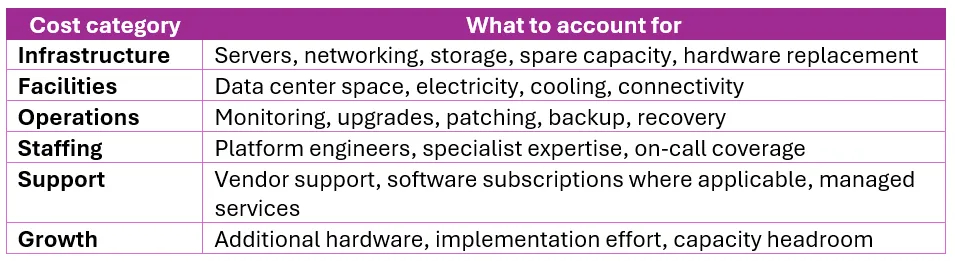
Organizations should compare these expenses over a three-to-five-year period.
Consider two scenarios.
Organization A already operates a data center with available compute and storage capacity. Its applications have predictable demand, and its infrastructure team already handles networking and hardware maintenance.
Running Kubernetes on existing infrastructure may provide attractive long-term economics.
Organization B has a smaller engineering team and needs to purchase hardware, establish redundancy, and develop operational capabilities from scratch.
Even if its hardware costs appear competitive, the combined investment in infrastructure and specialist staffing may outweigh the expected savings.
There is also the cost of downtime.
Delayed incident response, unsuccessful upgrades, and inadequate recovery planning can introduce business costs that aren't visible in a simple infrastructure pricing comparison.
The better question is:
What does it cost to operate a reliable Kubernetes platform, not just to deploy one?
Choosing where Kubernetes runs and deciding who operates it are separate decisions.
Organizations generally have three operating models to consider.
Internal teams handle deployment, monitoring, upgrades, security maintenance, and incident response.
This model offers direct operational control but requires sufficient engineering expertise and availability.
It generally fits organizations with established platform engineering teams and mature infrastructure operations.
Internal teams remain responsible for daily operations while external Kubernetes specialists provide architecture guidance, troubleshooting, and escalation support.
This approach can work well when a team already understands Kubernetes but needs additional expertise for complex incidents or platform changes.
A managed services provider takes responsibility for defined Kubernetes platform operations, including monitoring, upgrades, patching, and incident response.
The organization retains control of its infrastructure and applications while reducing the burden of managing the Kubernetes platform.
However, managed operations don't automatically transfer responsibility for physical hardware, application code, or every security requirement.
These boundaries should be defined in the service agreement.
Managed operations are particularly relevant when an organization wants to maintain control over its infrastructure without building a complete Kubernetes operations function internally.
Several situations make this approach worth evaluating.
Your engineering team is focused on applications. Developers and platform engineers need to deliver software rather than spend significant time troubleshooting infrastructure.
You need reliable operational coverage. Production workloads require monitoring, incident response, and maintenance beyond regular business hours.
Your infrastructure is already on-premises. Moving applications to public cloud isn't necessarily desirable, but maintaining Kubernetes expertise internally may be difficult.
You want to reduce operational complexity. Networking, storage, security, and Kubernetes upgrades require specialized knowledge that can be challenging to maintain across a small team.
Before selecting a managed Kubernetes provider, ask who is responsible for cluster upgrades, security patching, incident response, backup and recovery, capacity planning, and coordination with hardware or network teams.
Clear ownership matters more than the label attached to the service.
VEXXHOST provides Managed Kubernetes based on upstream Kubernetes, supporting deployment on customer-owned infrastructure, bare metal, OpenStack, VMware, Nutanix, and major public clouds.
Organizations can select the operating model that fits their capabilities.
With Expert Support, internal teams manage their clusters while receiving 24/7 access to Kubernetes specialists for guidance, troubleshooting, and escalation.
With Fully Managed Operations, VEXXHOST handles agreed platform responsibilities, including monitoring, upgrades, security patching, and incident response.
For organizations building broader private infrastructure environments, Kubernetes can also integrate with OpenStack for compute and infrastructure management and Ceph for persistent storage.
Together, these technologies can support a private cloud architecture that accommodates both virtual machines and containerized workloads.
The goal is to give organizations flexibility in where Kubernetes runs and how it is operated, without requiring every operational capability to be developed in-house.
It can be, particularly for organizations with existing infrastructure and stable workloads. However, total costs depend on hardware, facilities, staffing, operations, utilization, and support requirements.
Yes. Kubernetes can run on virtual machines provisioned through VMware or OpenStack, provided the infrastructure meets the necessary compute, networking, storage, and availability requirements.
Yes. Organizations can retain Kubernetes on their own infrastructure while engaging a provider to operate the platform. The precise division of responsibilities depends on the service agreement.
For many organizations, the challenge isn't initial installation. It's maintaining a secure, available, and recoverable platform as infrastructure, workloads, and Kubernetes versions evolve.
On-premises Kubernetes can deliver infrastructure control, integration flexibility, and predictable capacity.
But those benefits depend on the architecture and operational model behind the platform.
Organizations should evaluate not only where Kubernetes should run, but also who will maintain it, respond to incidents, and keep it secure over time.
With the right operating model, infrastructure ownership doesn't have to mean taking on every operational responsibility.
Considering Kubernetes on your own infrastructure?
Explore VEXXHOST Managed Kubernetes to discuss your architecture, operational requirements, and support options.
Choose from Atmosphere Cloud, Hosted, or On-Premise.
Simplify your cloud operations with our intuitive dashboard.
Run it yourself, tap our expert support, or opt for full remote operations.
Leverage Terraform, Ansible or APIs directly powered by OpenStack & Kubernetes